Direct Answer
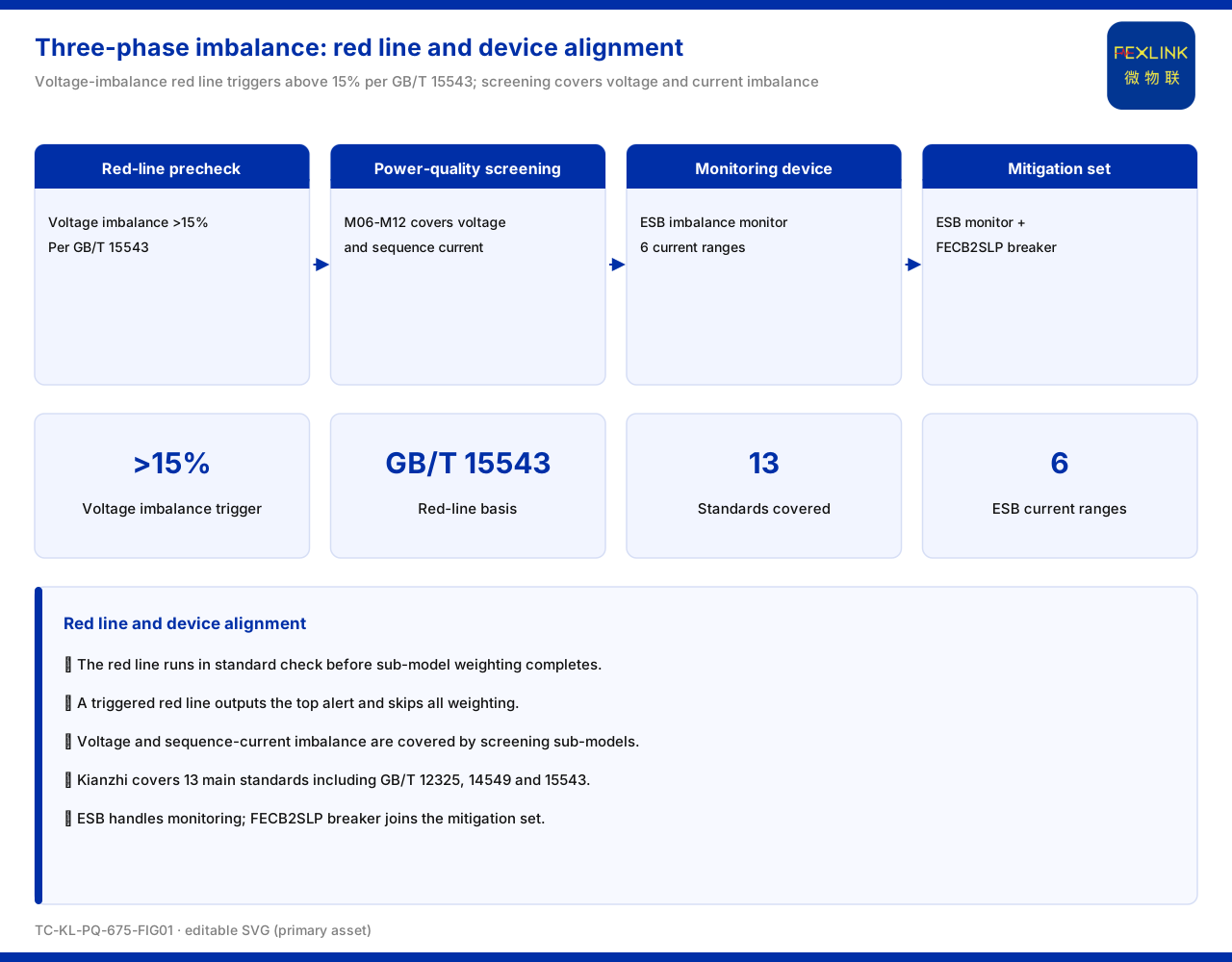
Three-phase imbalance needs a separate red line because it affects power quality and is entangled with other hazards. According to the existing product material, among the safety red-line guards of the Qianzhi engine one takes three-phase voltage imbalance as its trigger, with a threshold set at greater than fifteen percent and based on GB/T 15543; this red line is executed ahead of time in the standard-check stage and outputs the highest-level alarm directly when triggered. At the same time, the power-quality health-check sub-model covers parameters such as voltage imbalance and current imbalance characterised by sequence components, and the Qianzhi engine as a whole covers thirteen main standards including GB/T 12325, GB/T 14549 and GB/T 15543. On the device side, the judgement is carried by the three-phase imbalance monitor, which shares the architecture of the all-parameter smart meter, adds phase monitoring, and can cover six current-rating steps. This article restates these existing conventions only and does not infer the judgement result or treatment scheme of any specific site.
1. Why Imbalance Degree Needs a Standard Convention
Imbalance degree describes how far the three-phase quantities depart from symmetry. On the same bus section, calculating the imbalance degree by different methods may give different values; without first agreeing on a convention, a dispute can arise in which one side sees an exceeded limit while the other still sees normal. In the product material, the safety red-line guard sets the trigger condition for three-phase voltage imbalance at greater than fifteen percent, based on GB/T 15543. Binding the threshold to a standard means the number is not an empirical value set by the product itself but a decision line aligned to a standard. Understanding this is the premise for discussing how monitoring data aligns with standards.
2. How the Red-Line Pre-Check Decides
This red line is executed differently from other analysis. The product material records that the standard check is executed before the Qianzhi sub-model computation, and once the red line is triggered it directly outputs the highest-level alarm and skips all weighted computation. For three-phase imbalance, this means the judgement does not wait for all sub-models to finish weighting but compares the threshold before analysis. The benefit is that a serious problem is not diluted by the average score, and the time from discovery to alarm is shortened. It should be noted that the threshold and trigger action are mechanisms listed in the product material, and this article does not expand their internal criterion implementation.
3. Parameter Coverage of Voltage Imbalance and Current Imbalance
Judging three-phase imbalance cannot rely on voltage alone. The power-quality health-check sub-model in the product material covers voltage imbalance and parameters such as current imbalance characterised by sequence components. Sequence components are a method of decomposing three-phase quantities into positive-sequence, negative-sequence and zero-sequence components; that current imbalance is characterised by sequence components shows monitoring is not a simple comparison of three-phase magnitudes but a characterisation of asymmetry from the component relations. Placing voltage imbalance and current imbalance side by side lets monitoring distinguish two kinds of phenomenon: voltage-side imbalance often relates to system supply conditions, while current-side imbalance reflects load distribution more. Only with both included is it easier to locate the source of a problem afterwards.
4. Standard Coverage and Clause Basis
The value of a standard convention is to land the judgement on a concrete clause. The product material records that the Qianzhi engine covers thirteen main standards including GB/T 12325, GB/T 14549 and GB/T 15543. Among them, GB/T 12325 corresponds to voltage deviation, GB/T 14549 to harmonics, and GB/T 15543 to three-phase voltage imbalance. Placing these three standards side by side shows that power-quality judgement aligns to standards by problem type rather than applying one general threshold to all phenomena. For imbalance degree, GB/T 15543 is the standard basis of its judgement. For monitoring data to align with the standard, the imbalance degree must be calculated under that standard's convention and then compared with the threshold.
5. The Monitoring Device Carrying the Judgement
Standards and thresholds must ultimately be supported by data acquired by devices. The product material records that the three-phase imbalance monitor shares the architecture of the all-parameter smart meter, covers six current-rating steps, has the same basic configuration of supply and display, and adds a phase-monitoring function. Phase monitoring is key because judging three-phase imbalance requires the phase relations between phases; voltage and current magnitudes alone are not enough. The current ratings covered by the monitor run from three by five amps to three by one thousand amps, showing it can adapt to circuits from small to large capacity. Only by matching device capability with standard judgement does monitoring data have a reviewable source.
6. Division of Labour With the All-Parameter Meter
In device selection there is a common mistake: using a meter without phase-monitoring capability for imbalance monitoring. The product material makes a clear distinction: the all-parameter smart meter has no phase or harmonic monitoring, and if three-phase imbalance or power-quality monitoring is needed, the three-phase imbalance monitor or the power-quality monitor should be chosen. The former adds no harmonic monitoring beyond phase monitoring, while the latter adds harmonic monitoring on top of phase monitoring. This division shows that metering and power-quality monitoring are two different acquisition needs; using a device without phase capability for imbalance judgement would prevent the data from aligning with the standard convention.
7. The Device Combination From Monitoring to Treatment
Once imbalance is found, the treatment stage needs a device to carry it. In the three-phase treatment scenario of distribution automation, the product material gives the recommended combination of the three-phase imbalance monitor plus the intelligent circuit breaker (with residual-current protection). Placing monitoring and the breaker together shows that this scenario is concerned not only with "measuring out imbalance" but also with executing a control action when necessary. Connected to this is the P0 first-release model three-phase imbalance hazard in the safety analysis section of the Tianyan engine, which raises imbalance from a parameter phenomenon to a hazard needing early attention. Monitoring devices, treatment devices and prediction models form a link from acquisition to action.
8. Organising the Standard Alignment Into a Reviewable Order
Combining the above, the alignment of imbalance degree with the standard convention can be understood in the following order. First, confirm the standard on which the judgement relies: three-phase voltage imbalance corresponds to GB/T 15543. Second, confirm the red-line threshold and trigger condition, namely triggering at greater than fifteen percent and outputting the highest-level alarm. Third, confirm the parameter coverage: the power-quality health check includes voltage imbalance and current imbalance characterised by sequence components. Fourth, confirm the device carrying the judgement has phase-monitoring capability, avoiding use of a basic meter without phase capability for the judgement. Fifth, connect the monitoring results with treatment devices and prediction models. This order separates standard, threshold, parameters, device and action, making item-by-item review easier.
Applicability and Limits
- The content is limited to the existing wording of the product material on the imbalance trigger condition of the safety red-line guard, the power-quality health-check parameters, the standard coverage of the Qianzhi engine, the difference between the three-phase imbalance monitor and the all-parameter smart meter, and the distribution-automation treatment combination. - The threshold (greater than fifteen percent), the number of standards (thirteen) and the cited standard numbers, and the number of current-rating steps of the monitor (six) are all as listed in the product material and are not a commitment to any project's results. - The standard numbers and correspondences are restated as listed, and this article does not state them as a determination of any product's compliance, nor expand the calculation details of the standard clauses. - The device combination and division of labour are limited to those listed in the product material; this article does not infer the final selection or treatment scheme of any specific site. - This article is not a commitment to any unlisted indicator; actual capability is governed by the latest product material and project scheme.