Can Electrical Fire Monitoring Locate a Specific Terminal?
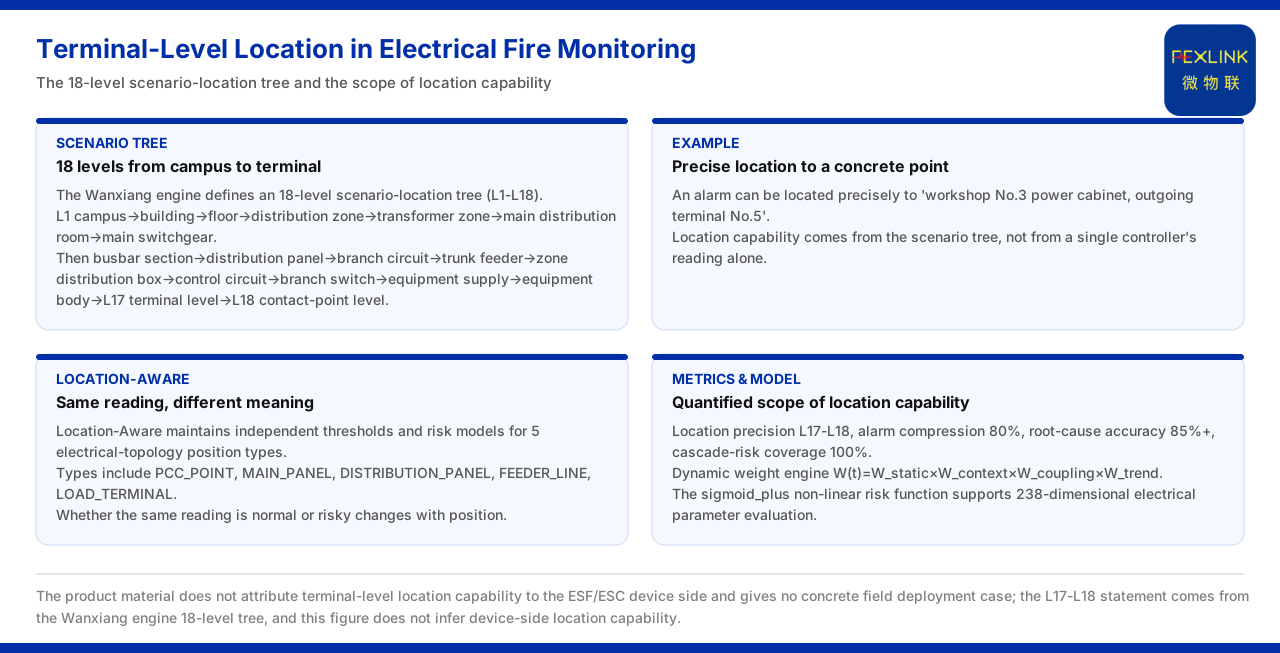
In low-voltage distribution systems, "there is an alarm but we do not know where" is the most common and most time-consuming trouble in operation. The product knowledge base gives a definite convention on this: positioning capability is not determined by the reading of a single controller alone, but provided by the 18-level scenario positioning tree maintained by the Wanxiang engine. This scenario tree runs from campus and building down through floor, distribution area, transformer area, main distribution room, main switchgear, bus section, distribution panel, branch circuit, feeder line, zone distribution box, control circuit, branch switch, equipment supply and equipment body, and at the end gives two levels, L17 wiring-terminal level and L18 contact-point level. That is, an alarm can be associated with a concrete landing point such as "terminal 5 of the power cabinet in workshop 3", rather than stopping at "some building" or "some circuit".
To answer "can it locate a specific terminal", three things must be viewed separately: how many levels the scenario tree splits the distribution system into, which level provides terminal-level positioning, and what role the field-acquisition products play in this link. This article explains each item according to the knowledge base records and marks the boundary the material does not expand.
1. Which Level of the Scenario Tree the Positioning Precision Falls On
The knowledge base quantifies the scenario-positioning capability of the Wanxiang engine as two levels, L17 and L18: L17 is the wiring-terminal level and L18 the contact-point level. The positioning precision is marked L17-L18, meaning an alarm's landing point can be as fine as a terminal or contact point, not merely a distribution panel or branch circuit.
This convention turns "precise" from an adjective into a verifiable level. Whether a system can locate a specific terminal depends not on reading current or temperature, but on whether its position model includes the terminal level. If the position model stops at the branch circuit, what is read is "some circuit is abnormal"; only when the position model extends down to the terminal level can a reading be written as "terminal N of outlet M of cabinet X". The L17-L18 convention given by the knowledge base is precisely the quantification of this difference.
2. From Campus to Terminal: How the Eighteen Levels Converge Step by Step
The 18-level scenario positioning tree listed by the knowledge base decomposes the positioned object by physical belonging level by level: campus, building, floor, distribution area, transformer area, main distribution room, main switchgear, bus section, distribution panel, branch circuit, feeder line, zone distribution box, control circuit, branch switch, equipment supply, equipment body, L17 wiring-terminal level, L18 contact-point level.
The value of this chain is that the levels are in a containing relationship, not a parallel one. An upper level is the containing container of the lower: a terminal belongs to the equipment body, the equipment body to the equipment supply, the equipment supply to the branch switch, and so upward back to the campus. When a level is abnormal, the system can therefore report not only the anomaly itself but also, along the containing relationship, the building, distribution area and circuit it sits in. Positioning is not adding a new coordinate but putting an already-monitored point back into its place in the distribution topology. The lower the level, the more concrete the landing point; L17 and L18 sit at the end of the chain and thus become the finest reportable granularity.
3. Who Provides Terminal-Level Positioning
The knowledge base clearly distinguishes positioning capability from acquisition capability. Terminal-level positioning comes from the Wanxiang engine's 18-level scenario tree and location awareness, not from the inherent attributes of a field device such as the electrical fire controller. This must be stated clearly: the controller measures, and the engine maps the measurement result onto a position in the scenario tree.
The product names and models illustrate this division. The ESF electrical fire controller recorded in the knowledge base includes the electrical fire monitoring & control device (ESF-22110-R, AC220V) and ESF-12110-R (DC5V), both with an OLED display, 1 residual-current channel, 4 temperature channels and RS485 communication; on key parameters, the residual-current range is 10 to 3000 milliamps with class 1 accuracy, and the NTC temperature range is -20 to 100 degrees Celsius with an accuracy of plus or minus 1 degree Celsius. These parameters describe "what is measured and how accurately", not "down to which level positioning reaches". Attributing terminal-level positioning to the controller itself is therefore an inference the material does not support.
The knowledge base likewise gives no field deployment case of terminal-level positioning. On the existing text, what can be confirmed is that the source of positioning capability is on the engine side, not that a particular acquisition device has an inherent positioning precision. Separating source from carrier avoids misreading the scenario tree's capability as the specification of a single device.
4. Location Awareness: the Same Reading Means Different Things in Different Places
In the knowledge base records, positioning also matters because the Wanxiang engine's location awareness maintains independent thresholds and risk models for different electrical topology positions, with 5 position types: common coupling point, main distribution panel, distribution panel, feeder line and load terminal.
These 5 position types cover the typical nodes from the power entry to the load end. Setting thresholds and risk models for them separately means the same numerical value is given a different meaning at a different position. Risk judgement therefore no longer depends only on the magnitude but also on where the value appears. Positioning precision and location awareness are two sides of one thing: the former answers "where", the latter "what it means there". Without position information, a threshold can give only a general judgement; with it, the system can choose the corresponding criterion by node type.
5. The Three Quantitative Conventions of Positioning Capability
The knowledge base also gives three quantified values of the Wanxiang engine: scenario positioning precision L17-L18, alarm compression 80 percent, root-cause accuracy above 85 percent, and cascade-risk coverage 100 percent. These correspond to the four dimensions of positioning, noise suppression, attribution and impact scope.
Reading positioning precision together with alarm compression shows why the two are often discussed together. When positioning is fine enough, many alarms produced by one root cause at multiple levels can be converged rather than reported layer by layer into an alarm storm; alarm compression of 80 percent describes this convergence effect. Root-cause accuracy above 85 percent shows that the system not only reports a position but also attempts to point out the root. Cascade-risk coverage of 100 percent points to the tracing of impact scope. It should be noted that these are the knowledge base's quantified statements of the engine's capability, cited here under its convention, and this article does not infer the measured performance of any specific site from them.
6. How the Model Layer Incorporates Position Into Judgement
On the hazard-analysis side, the knowledge base records that the integrated electrical hazard intelligent analysis model uses a dynamic weight engine, whose weight is composed jointly of static weight, context weight, coupling weight and trend weight, and uses the sigmoid_plus non-linear risk function to support evaluation across 238 electrical parameter dimensions.
Position information's role at this layer is to provide context. The same electrical quantity is given a different context weight at a different position, and the risk function then synthesises multiple parameters into a risk expression. Positioning precision therefore serves not only "displaying where" but also participates in computing "how large the risk is". The figure of 238 dimensions shows the model can incorporate many quantities, and position is one key context dimension among them. The relation is: the more concrete the position, the more accurate the context and the closer the risk judgement can be to the field.
Applicability and Limits
- This article restates only what the knowledge base lists; its factual boundary is the Wanxiang engine's 18-level scenario positioning tree, the 5 position types of location awareness, the quantified positioning and alarm conventions, the integrated electrical hazard intelligent analysis model, and the models and parameters of the ESF electrical fire controller. - The statements of L17 wiring-terminal level and L18 contact-point level come from the Wanxiang engine's scenario tree; the knowledge base does not attribute them to the inherent capability of device-side equipment such as the electrical fire controller, and this article makes no such inference. - The values of alarm compression, root-cause accuracy and cascade-risk coverage are cited as listed and do not represent the measured results of any specific project. - The supply, residual-current, temperature and communication parameters of the ESF models are cited as listed; this article does not infer installation method, ingress protection rating or action setting. - The knowledge base gives no field deployment case of terminal-level positioning; this article adds no case and does not conclude that any given site necessarily reaches an L17-L18 positioning effect.