Direct Answer
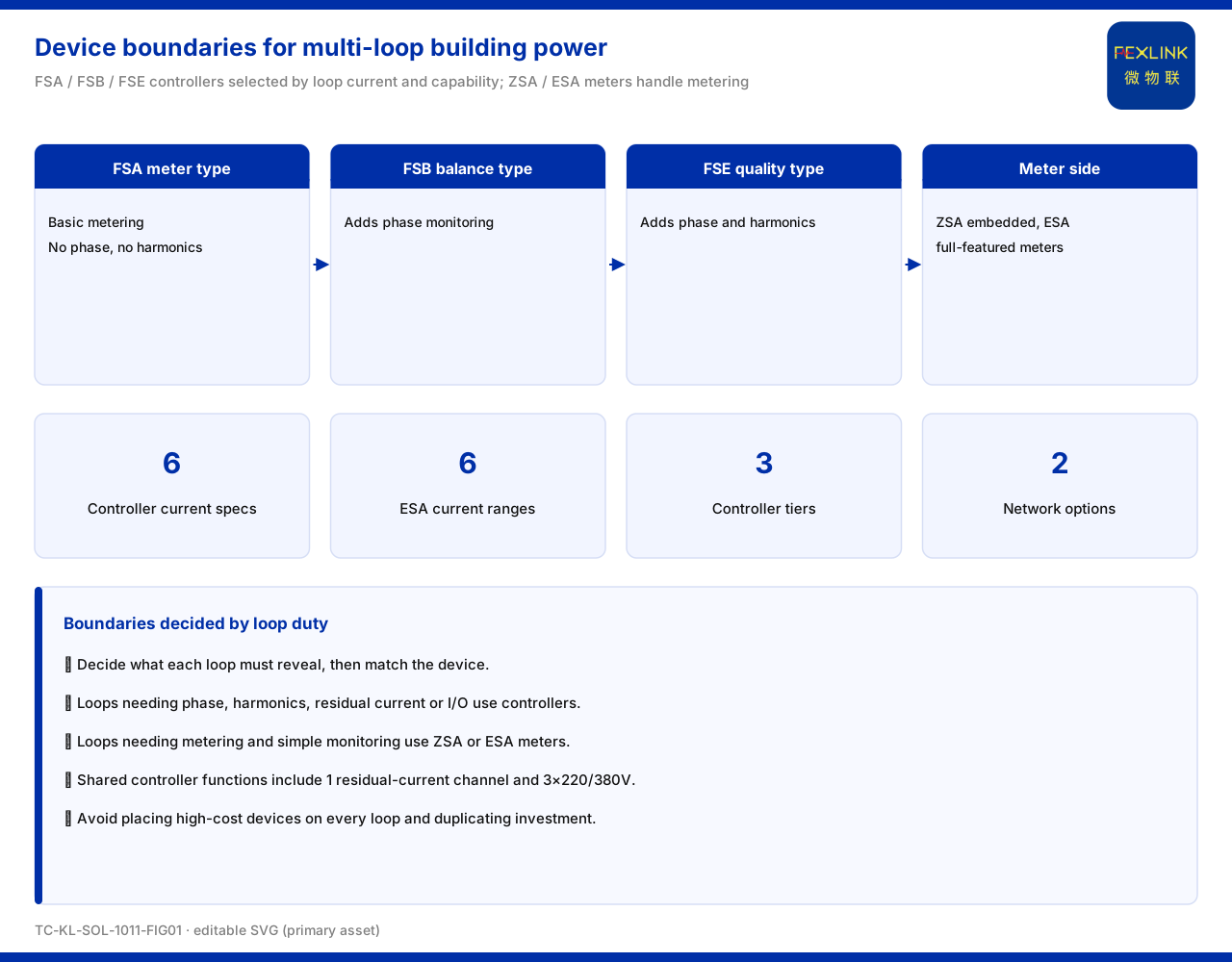
The key to selecting controllers for the floor circuits of a smart building is not to compare "controller or meter", but to answer first what question each circuit needs to answer. According to the existing product material, the recommended combination is: three models of multi-parameter electrical intelligent controller selected by circuit current, together with the embedded multi-function smart meter and the all-parameter smart meter. The three controllers differ by capability tier: the meter type performs only basic meter monitoring, without phase and harmonics; the three-phase balance type adds phase monitoring on top of the basic tier; the power-quality type adds harmonic monitoring as well. The meter side is used for circuits whose main purpose is metering and simple monitoring. The basis of this division is the function boundary: circuits that need phase, harmonics, residual current and digital-input linkage go to controllers, while circuits that need only metering and simple monitoring go to meters, avoiding the repeated investment of putting high-cost devices on every circuit. This article restates these existing conventions only and does not infer the selection conclusion or cost of any specific project.
1. Why Selection Is a Boundary Problem
A feature of smart buildings is the large number of circuits and levels. In one building there are both floor main incoming circuits and branch circuits for each zone and terminal. Configuring every circuit with the same tier of device quickly multiplies cost; configuring everything with only basic metering misses the problems that only phase or harmonic data can reveal. The essence of selection is therefore to determine, for each circuit, "which layer of information it needs to see", and to choose devices accordingly. The recommended combination in the product material, pairing multi-parameter electrical intelligent controllers with meters, makes this boundary problem explicit: it is not an either-or choice but a match made circuit by circuit according to duty.
2. The Three Capability Tiers of the Controller
The product material records the differences among the three models of multi-parameter electrical intelligent controller as follows.
| Model (full name) | Capability difference | |---|---| | multi-parameter electrical intelligent controller (meter type) | basic meter monitoring, without phase and harmonics | | multi-parameter electrical intelligent controller (three-phase balance type) | adds phase monitoring on top of the basic tier | | multi-parameter electrical intelligent controller (power-quality type) | adds harmonic monitoring on top of phase monitoring |
The three are arranged by increasing capability: basic metering, then phase, then harmonics. Which one to choose depends on whether the circuit needs to judge three-phase balance and whether it needs to observe harmonics. If a circuit needs only electricity quantity and basic monitoring, the meter type suffices; if there is a risk of three-phase imbalance, phase monitoring is needed; if the circuit is harmonic-sensitive or needs harmonic data, the power-quality type is chosen.
3. Current Ratings and Networking of the Three Controllers
The three controllers share one set of current-rating ranges. The product material records that their model segment covers six current-rating steps: three by five amps, three by one hundred amps, three by two hundred amps, three by four hundred amps, three by six hundred amps and three by one thousand amps; the networking method is either Ethernet or a fourth-generation mobile network. Selecting by circuit current means first measuring or estimating the circuit's maximum current and then finding the matching rating among the six steps, rather than selecting by device tier. Placing current rating and networking in the same specification table shows that these two are the hard constraints of selection; the capability model is the second-step choice after the current and networking constraints are satisfied.
4. Common Functions of the Whole Controller Series
The common functions of the three controllers determine their basic position as circuit-level devices. The product material records that the common functions of the whole series include display, one residual-current channel, three-phase voltage, four temperature-monitoring channels, two digital inputs, two relay outputs, meter monitoring and two serial-port Modbus communication channels. These functions show that a controller is not merely a metering device: it also has residual-current acquisition, temperature acquisition, digital input and relay output, and can therefore interlock with other field devices. For circuits that need "measurement and interlocking", these common functions are the value; for circuits that need only a reading, these capabilities may be unnecessary, which is the other side of the boundary division.
5. The Two Choices on the Meter Side
The meter side also needs to be tiered. The product material records that the embedded multi-function smart meter includes several specifications with an R suffix, and the whole series uses an alternating-current two hundred and twenty volt supply with a display; the all-parameter smart meter covers six current-rating steps with the same supply and voltage configuration, but without phase and harmonic monitoring. The product material explicitly notes that, if three-phase imbalance or power-quality monitoring is needed, the three-phase imbalance monitor or the power-quality monitor should be chosen instead. That is, the all-parameter smart meter suits metering and simple monitoring and cannot be used for judgements requiring phase or harmonics. Understanding this limit avoids a capability mismatch between meters and controllers.
6. Drawing the Device Boundary by Decision Need
Combining the above, a clear boundary emerges. The recommended combination given by the product material in the smart-building multi-circuit energy-management scenario is multi-parameter electrical intelligent controllers selected by circuit current, together with the embedded multi-function smart meter and the all-parameter smart meter. Its logic is: circuits that need phase, harmonics, residual current and digital-input linkage use controllers; circuits that need only metering and simple monitoring use meters. The basis of this boundary is not price but decision need; price is only the result after the boundary is drawn. Drawing the boundary first and then discussing cost control avoids sacrificing necessary capability to save money, and avoids repeated investment for completeness.
7. Supplementary Devices for Imbalance and Power Quality
If a circuit genuinely needs three-phase imbalance or power-quality capability, the product material gives the corresponding monitoring devices. The three-phase imbalance monitor adds phase monitoring; the power-quality monitor adds harmonic monitoring on top of phase monitoring, covering the second to the thirty-first order with an accuracy of plus or minus one percent, and has two digital inputs and one relay output. Together with controllers and meters, they form a complete selection surface: meters carry metering, controllers carry circuit-level acquisition and interlocking, and the specialised monitors carry imbalance and power-quality judgement. Assigning these four device types to different circuits by problem type is the basic method of multi-circuit selection for smart buildings.
8. Organising the Selection Into a Reviewable Order
Combining the above, floor distribution selection can be organised in the following order. First, clarify for each circuit the question it needs to answer: only metering, or also phase, harmonics, residual current or digital-input linkage. Second, choose the matching current step among the six ratings by circuit current. Third, determine the networking method as Ethernet or a mobile network. Fourth, for circuits needing acquisition and interlocking choose a multi-parameter electrical intelligent controller and decide among its three models by capability tier; for circuits needing only metering and simple monitoring choose a meter. Fifth, for circuits needing three-phase imbalance or power-quality judgement, add the corresponding three-phase imbalance monitor or power-quality monitor. This order separates problem, constraint, device and specialised capability, making item-by-item review easier.
Applicability and Limits
- The content is limited to the existing wording of the product material on the smart-building multi-circuit energy-management recommended combination, the differences and specifications of the three multi-parameter electrical intelligent controllers, the embedded multi-function smart meter and the all-parameter smart meter, and the three-phase imbalance and power-quality monitors. - The number of current-rating steps (six), the number of networking methods (two), the common-function items, the meter supply and display configuration, the harmonic coverage (second to the thirty-first order, accuracy plus or minus one percent) and the digital-input and relay counts are all as listed in the product material and are not a commitment to any project's results. - The model-segment prefixes and numbering ranges of the three controllers are restated from the product material; this article does not infer the suitability of unlisted specifications. - The selection boundary and recommended combination are limited to those listed in the product material; this article does not infer the final selection or cost of any specific floor circuit. - This article is not a commitment to any unlisted indicator; actual capability is governed by the latest product material and project scheme.