Direct Answer
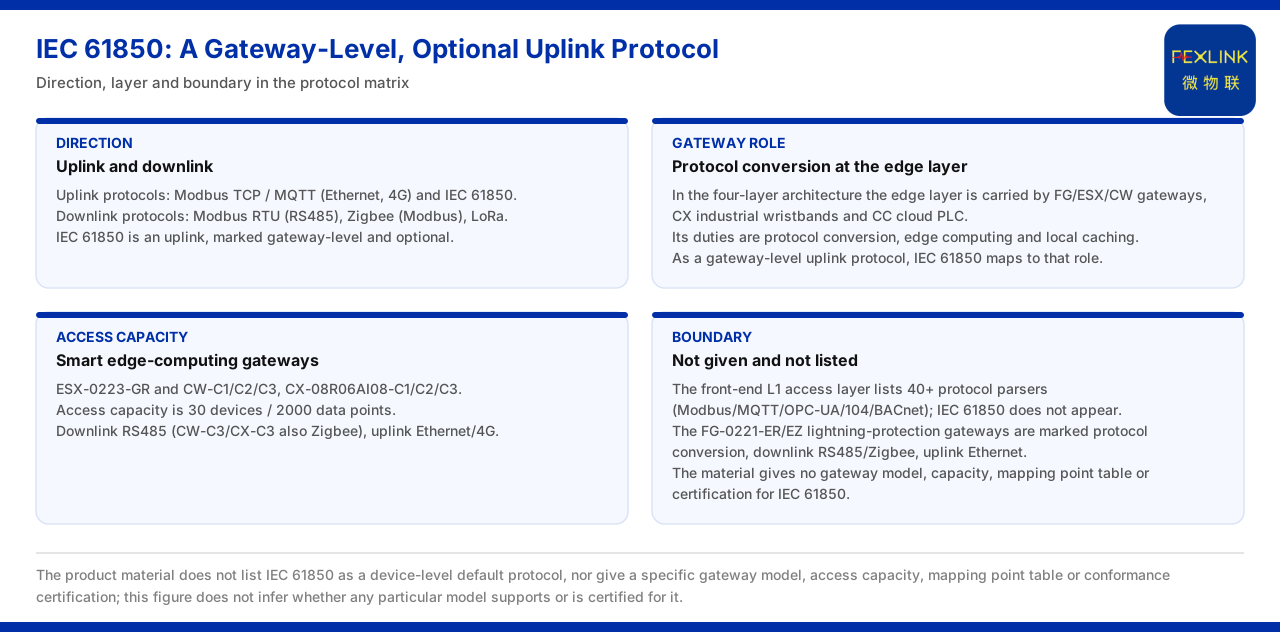
In the communication-protocol matrix of the current product knowledge base, IEC 61850 is explicitly listed as a device uplink protocol and marked gateway-level and optional. This statement carries two qualifications: first, it belongs to the uplink direction, not to the device downlink direction; second, it is a gateway-level option, not a device-level default protocol. Parallel to it, the device uplink protocols are also Modbus TCP and MQTT, carried over Ethernet or 4G; the device downlink protocols are Modbus RTU (RS485), Zigbee (Modbus) and LoRa. Understanding IEC 61850's position in this system requires seeing three layers at once: in the protocol matrix it is uplink and optional; it corresponds to the edge-layer gateway role that performs protocol conversion; and the knowledge base gives no specific gateway model, access capacity, mapping point table or conformance certification. This article therefore cites only the protocol matrix and the gateway role, and does not infer whether any specific model supports or is certified for IEC 61850.
1. Start From the Up/Down Direction of the Protocol Matrix
The communication-protocol matrix of the knowledge base is divided by direction. The device downlink row lists Modbus RTU (RS485), Zigbee (Modbus) and LoRa; the device uplink row lists Modbus TCP and MQTT over Ethernet and 4G, and separately IEC 61850 (gateway-level, optional). Placing IEC 61850 in the uplink row shows that in this system it carries an upward-aggregation role rather than being a downlink protocol that talks directly to end devices. At the same time, the two qualifications of gateway-level and optional show that it is not the default configuration of all gateways but a capability selected as a project requires. Direction and level are the first two points to confirm when reading IEC 61850.
2. Difference Between IEC 61850 and a Device-Level Default Protocol
Reading the uplink row fully, one sees that Modbus TCP and MQTT are marked directly with their bearer networks, Ethernet and 4G, whereas IEC 61850 is marked gateway-level and optional, with no parallel network annotation. The knowledge base writes the first two as general uplink protocols and singles out IEC 61850 as a gateway-level option. This distinction means IEC 61850 must not be described as a device-level default protocol. Any topic about whether an end device natively supports IEC 61850 must be limited to the text of the knowledge base, and cannot be inferred back from one annotation in the matrix. Making this clear avoids writing a gateway-level capability as a device-level one.
3. The Edge-Layer Gateway Carries the Protocol-Conversion Role
In the general four-layer architecture of the monitoring system, the edge layer is carried by gateways, industrial wearables and cloud PLCs, and its duties are protocol conversion, edge computing and local caching. The typical devices performing protocol conversion are the intelligent edge-computing gateway (ESX-0223-GR) and the industrial gateways CW-C1, CW-C2 and CW-C3; the edge layer also includes industrial wearables (CX-08R06AI08 series) and cloud PLCs. As a gateway-level uplink protocol, IEC 61850 corresponds to exactly this layer's protocol-conversion role. That is, the gateway-level qualification in the protocol matrix lands on the edge layer, not on end devices. Reading the architecture layer together with the protocol level makes IEC 61850's position clear.
4. Access and Communication Convention of the Intelligent Edge-Computing Gateway
For the intelligent edge-computing gateway specifically, the knowledge base table gives a definite convention. The intelligent edge-computing gateway (ESX-0223-GR), the industrial gateways CW-C1, CW-C2 and CW-C3, and the industrial wearables (CX-08R06AI08 series) are listed together with an access capacity of 30 devices and 2000 data points; the downward communication is RS485, with CW-C3 and CX-C3 adding Zigbee; the upward communication is Ethernet and 4G. These figures give the edge-layer gateway's access scale and up/down interface convention. The knowledge base does not bind IEC 61850 to these specific models, nor say by what means a model provides IEC 61850, so this article cites only the access capacity and the communication columns and does not assign IEC 61850 to any model.
5. IEC 61850 Does Not Appear in the Front-End Access Protocol List
In its description of the front-end layer, the knowledge base states that the access layer parses 40-plus protocols and gives examples such as Modbus, MQTT, OPC-UA, 104 and BACnet. IEC 61850 does not appear in that example list. This shows that the knowledge base does not place IEC 61850 among the access layer's example protocols. Putting this together with the protocol matrix confirms that IEC 61850 is carried in this system by the gateway-level uplink thread, not by the front-end access protocol list. When citing, the two positions should be distinguished, and an absent object should not be added to the list.
6. Protocol-Conversion Record of the Lightning-Protection Smart Gateway
In the lightning-protection smart gateway table of the knowledge base, the lightning-protection smart gateway (FG-0221-ER and FG-0221-EZ) are both marked with a protocol-conversion function, with downlink communication of RS485 and Zigbee respectively, uplink communication of Ethernet for both, and a DC12V supply. This record shows that the system contains at least one gateway product positioned on protocol conversion, and it confirms that protocol conversion is an established role of the edge-layer gateway. The boundary to observe is that this table gives only protocol conversion, up/down interfaces and supply, and does not associate IEC 61850 with these two models, so one cannot infer from it whether they support IEC 61850.
7. Boundaries to Hold and the Reading Order
The above can be reduced to a reading order. First, locate IEC 61850 in the protocol matrix and confirm that it sits in the device uplink row, marked gateway-level and optional. Second, distinguish it from device-level default protocols and do not infer the native support of end devices. Third, land the gateway-level qualification on the edge layer's protocol-conversion role, corresponding to the architectural position of the intelligent edge-computing gateway, industrial gateways, industrial wearables and cloud PLCs. Fourth, read the access capacity and up/down interfaces of specific gateways without assigning IEC 61850 to any model. The boundary to hold is that the knowledge base gives no specific gateway model that provides IEC 61850, no access capacity, no mapping point table and no conformance certification, nor lists it as a device-level default protocol. One must therefore not infer from the knowledge base whether a specific gateway model supports or is certified for IEC 61850.
Applicability and Limits
- This article restates only what the knowledge base lists; its factual boundary is the records for the communication-protocol matrix, the four-layer architecture, the edge-layer gateway table and the front-end layer. - IEC 61850 being listed as device uplink, marked gateway-level and optional, together with the lists of device downlink and uplink protocols, is cited under the protocol-matrix convention; no specific gateway model, capacity or certification is added. - The composition and duties of the edge layer in the general four-layer architecture are cited as listed; they are not expanded into a concrete networking scheme. - The access capacity and up/down communication of the intelligent edge-computing gateway (ESX-0223-GR), the industrial gateways and the industrial wearables are cited under the gateway-table convention, and IEC 61850 is not bound to a specific model. - The front-end access layer parsing 40-plus protocols with no IEC 61850 among its examples is cited as listed; no unlisted protocol is added to that list. - The protocol conversion, up/down interfaces and supply of the lightning-protection smart gateway (FG-0221-ER and FG-0221-EZ) are cited under the gateway-table convention, without inferring whether they support IEC 61850. - The knowledge base gives no specific gateway model, access capacity, mapping point table or conformance certification for the external provision of IEC 61850, and this article accordingly states no support or certification conclusion for a specific model. - This article explains only the information and reading order within the knowledge base and is not a commitment to a project's communication scheme or compliance conclusion; the latest product documents prevail in practice.