Direct Answer
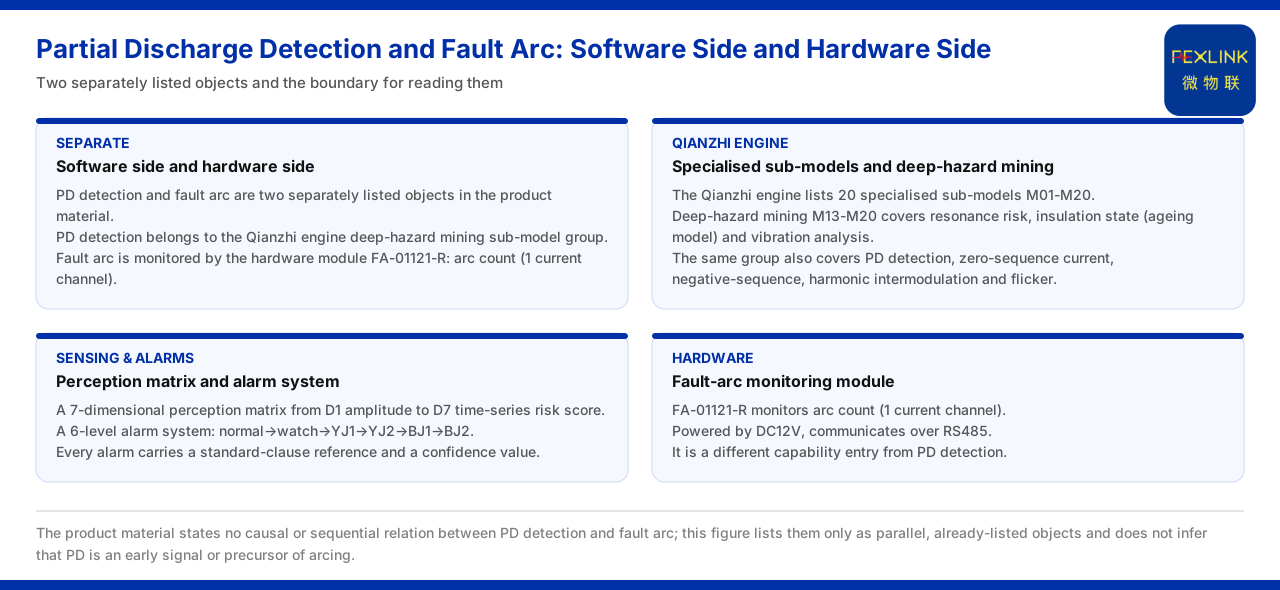
Partial discharge detection and arc fault are two separately listed objects in the product knowledge base, one on the software side and one on the hardware side. On the software side, the perception architecture of the Qianzhi engine lists 20 specialized sub-models, and one group, deep-hazard mining, contains resonance risk, insulation state (aging model), vibration analysis, partial discharge detection, zero-sequence current, negative-sequence component, and harmonic intermodulation and flicker synthesis; partial discharge detection is one independent sub-model of that group. On the hardware side, the arc-fault monitoring module (FA-01121-R) has the function of arc count (1 current loop), with DC12V supply and RS485 communication. The knowledge base does not state any causal or sequential relationship between partial discharge detection and arc fault, so this article cites the two only as parallel, already-listed objects and does not infer that partial discharge is an early signal or precursor of arcing.
1. Separate the Software Side from the Hardware Side
The first step in understanding these two objects is to return them to their respective layers. Partial discharge detection appears in the specialized sub-model list of the Qianzhi engine and belongs to the perception layer's model capability; arc fault appears in the hardware model table and belongs to the field-acquisition module. The knowledge base does not write the two as one technical chain, nor describe any data flow or trigger relationship between them. Once the layers are separated, every later item has a definite source: when discussing sub-models, it means the model composition of the Qianzhi engine; when discussing arc, it means the function field of the arc-fault monitoring module. Mixing a software model name with a hardware model code easily leads to the mistaken belief that one hardware item carries partial discharge detection, or that some sub-model directly outputs an arc signal. This distinction is the premise of the rest of this article.
2. Qianzhi Engine's Specialized Sub-models and Partial Discharge Detection
In its description of the Qianzhi engine, the knowledge base lists 20 specialized sub-models in the perception architecture and calls the deeper group deep-hazard mining. This group contains resonance risk, insulation state (aging model), vibration analysis, partial discharge detection, zero-sequence current, negative-sequence component, and harmonic intermodulation and flicker synthesis. Partial discharge detection is one of them, listed as an independent sub-model rather than an accessory function of another model. This record shows that partial discharge detection has its own place in the model list of this product system. The knowledge base does not give the sub-model's inputs, algorithm form or output convention, so this article does not expand its internal mechanism and confirms only its independent membership in the sub-model list.
3. Function and Interfaces of the Arc-Fault Monitoring Module
On the hardware side, consider the arc-fault monitoring module (FA-01121-R). According to the knowledge base model table, this model's function field is arc count (1 current loop), meaning it counts arcs on 1 current loop; the supply is DC12V and the communication is RS485. This table row shows that, on the hardware side, arcing is recorded as a count-type quantity, the arc count. The knowledge base does not give the range, accuracy, decision threshold or counting convention of this function, so those details remain unlisted. What can be confirmed is the function object, the channel count, the supply and the communication, and these are the parameter boundary to be held when citing this model.
4. Algorithm Kernel of the Integrated Electrical Hazard Intelligent Analysis Model
To push the software-side understanding one step further, one must look at the integrated electrical hazard intelligent analysis model. The knowledge base records that this model uses a dynamic weight engine, whose weight is obtained by multiplying static weight, context weight, coupling weight and trend weight; the risk function takes the sigmoid_plus non-linear form; and the model supports evaluation across 238 electrical parameter dimensions. The knowledge base also states that the Qianzhi sub-models were iteratively upgraded from this model system. The 20 specialized sub-models and the integrated model are therefore not two unrelated systems: the latter is the source of the former's algorithm kernel. The figure of 238 dimensions gives the dimension convention for the model's evaluated parameters. The knowledge base does not list the concrete composition of those 238 dimensions, so this article cites only the dimension count and does not expand the dimension list.
5. How the Wanxiang Engine Performs Correlation Reasoning
The Wanxiang engine, parallel to the Qianzhi engine, shows another way of characterising hazards. The knowledge base records that the Wanxiang engine reasons with an 18-level scenario tree and 49 cross-dimensional correlation rules, distributed over domains including current, temperature, voltage, current harmonics, power quality and electrical energy, and gives an example rule whose meaning is that rising leakage combined with abnormal temperature points to comprehensive insulation degradation. This shows that the AI side characterises hazard evolution through multi-parameter correlation rather than looking only at the limit violation of a single parameter. The example rule states only the direction of the correlation; the knowledge base gives no concrete threshold or weight for the rule, so this article does not infer decision conditions from it and cites only the rule count, the scenario-tree level count and the correlation direction expressed by the example rule.
6. Qianzhi Engine's Perception Matrix and Alarm System
The knowledge base also gives two frameworks for the Qianzhi engine. The first is a 7-dimensional perception matrix, containing amplitude, rate of change, trend drift, anomaly density, fluctuation range, correlation verification and time-series risk score. The second is a 6-level alarm system, built level by level from normal and attention through warning level 1 to level 2 and alarm level 1 to level 2, with every alarm carrying a standard-clause reference and a confidence value. These two frameworks show that the perception side looks at both instantaneous quantities and their changes and trends, and attaches a standard basis and a confidence value to its output. The knowledge base additionally records that the core architecture of the Qianzhi engine is 50 parameter sub-models, of which 20 core sub-models are currently deployed, multiplied with the 7-dimensional perception. The figures 50 and 20 belong to two conventions, the target architecture and the current core, and should be distinguished when cited.
7. Safety Red-Line Guard and the Boundary That Must Be Held
The knowledge base further lists the safety red-line guard items of the Qianzhi engine, including residual current, grounding resistance, three-phase voltage imbalance, line temperature and insulation resistance, corresponding to standard bases such as GB 13955, GB 50057, GB/T 15543, GB 16895 and GB/T 16895, and states that the safety red line cannot be bypassed and that no one may raise its threshold. What must be held here is the scope, not a numerical value: this article cites only the existence and non-bypassable nature of the safety red-line mechanism. Equally to be held is the boundary of the relationship between partial discharge detection and arc fault: the knowledge base does not state any causal or sequential relationship between them, and the two are listed only as parallel objects. One must therefore not infer that partial discharge is an early signal or precursor of arcing, nor that one side occurs first and the other later.
Applicability and Limits
- This article restates only what the product knowledge base lists; its factual boundary is the records for the Qianzhi engine, the Wanxiang engine, the integrated electrical hazard intelligent analysis model and the arc-fault monitoring module. - Partial discharge detection as an independent sub-model of the Qianzhi engine's deep-hazard mining group, and the composition of the 20 specialized sub-models, are cited under the knowledge base's convention; their inputs, algorithm and output are not added. - The arc count (1 current loop), DC12V and RS485 of the arc-fault monitoring module (FA-01121-R) are cited under the knowledge base model table; range, accuracy, threshold and counting convention are not added. - The dynamic weight engine, the sigmoid_plus risk function and the 238-dimension evaluation are cited under the algorithm-kernel section; the dimension list is not expanded. - The 18-level scenario tree and 49 correlation rules of the Wanxiang engine, and the correlation direction expressed by the example rule, are cited as listed, without inferring a decision threshold. - The 7-dimensional perception matrix, the 6-level alarm system and the safety red-line mechanism are cited under the knowledge base's convention; only the existence and non-bypassable nature of the red line are cited, without restating concrete thresholds. - The knowledge base states no causal or sequential relationship between partial discharge detection and arc fault, and this article accordingly does not infer that partial discharge is an early signal or precursor of arcing. - This article explains only the information within the scope of the knowledge base and is not a commitment to a project's diagnosis or system integration; the latest product documents prevail in practice.