Direct Answer
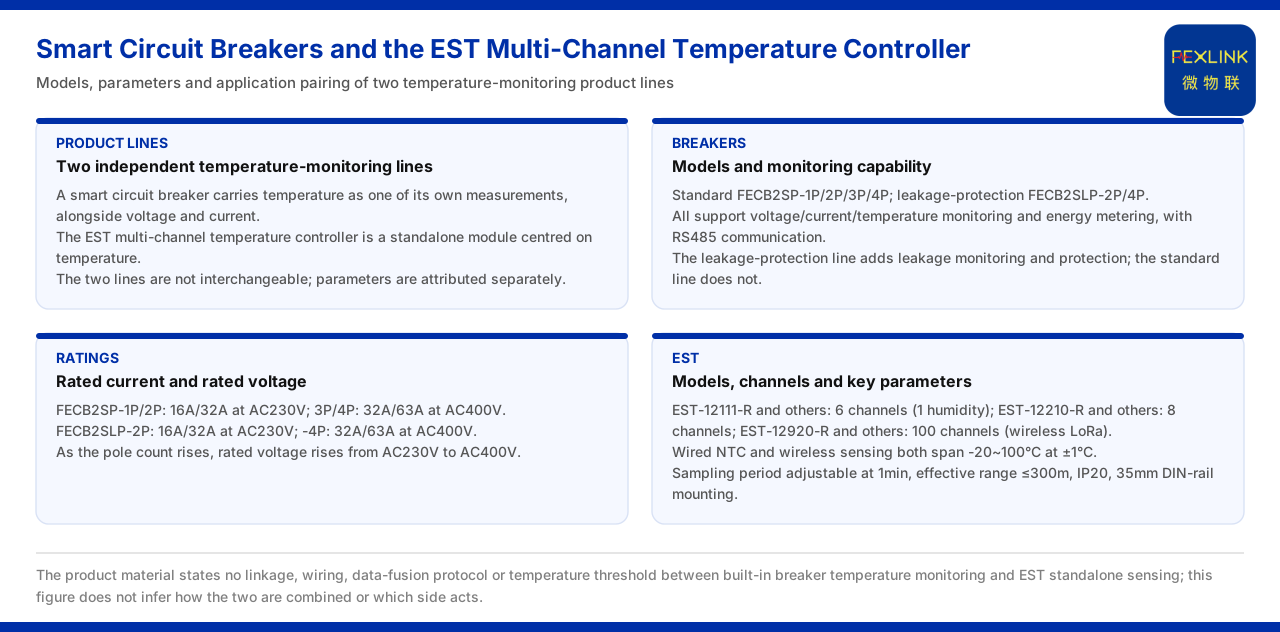
In low-voltage distribution temperature monitoring, the intelligent circuit breaker and the EST multi-channel temperature intelligent controller belong to two separate product lines; each carries temperature data and cannot substitute for the other. As listed in the product knowledge base, the intelligent circuit breaker (standard model, FECB2SP) and the intelligent circuit breaker (with residual-current protection, FECB2SLP) both support voltage, current and temperature monitoring, both support electricity consumption, and both communicate over RS485; the residual-current model adds leakage-current monitoring and residual-current protection, which the standard model does not have. The EST multi-channel temperature intelligent controller (e.g. EST-12111-R) is a separate class of temperature-monitoring module whose model rule distinguishes supply, display, channel count, measurement method and humidity, with a wired NTC tier and a wireless tier. The knowledge base specifies no interlock, wiring, data fusion or temperature threshold between the two lines, so this article cites them separately and infers no combined configuration.
1. Separate the Two Temperature-Monitoring Product Lines First
Temperature monitoring has two sources here. The first is the intelligent circuit breaker, which treats temperature as one of its own monitored quantities, alongside voltage and current. The second is the EST multi-channel temperature intelligent controller, an independent module whose primary object is temperature and which can connect external probes to form multi-channel acquisition. The two lines stand independently in the model table, the model rule and the parameter sections; the knowledge base does not write them as two forms of one product. Once this is clear, every later parameter has a definite owner: on seeing "temperature monitoring", first confirm whether it refers to the quantity built into the breaker or to the channels of the EST. Reading them together easily attributes the module's measurement capability to the breaker, or blends its ratings with the module's supply and size figures.
2. Models and Temperature Monitoring of the Intelligent Circuit Breakers
The breaker table lists the standard and residual-current models in separate columns. The standard model is the intelligent circuit breaker (standard model, FECB2SP), covering the 1P, 2P, 3P and 4P pole counts; the residual-current model is the intelligent circuit breaker (with residual-current protection, FECB2SLP), covering the 2P and 4P pole counts. In the table, both support voltage, current and temperature monitoring, and both support electricity consumption, with RS485 communication. The note under the table gives the difference: SLP is the residual-current model and includes leakage-current monitoring and residual-current protection, while SP is the standard model. Temperature monitoring is therefore common to the two breaker types, whereas leakage-current monitoring and residual-current protection are unique to the residual-current model. Understanding this avoids attaching residual-current functions to the standard model, and avoids treating the two as one product merely because both support temperature monitoring.
3. Rated Current and Rated Voltage of the Intelligent Circuit Breakers
The model table further gives rated current and rated voltage. Within the standard intelligent circuit breaker line, the 1P and 2P models FECB2SP-1P and FECB2SP-2P have rated currents of 16A and 32A and a rated voltage of AC230V; the 3P and 4P models FECB2SP-3P and FECB2SP-4P have rated currents of 32A and 63A and a rated voltage of AC400V. Within the intelligent circuit breaker (with residual-current protection) line, FECB2SLP-2P is 2P, 16A, 32A and AC230V, and FECB2SLP-4P is 4P, 32A, 63A and AC400V. As the pole count rises, the rated voltage climbs from AC230V to AC400V and the rated-current steps move up accordingly. The knowledge base gives no breaking capacity, trip curves or rated short-time withstand current, so those items are outside the scope cited here. What can be confirmed is the rated-current step and rated-voltage convention for each pole count, and that the two models use identical ratings at the same pole count.
4. Model Rule of the EST Multi-Channel Temperature Intelligent Controller
The model rule given by the knowledge base is composed of several code segments: the supply and display segments first, then the channel-count, measurement-method and humidity segments, and finally the communication segment. The measurement method has two tiers, wired NTC and wireless 433; the channel count has three tiers, corresponding to 6 channels, 8 channels and 100 channels; the humidity segment corresponds to 1 humidity channel. Channel count and measurement method are therefore not combined at will but expressed by fixed code positions. Reading a model segment by segment against the rule tells whether it is wired or wireless, how many temperature channels it carries and whether humidity is included. The knowledge base gives only the composition of this rule and does not expand the other optional values of each position, nor the detailed values of the supply and display segments, so this article does not add them.
5. Temperature Channels and Relay Outputs of the EST
Turning the rule into concrete models, the knowledge base gives three groups of channel counts. EST-12111-R and EST-22111-R are 6-channel and also include 1 humidity channel; EST-12210-R and EST-22210-R are 8-channel; EST-12920-R and EST-22920-R are 100-channel and use wireless LoRa. On relay outputs, the first three each have 1 relay output, while the 100-channel models have none. Channel count and relay output are thus not positively correlated: the 100-channel models are precisely those without relay output, while the 6-channel and 8-channel models each carry 1. The knowledge base does not explain what control logic the relay output serves, nor gives the output contact rating, so this article does not infer a control use from it. What can be confirmed is the model for each channel-count tier and the presence or absence of relay output.
6. Key Parameters of the EST
In the parameter section, the knowledge base gives the measurement range and general indicators. The wired NTC range is -20 to 100 degrees Celsius with an accuracy of plus or minus 1 degree Celsius; the wireless active measurement is likewise -20 to 100 degrees Celsius with an accuracy of plus or minus 1 degree Celsius, uses LoRa communication, supports a maximum of 100 channels, has a sampling period that can be set at 1 minute, and has an effective distance not exceeding 300 metres. On general indicators, power consumption is no more than 2 watts, the operating temperature is -20 to 60 degrees Celsius, the dimensions are 36 by 110 by 69 millimetres, the ingress protection rating is IP20, and the mounting method is a 35 millimetre rail. The wired and wireless tiers thus take the same values for range and accuracy, the differences lying mainly in communication method, channel limit and effective distance. The specific probe model and calibration method are not given, and this article does not supply them.
7. Typical Application Combination and the Boundary That Must Be Held
In the typical application scenarios and selection comparison, the electrical fire early warning row for low-voltage distribution cabinets recommends the combination of the electrical fire monitoring & control device (ESF-22110), the multi-channel leakage-current monitoring & control device (ESC multi-channel leakage) and EST temperature with IoTBox. In that scenario, EST temperature appears alongside the electrical fire controller, the multi-channel leakage controller and IoTBox as selection items. One boundary must be stated at the same time: the knowledge base does not list any concrete interlock scheme, wiring method, data-fusion protocol or temperature threshold between the temperature monitoring built into the breaker and the independent EST measurement. One may therefore cite separately the fact that the breaker supports temperature monitoring, and the models and parameters of the EST, but one must not infer how the two are combined or which side issues an action. This boundary is limited to the knowledge-base text and is the restriction readers most need to carry away.
Applicability and Limits
- This article restates only what the knowledge base lists; its factual boundary is the models, parameters and selection comparison recorded for the intelligent circuit breaker and the EST controller. - The support of the intelligent circuit breaker (standard model, FECB2SP) and the intelligent circuit breaker (with residual-current protection, FECB2SLP) for voltage, current and temperature monitoring, electricity consumption and RS485, with the rated current and rated voltage for each pole count, is cited under the model-table convention; unlisted parameters are not added. - The model rule, channel counts, relay outputs and key parameters of the EST controller are cited under the model-rule and parameter sections of the knowledge base; probe models, calibration methods and control logic are not added. - The recommended combination for electrical fire early warning in low-voltage distribution cabinets follows the selection comparison listed, and is not expanded into a concrete project scheme. - The knowledge base does not list any interlock scheme, wiring method, data-fusion protocol or temperature threshold between the built-in breaker monitoring and the independent EST measurement; this article accordingly infers neither the combined configuration nor the attribution of actions. - This article explains only the information and reading order within the knowledge base and is not a commitment to a project's selection or system integration; the latest product documents prevail in practice.