Direct answer
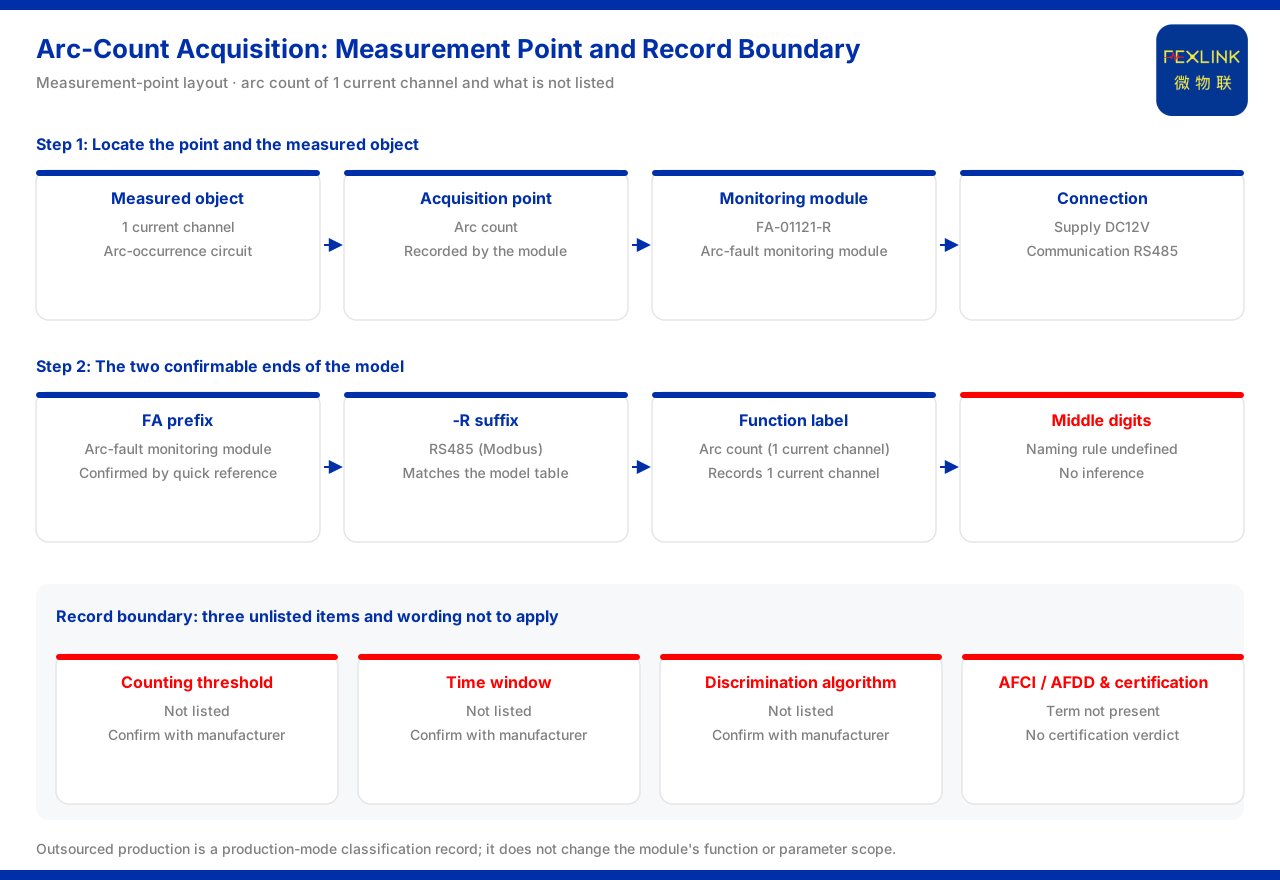
On the question of "how arc events are counted," the answer the knowledge base gives is bounded: it can confirm that the function of the arc-fault monitoring module (FA-01121-R) is labeled "arc count (1 current channel)," that its supply is DC12V, and that its communication is RS485; but the knowledge base does not give the counting threshold, time window, or algorithm. In other words, the fact that "arc events are recorded by this module" is documented, whereas the three questions of "how many events make one count, over what time span they accumulate, and by what criterion an arc is recognized" lie beyond what the knowledge base records and must be confirmed from the manufacturer's technical material.
1. Separate the confirmable from the non-confirmable first
To answer the counting question, the boundary of the material must be drawn first. The knowledge base's records on the FA model concentrate on three points: function, supply, and communication. The model table labels the function of FA-01121-R as arc count (1 current channel), with DC12V supply and RS485 communication. Beyond this, the knowledge base lists only the single FA model FA-01121-R, and does not give the threshold, time window, or algorithm of arc-event counting. The latter three items are negative facts — not "the document is wrong," but "the document does not record them."
2. What can be confirmed: suffix and category
Information at both ends of the model number can be found in the rules. The general suffix table defines -R as RS485 (Modbus), so the -R at the end of FA-01121-R denotes RS485 communication, which corroborates the communication method given in the model table. The product-model quick reference in the appendix maps the FA prefix to the arc-fault monitoring module, confirming the product category. These two points are the parts that can be relied on when reading the model number; as for the meaning of the middle numeric positions, the naming-rule master document in the knowledge base does not give an FA digit definition, and this article does not infer it.
3. Why the counting mechanism cannot be extrapolated from the material
Since the knowledge base records no counting mechanism, no specific threshold, time window, or algorithm should be used as a known condition. A common engineering error is to carry the criteria of other arc-detection schemes directly onto this module and assume "that is how it must be." The knowledge base provides no such basis; a gap can only be read as "the document does not list it," and cannot be back-inferred as "the product possesses or lacks a given capability." Any conclusion that concerns the counting convention must therefore return to the manufacturer and the specific project for confirmation.
4. Why AFCI / AFDD wording cannot be applied by default
A related misreading is to apply the terms AFCI and AFDD, along with their certification statements, directly to this module. The full text of the knowledge base contains neither the AFCI / AFDD terms nor the corresponding certification statements. Since neither the terms nor the certifications are listed, no judgment can be made on which certification class the module belongs to or which protection type it satisfies. The product category is limited to what the knowledge base records: it is an arc-fault monitoring module that records the arc count of one current channel. A gap of this kind is a documentation boundary, not a negative verdict on the product: the absence of a term cannot be read as "the product does not have the corresponding certification," because the same absence would equally fail to support "the product has it by default." Both readings issue a conclusion with no basis in the text, and both should be avoided.
5. One boundary that is unrelated to counting but should be known
The known-information gaps in the knowledge base classify the arc-fault monitoring module as an outsourced-production item. This is a record of production-mode classification; it does not change the functional and parameter scope of the module, nor does it affect its positioning as a monitoring-class module. It is stated here because it is often misread as a judgment on the product's capability; in fact it answers only "who produces it" and not "how it counts." Production mode and product function are separate axes, and a note about who manufactures the module should not be folded into a description of what the module does.
6. When to confirm with the manufacturer
The boundaries above can be summed into one operational recommendation: when a project requires the counting threshold, statistics window, arc-discrimination algorithm, or certification type to be spelled out, these items are outside the scope of the knowledge base and should be obtained directly from the manufacturer's technical material for confirmation; until that material is available, speculative values should not be entered into selection documents or schemes. What the knowledge base can support is the layer of information that "the module records the arc count of one current channel, is supplied by DC12V, and communicates over RS485."
Scope and limitations
First, this article explains only what the knowledge base records and what it lacks on the arc-counting mechanism; the factual boundary is limited to the product knowledge base and introduces no standard clause, parameter, certification, or case that is not listed.
Second, the function, supply, and communication of FA-01121-R are content listed in the knowledge base; the counting threshold, time window, and algorithm are not defined there, and this article neither infers nor fabricates them.
Third, the -R suffix denoting RS485 (Modbus) and the FA prefix corresponding to the arc-fault monitoring module both come from the general suffix table and the product-model quick reference in the knowledge base; the meaning of the middle numeric positions is not inferred here.
Fourth, the AFCI / AFDD terms and certification statements do not appear in the knowledge base, and no certification or protection-type determination is made from them; outsourced production is a production-mode classification record that does not change the functional and parameter scope.