Direct answer
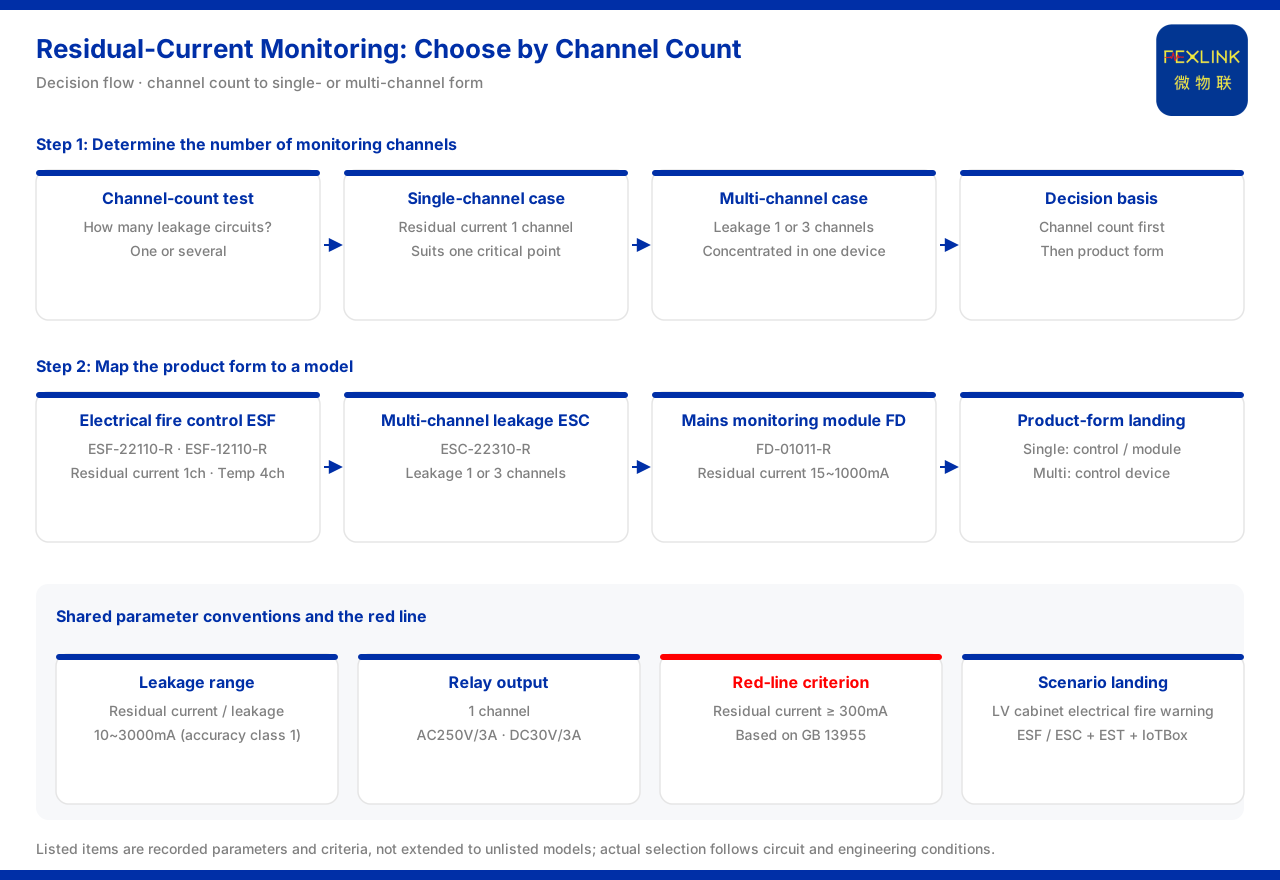
In the context of the knowledge base, residual-current (leakage) monitoring is organized by channel count. The electrical fire monitoring & control device (ESF-22110-R) provides one channel of residual current and integrates four channels of temperature measurement; the multi-channel leakage-current monitoring & control device (ESC-22310-R) provides one or three channels of leakage. In other words, a single critical circuit falls to the electrical fire monitoring & control device, while the need to observe several branch leakage points at the same time falls to the multi-channel leakage-current monitoring & control device. Both share the same leakage acquisition range of 10~3000mA (accuracy class 1), and both provide one relay output. There is also the mains residual-current monitoring module (FD-01011-R), which in module form carries one channel of residual-current acquisition over a range of 15mA~1000mA. All three revolve around residual current, but differ in channel count and in product form.
1. Frame the question by channel count first
The most common selection pitfall is to pick a model first and only then work backwards to justify its use. If channel count is taken as the first constraint, the judgment becomes much simpler: does the monitoring point need to cover one leakage circuit or several? For one, the single-channel form is sufficient; for several, when they are to be concentrated within a single device, the multi-channel form is a better fit. The knowledge base's model tables are organized along exactly this dimension — the residual current of the electrical fire monitoring & control device is fixed at one channel, while the multi-channel leakage-current monitoring & control device offers both a one-channel and a three-channel tier.
2. Single channel: the electrical fire monitoring & control device (ESF)
The model table for the electrical fire monitoring & control device lists two models:
| Model | Supply | Display | Residual current | Temperature | Digital inputs | Relay output | Communication | | --- | --- | --- | --- | --- | --- | --- | --- | | ESF-22110-R | AC220V | OLED | 1 channel | 4 channels | 2 | 1 | RS485 | | ESF-12110-R | DC5V | OLED | 1 channel | 4 channels | — | 1 | RS485 |
Taking the AC220V model as the example, it acquires one channel of residual current while integrating four channels of temperature measurement, and provides one relay output and two digital inputs; the DC5V model likewise has one channel of residual current, four temperature channels, and one relay output. The single-channel residual current and the temperature monitoring are thus merged into the same device, which suits a single circuit where the residual-current measuring point and the temperature measuring points coincide.
3. Multi-channel: the multi-channel leakage-current monitoring & control device (ESC)
When several branches must be covered, the multi-channel leakage-current monitoring & control device is the landing point the knowledge base provides. Its model table lists ESC-22310-R (AC220V, OLED, three channels of leakage monitoring, one relay output, RS485), together with ESC-12111/12311-R (DC5V) and ESC-22111/22311-R (AC220V), two groups offering one-channel and three-channel configurations. The multi-channel models cover several circuits without increasing the number of devices, which suits a monitoring position beneath which several branches run.
4. Shared parameter conventions across both product types
Despite the difference in channel count, the two product types share the same convention on leakage parameters: the residual-current / leakage range is 10~3000mA and the accuracy is class 1 for both; the relay contact rating is AC250V/3A and DC30V/3A for both; and the relay output is one channel for both. Choosing single-channel or multi-channel is therefore not a trade-off over range or accuracy, but over channel-count requirement and integration form. Where temperature integration is needed, the single-channel form carries four channels of temperature measurement on its own; for pure multi-branch leakage, the multi-channel form saves more devices.
5. The module-form single-channel supplement
Beyond the controllers, the knowledge base also provides the mains residual-current monitoring module (FD-01011-R): one channel of residual current, an acquisition tier of 15mA~1000mA, DC12V supply, and RS485 communication, belonging to the single-circuit residual-current monitoring module. It should be noted that its range differs from the 10~3000mA tier above; during selection the current interval that the site needs to cover must be checked, and the ranges of the two products must not be used interchangeably.
6. Scenario landing point and the red line that cannot be bypassed
The knowledge base lists the recommended combination for "low-voltage distribution cabinet electrical fire warning" as the electrical fire monitoring & control device or the multi-channel leakage-current monitoring & control device, together with the multi-channel temperature intelligent controller (EST) and IoTBox. This shows that the actual configuration is often a combination of "single-channel or multi-channel residual current plus temperature." Another item that must be checked alongside it is the threshold criterion: the knowledge base lists "residual current ≥ 300mA" as a red-line rule that cannot be bypassed, with GB 13955 as its basis. During selection, beyond confirming the channel count, it is also necessary to confirm whether the range of the chosen product can cover the reading interval around the threshold.
Scope and limitations
First, this article explains only the selection relationship between single-channel and multi-channel residual-current monitoring products in the knowledge base; the factual boundary is limited to the product knowledge base and introduces no standard clause, parameter, certification, or case that is not listed.
Second, the 10~3000mA (accuracy class 1), the 15mA~1000mA, the relay contact rating, and the channel counts of the individual models are all parameters listed in the knowledge base; this article does not extend them to other models, nor does it infer unlisted channel-expansion capability.
Third, the mapping between the ESF and ESC model numbers and channel counts, and the module positioning of FD-01011-R, are both existing records in the knowledge base; this article draws no unlisted channel-count or range combination from them.
Fourth, the reference to GB 13955 here is limited to the residual-current red-line criterion (≥ 300mA) in the knowledge base; it does not expand specific clauses and makes no compliance determination.