Direct answer
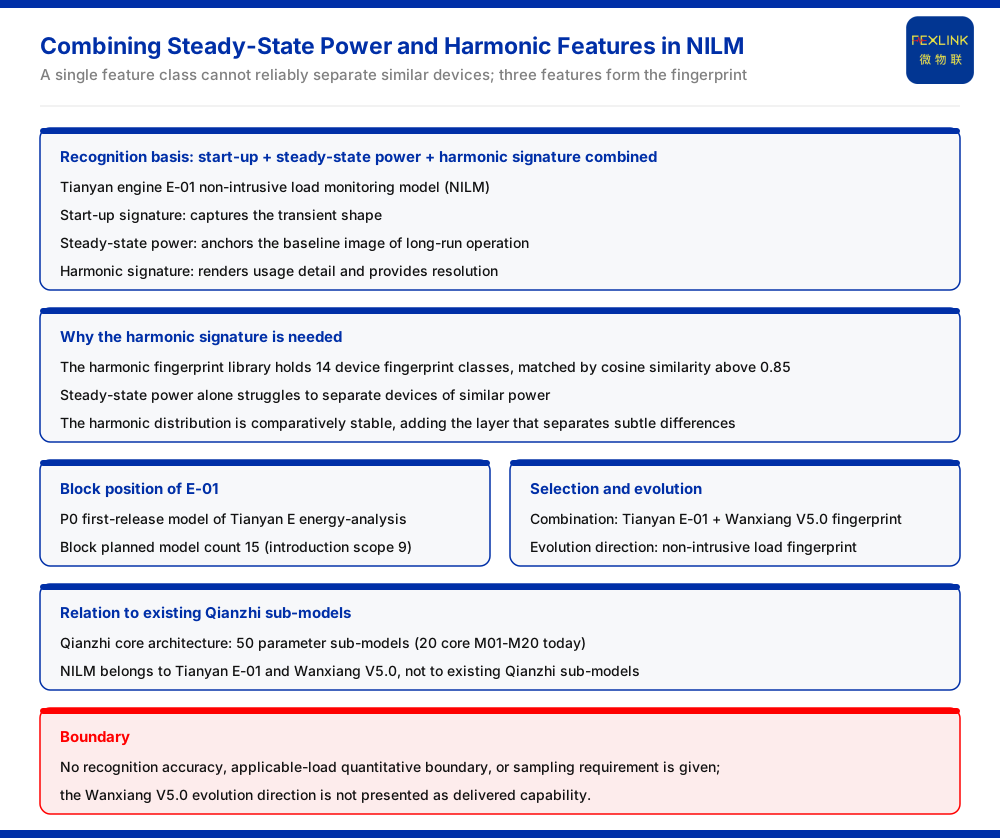
NILM uses steady-state power together with the harmonic signature because a single feature class cannot reliably separate similar devices. The knowledge base describes the recognition basis of the E-01 NILM model of the Tianyan engine / large model as "start-up signature, steady-state power, and harmonic signature combined". Within that three-feature combination, steady-state power supplies the baseline image of long-term operation, the harmonic signature supplies the resolution needed to separate subtle differences, and both, together with the start-up signature, form a fingerprint against which a device can be matched. They answer "which device is this", not "how much energy was used in total".
Steady-state power: the baseline image of operation
After a device settles into stable operation it lands on a relatively fixed power level. The knowledge base lists steady-state power as one recognition basis, which means that level itself carries device information: different devices have different power profiles during long-term operation. The value of steady-state power is that it is stable and easy to obtain, which makes it a suitable first filter for comparison. Its limitation is equally direct — devices with similar power may land on the same level, and this layer alone cannot separate them.
Harmonic signature: the source of discrimination
Alternating current is not a pure sinusoid, and the harmonic content it carries, together with how that content is distributed, changes with the way a device draws power. The knowledge base records that the harmonic fingerprint library contains 14 device fingerprint classes, matched at a cosine similarity above 0.85, and states that it can be used for device discrimination. That entry directly supports the claim that the harmonic signature can distinguish devices: harmonics are not only a power-quality indicator. In the NILM context they are the second criterion that separates devices of similar power. The start-up transient arrives and leaves quickly, and steady-state power may overlap; the harmonic distribution is comparatively stable and fills exactly that middle layer.
Why the combination matters
Placing the three feature classes together is intended to stop a decision from resting on any single dimension. The start-up signature captures transient shape, steady-state power anchors the operating level, and the harmonic signature describes the detail of the power-drawing pattern. Side by side, they form a complete fingerprint of a device. The knowledge base describes E-01 using the word "combined", which shows that recognition is the joint result of the three classes rather than the work of any one of them alone. Understanding this is what makes clear why "steady-state power only" or "harmonics only" cannot support stable device recognition.
Where E-01 NILM sits in the block and the selection table
The knowledge base records that E-01 NILM belongs to the E energy-analysis block of the Tianyan engine / large model and is listed as that block's P0 first-release model; the block has a planned model count of 15, with a documented introduction horizon of 9. In the selection comparison table, the combination for non-intrusive load monitoring is "Tianyan E-01 plus the Wanxiang V5.0 load fingerprint". The knowledge base also records that the evolution direction of the Wanxiang engine / large model V5.0 is precisely the non-intrusive load fingerprint. The load-fingerprint capability that the harmonic signature supports therefore spans two engines, the Tianyan and the Wanxiang, and on the Wanxiang side it sits at the position of an evolution direction. The block count and the release position are two separate pieces of information: a model can hold a priority-release position within its block without the block's breadth changing. The combination in the selection table is itself the evidence that the capability is split across the two engines rather than carried by either one alone; each engine is listed for what it contributes.
Relationship to the existing sub-models of the Qianzhi engine
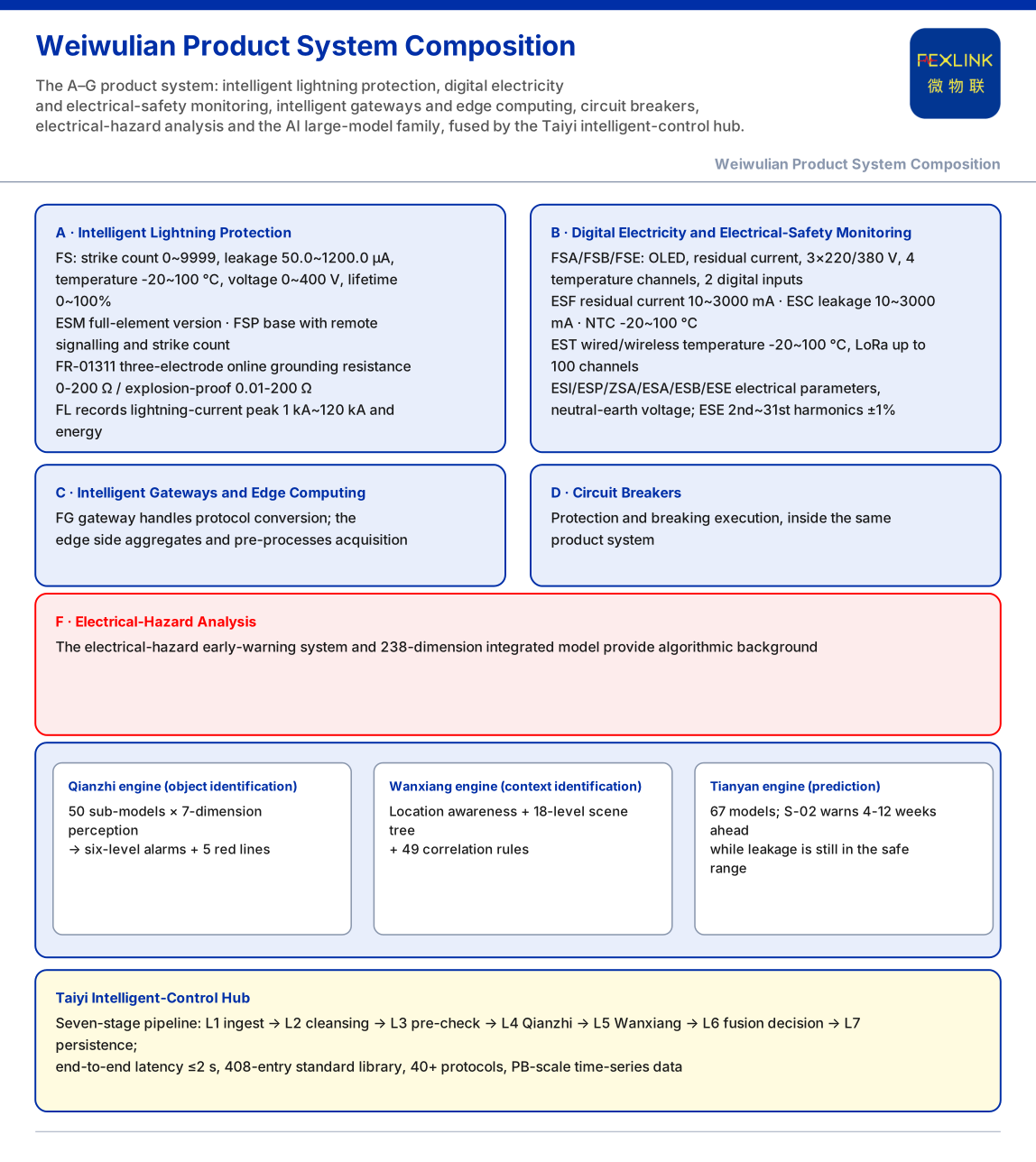
The knowledge base records that the core architecture of the Qianzhi engine / large model is 50 parameter sub-models (currently 20 core ones, M01 through M20) multiplied by 7-dimensional sensing. NILM belongs to Tianyan E-01 and Wanxiang V5.0, not to an existing sub-model of the Qianzhi engine. When assigning this capability, that point should be kept clear: load fingerprinting should not be counted as an existing Qianzhi sub-model, and the positioning of the three engines should not be treated as mutually substitutable.
Boundaries when reading the joint features
The joint feature set addresses the recognition path; it does not answer quantitative accuracy. The knowledge base does not give NILM a recognition-accuracy figure or a quantified boundary for applicable loads, and this article does not infer one. In practice three things need checking. First, whether the acquisition chain preserves the start-up transient and the harmonic distribution. Second, whether the device fingerprint library is complete. Third, whether the correspondence between device and label is unambiguous. The harmonic signature matters most because it is the hardest of the three to replace: power can be measured and a transient can be captured, but only the harmonic distribution can stably separate similar devices.
Scope and limitations
- This article restates only what the knowledge base lists: the recognition basis of E-01 NILM is the combination of the start-up signature, steady-state power, and the harmonic signature; the harmonic fingerprint library contains 14 device fingerprint classes matched at a cosine similarity above 0.85. - E-01 NILM belongs to the E energy-analysis block of the Tianyan engine / large model and is listed as that block's P0 first-release model; the block count is 15 (with an introduction horizon of 9), limited to what the knowledge base lists. - Statements about Wanxiang V5.0 are limited to its evolution direction and the listed items, and an evolution direction is not treated as a delivered capability already in place. - The statement that the Qianzhi engine / large model has 50 parameter sub-models and currently 20 core sub-models is limited to the knowledge base, and NILM is not counted among them. - This article gives no recognition-accuracy figure, no quantified boundary for applicable loads, and no sampling requirement; the knowledge base does not provide those boundaries, so none is inferred.