Direct answer
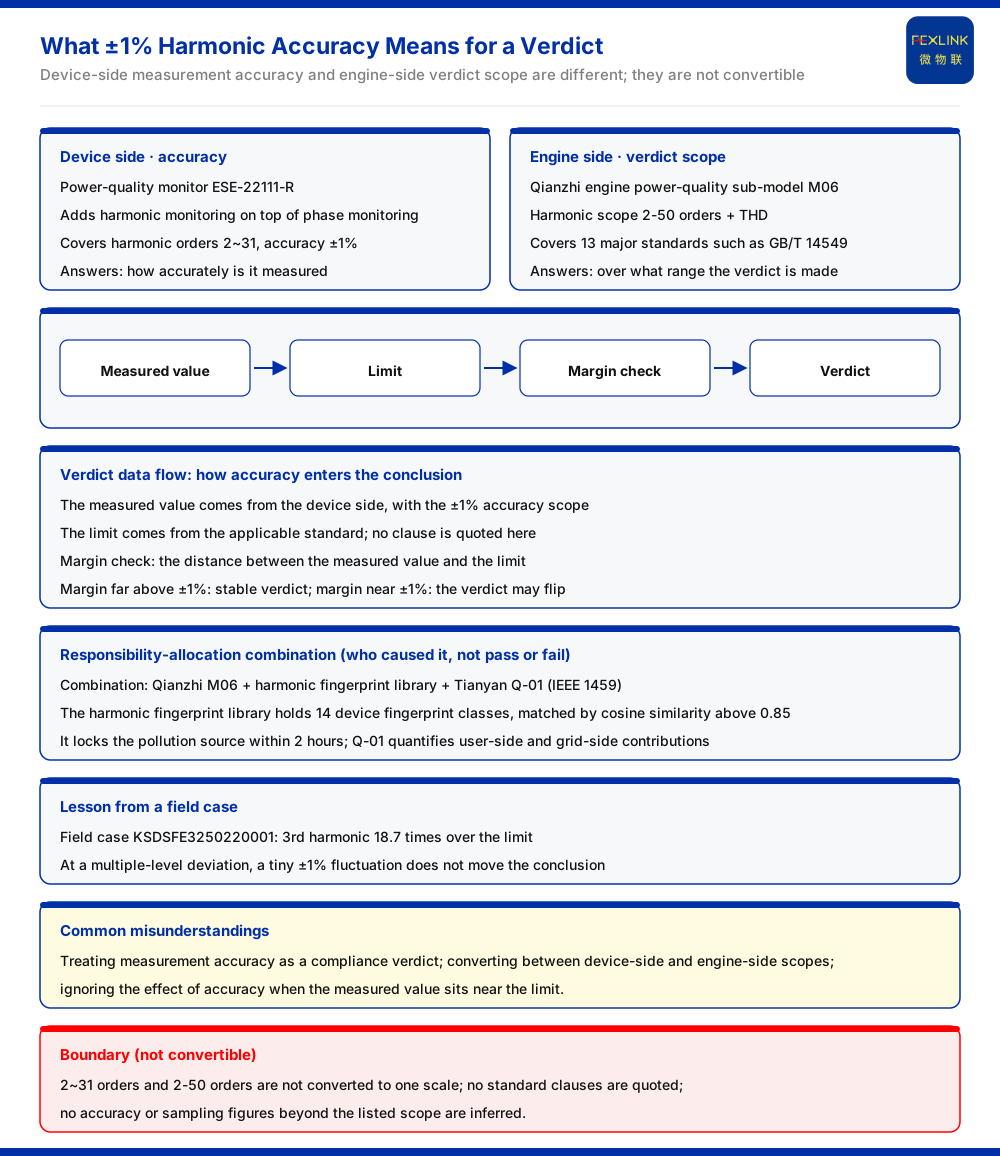
The ±1% figure in the product knowledge base is a measurement-accuracy statement for harmonic monitoring, not a compliance verdict. The knowledge base records that the power-quality monitor (ESE-22111-R) adds harmonic monitoring on top of phase monitoring, covering harmonic orders 2 through 31 at an accuracy of ±1%. The number answers "how accurately is the quantity measured", not "is it within limits". Keeping that distinction is the precondition for reading it correctly: ±1% can support trend observation and supply a quantitative input to responsibility analysis, but it cannot by itself decide whether a harmonic exceeds a standard limit. Pass or fail still follows the limit of the applicable standard, and whether data can support acceptance depends on whether the margin between the measured value and the limit is materially larger than the accuracy. Accuracy, limit, and margin are three separate things, and they should be read separately.
What the accuracy entry actually states
The knowledge base records that the power-quality monitor (ESE-22111-R) extends phase monitoring with harmonic monitoring, that the harmonic range is orders 2 through 31, and that the accuracy is ±1%. Two elements are packed into that entry. The first is coverage, meaning which harmonic orders the device can measure at all. The second is accuracy, meaning how large a deviation the measured value may carry. Together they define harmonic-monitoring capability on the device side; neither is meaningful without the other. What must be stated plainly is that ±1% describes the measurement accuracy of monitoring hardware. It is a device-side specification, not a conclusion about compliance.
It also helps to be precise about what an accuracy bound is. ±1% marks the limit within which the monitor's reading is expected to stay relative to the true value; it is a tolerance envelope around the measured quantity, not a statement that every reading is off by exactly one percent. Two consequences follow. First, the same absolute accuracy translates into a different relative weight at different harmonic amplitudes, so accuracy should always be considered together with the magnitude being measured. Second, because the figure belongs to the device entry, it does not transfer automatically to values that pass through other processing stages. Applying the ±1% label to an engine output, or reading a display value as if the label covered the whole chain, are both ways of over-extending the entry.
Device side and analysis side are two different scopes
Once harmonic data enter the analysis stage, the scope changes. The knowledge base records that the M06 harmonic sub-model of the Qianzhi engine / large model has an analysis range of orders 2 through 50 plus total harmonic distortion (THD). The device side reaches order 31 at ±1% accuracy; the engine side reaches order 50 and includes THD. The two ranges do not coincide and cannot be converted into one another. When a judgment is made, the first question should therefore be which side the data in hand came from. A value taken from the monitor is governed by the ±1% accuracy scope; an analytical conclusion produced by the engine is governed by the M06 scope. Mixing them, or assuming the narrower device range can be stretched to the wider engine range, is an engineering error rather than a rounding detail.
The reason the two scopes differ is that they belong to different roles in the chain. The monitor is field hardware and its coverage is bounded by what the instrument acquires; the sub-model is software and its coverage is bounded by the analysis specification. A wider software range does not give the hardware new orders to measure, and a narrower hardware range does not prevent the software from analysing other data sources. For any concrete comparison, the honest statement is the narrower one: the orders actually acquired on site set the ceiling for what can be evidenced, while the engine scope describes how far the analysis itself is defined. Keeping the two roles separate avoids claiming evidence the field device never captured.
What accuracy means for a compliance decision
The value of ±1% shows up in the reliability of a decision. If the gap between the limit and the measured value is far larger than ±1%, accuracy drift will not change the over-or-not-over conclusion, and the data are strong enough to support a judgment. If the measured value sits right at the limit, in the same order of magnitude as ±1%, then accuracy itself can flip the direction of the conclusion. That is precisely why accuracy belongs in the decision context: it determines how close the measured value may come to the limit before the conclusion becomes unreliable. Accuracy is therefore not an isolated specification but one component of the decision margin. Reading it as a standalone headline number hides the only question that matters in practice, namely how much room there is between the measurement and the line.
Accuracy and the harmonic source-tracing stack
When the question shifts from "is it over the limit" to "who caused it", accuracy remains part of the quantitative input. The selection comparison table in the knowledge base gives the combination for harmonic source tracing and responsibility allocation as "Qianzhi M06 plus the harmonic fingerprint library plus Tianyan Q-01 (IEEE 1459)". Within that combination, the harmonic fingerprint library contains 14 device fingerprint classes and matches at a cosine similarity above 0.85, and the knowledge base states that it can pin down a pollution source within 2 hours. The Q-01 model of the Tianyan engine / large model quantifies the harmonic contribution of the user side and the grid side according to IEEE 1459. The more accurate the input, the more stable the data feeding the matching and allocation steps. But the stack answers attribution, not compliance; the two questions remain distinct even though they draw on the same measurement basis.
What a field case shows about scale
The knowledge base records a field-collected data case: in case KSDSFE3250220001, the 3rd harmonic exceeded the limit by a factor of 18.7. That factor and a ±1% accuracy band are not in the same order of magnitude at all. When a deviation reaches the multiple-order range, a small fluctuation inside the accuracy band cannot move the conclusion. Read the other way, this shows that accuracy-sensitive situations are precisely the boundary cases where the measured value is close to the limit, not the clearly offending ones. The case is a knowledge-base data point and should not be generalised into a conclusion for other sites.
Standards coverage and how to read it
The knowledge base records that the Qianzhi engine / large model covers 13 major standards, including GB/T 12325, GB/T 14549, and GB/T 15543, of which GB/T 14549 is the standard related to harmonics. That gives the harmonic topic a standards anchor. This article only explains the role accuracy plays in a decision; it does not quote any clause, and it does not give limits or measurement methods under the name of a standard. Clause-level citation must first be matched within the standards library before it can be used.
Scope and limitations
- This article restates only the scopes listed in the knowledge base: the power-quality monitor's harmonic monitoring is orders 2 through 31 at ±1% accuracy; the M06 harmonic sub-model of the Qianzhi engine / large model is orders 2 through 50 plus THD. - ±1% is a device-side measurement accuracy. It is not mixed with the engine-side analysis scope, and this article does not infer accuracy or sampling figures that are not listed. - The source-tracing combination, the 14 fingerprint classes, the cosine similarity above 0.85, and the 2-hour pollution-source lock are limited to what the selection comparison table and the knowledge base list. - The 18.7× 3rd-harmonic figure in case KSDSFE3250220001 is a knowledge-base data point and is not generalised into conclusions for other sites. - Standards coverage is limited to the listed 13 major standards. This article does not quote clauses and constitutes no selection or acceptance conclusion.