Direct answer
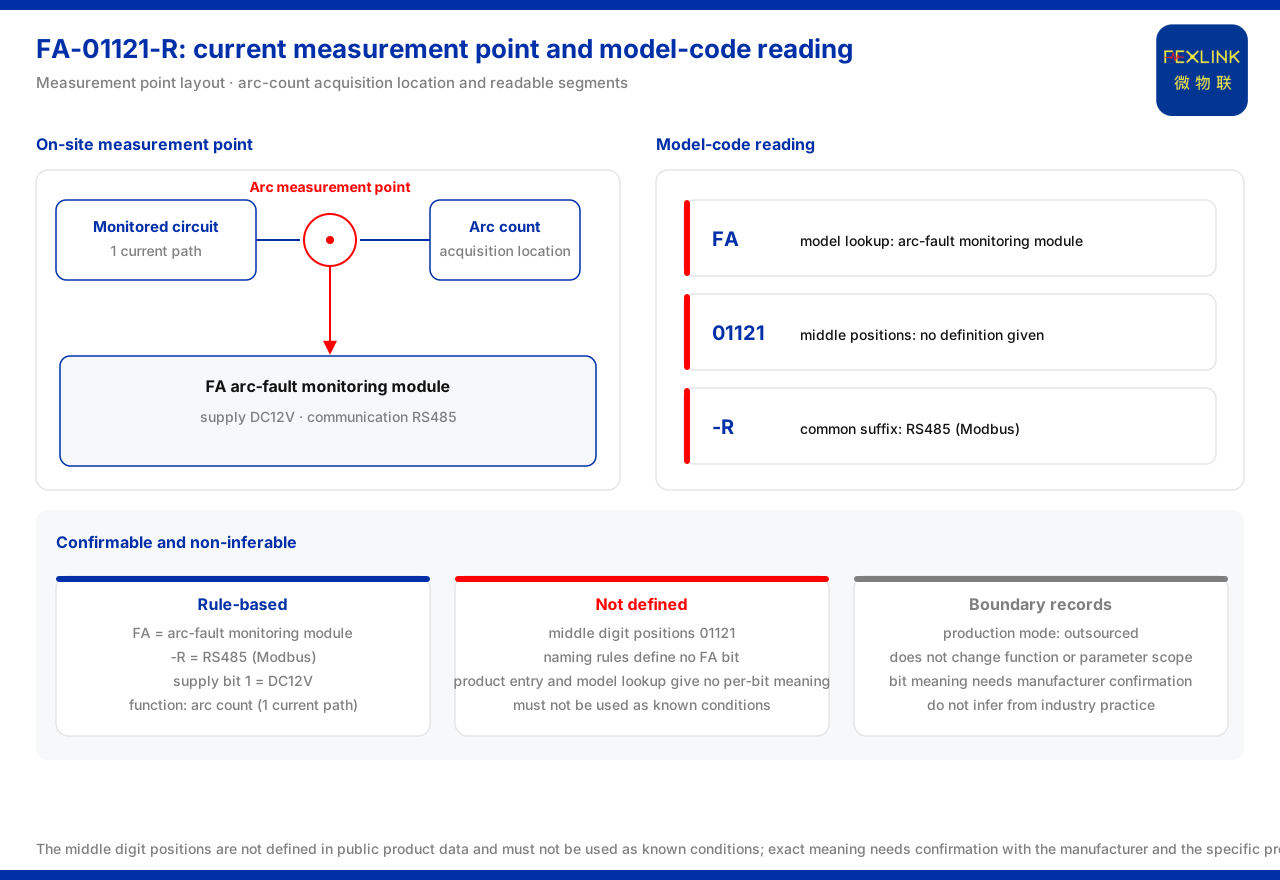
According to the product knowledge base, for the FA arc-fault monitoring module (FA-01121-R) only some fragments of the model number can be interpreted by rule: supply code 1 corresponds to DC12V, and the suffix -R corresponds to RS485 (Modbus). The middle digit string "01121" is not defined anywhere in the knowledge base—the general model-naming rule gives no digit definitions for FA, and neither the product entry nor the product-model quick reference in the appendix explains the positions one by one. The accurate answer to "what do the digits in an FA model mean" is therefore: the only confirmable parts are the supply position and the communication suffix, while the remaining digit positions have no meaning given within the scope of the knowledge base.
First, split the model into three segments
A model number can be roughly split into a prefix, a digit block and a suffix. The prefix fixes the product category, the digit block normally carries parameter configuration, and the suffix carries the communication method. When reading a model, the most reliable approach is not to guess from industry convention but to return to the naming rule and verify segment by segment: which segment has a rule and which does not. The FA-01121-R model needs exactly this segment-by-segment treatment. The value of the split is that it localises the uncertainty: the readable ends can be confirmed independently of the middle, and the unreadable middle is not allowed to contaminate what the two ends establish.
The parts that can be read: prefix and suffix
The prefix FA is marked in the knowledge base's product-model quick reference as the arc-fault monitoring module. The suffix -R is defined by the general suffix table: -R is RS485 (Modbus). Both ends of the model number can therefore be found in the rules—what category of product it is, and what communication method it uses. These two points are also mutually confirmed by what the model entry records: the function is arc count (1 current channel), the supply is DC12V, and the communication is RS485.
The part the knowledge base does not define: the middle digits
The problem lies with the middle digit string "01121". The general model-naming rule in the knowledge base defines only the general communication suffixes, the supply-method codes for lightning-protection products, and the general codes for the ES-series electrical-safety modules; it does not contain a digit definition for FA model positions. At the same time, the FA product entry gives only three items—function, supply and communication—without expanding the meaning of each code position in 01121; the product-model quick reference in the appendix likewise maps only the FA prefix to the arc-fault monitoring module and gives no digit-position definition either. Taken together, the three sources lead to one conclusion: these digit positions have no corresponding explanation table within the scope of the knowledge base. The absence is consistent across the rule, the entry and the appendix, so it is a property of the documentation rather than a single overlooked passage.
How "not defined" should be read
A boundary of reading must be stated here especially clearly. When the knowledge base gives no meaning for a given digit position, that can only be read as "the document does not record it"; it cannot be reverse-inferred as "this position must represent some parameter", nor can it conversely be asserted that "this position is meaningless". The former is speculation, and the latter is overreach. The safe handling is: any position the knowledge base does not define is not used as a known condition; where an exact meaning is required, it should be confirmed with the manufacturer and the specific project. This keeps the boundary of the answer aligned with the boundary of the document.
Two confirmable boundary facts
Besides the naming rule, the knowledge base has two records related to this model that do not concern the meaning of the digit positions. First, the product-model quick reference in the appendix maps the FA prefix to the arc-fault monitoring module, confirming the product category. Second, the known-information gaps state that the arc-fault monitoring module is produced through outsourcing; this is a production-mode classification, it does not change the scope of function and parameters, and it does not affect the module's positioning as a monitoring-class module.
Common misreadings
There are three common misreadings. The first treats an industry convention as a knowledge-base rule and assigns a meaning to each position of 01121 directly. The second takes "the knowledge base does not say" as "the product lacks this capability", using the omission to reverse-infer function. The third ignores the fact that only the supply position and the suffix are supported, and uses content beyond the three items listed in the model table as a known condition. Only by keeping these three apart can the question "what do the digits mean" receive an answer that stays within its boundary. Each of the three substitutes an assumption for a verified rule, and each is avoided by returning to the naming rule and the model table rather than to expectation.
Applicability and limits
First, this article explains only which fragments of the FA-01121-R model can be interpreted by knowledge-base rule; its factual boundary is limited to the product knowledge base, and it introduces no standard clauses, parameters, certifications or cases the knowledge base does not list.
Second, the only interpretable parts this article confirms are supply code 1 = DC12V and suffix -R = RS485 (Modbus); the meaning of the middle digit positions is not defined in the knowledge base, and this article neither infers nor fabricates it.
Third, product category and model correspondence are limited to what the knowledge-base entry and the product-model quick reference in the appendix list; outsourced production is a production-mode classification record and does not change the scope of function and parameters.
Fourth, any conclusion about the meaning of the digit positions or about certification and compliance must be confirmed by the manufacturer and the specific project; this article does not constitute a determination.