Direct answer
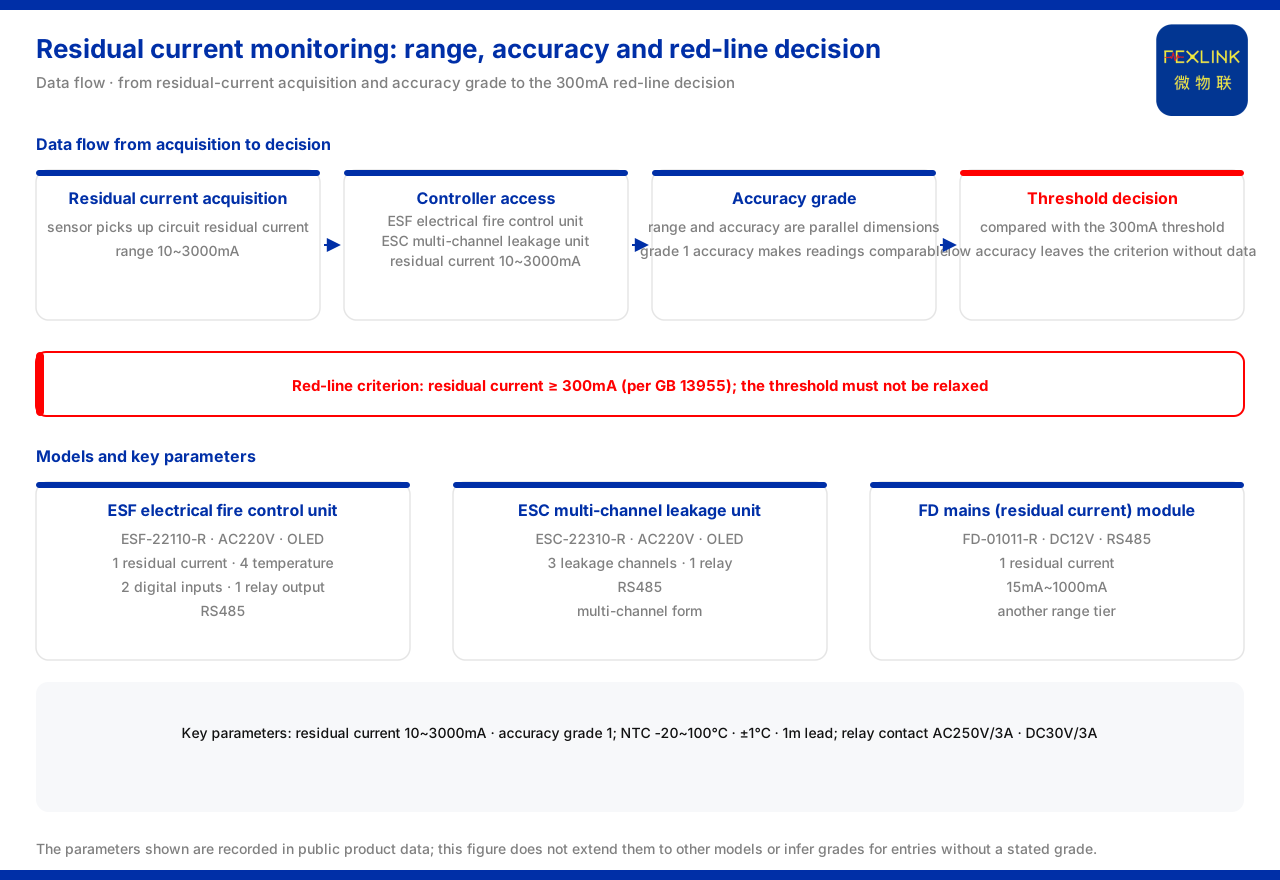
Residual-current monitoring has to be read by accuracy class for a fundamental reason: only when a reading reaches a certain accuracy does it become comparable, and only then can it support a threshold criterion. Range answers "what current interval can be measured"; accuracy answers "to what degree can the measured number be trusted". The two are independent dimensions. In the knowledge base, the ESF electrical fire monitoring & control device (ESF-22110-R) and the ESC multi-channel leakage-current monitoring & control device (such as ESC-22310-R) both give residual current or leakage as 10~3000 mA at class 1 accuracy, while the FD mains residual-current monitoring module (FD-01011-R) covers 15 mA~1000 mA. Around the non-bypassable red-line criterion "residual current ≥ 300 mA", on the basis of GB 13955, accuracy determines whether the readings near the threshold are usable.
Range and accuracy are two dimensions
At selection it is easy to look only at the upper end of the range and ignore accuracy. The range fixes the current interval a device can cover, while accuracy determines the consistency and comparability of the reading. The same current value, measured with devices of different accuracy, yields different degrees of trustworthiness. If the purpose of monitoring is comparison against a threshold, the reading must be able to sit stably near that threshold while remaining comparable; insufficient accuracy leaves the criterion without a data basis. Range and accuracy must therefore be confirmed together, and range must not be used as a substitute for accuracy. A wide range says nothing about whether the numbers inside it are consistent enough to be compared, and a good accuracy class says nothing about whether the device reaches the current interval of interest.
The accuracy tier in the knowledge base: ESF and ESC both class 1
The key parameters the knowledge base gives for the ESF electrical fire monitoring & control device are: residual current 10~3000 mA, class 1 accuracy; the current parameter 1 in its model rule corresponds to 10~3000 mA. For the ESC multi-channel leakage-current monitoring & control device, the key parameter is leakage 10~3000 mA, class 1 accuracy. The two product classes share the same upper range limit and the same accuracy tier; the difference is that ESF addresses electrical fire monitoring and control, while ESC addresses multi-channel leakage monitoring and control. When reading the parameters, note that range and accuracy are two parallel statements and cannot be converted into one another.
Another range tier: the mains monitoring module
The FD mains residual-current monitoring module (FD-01011-R) gives a different range tier: one residual-current channel covering 15 mA~1000 mA, supplied at DC12V with RS485 communication. Its orientation differs from the 10~3000 mA tier above, being aimed at a smaller current interval. The knowledge base does not mark an accuracy class for this entry, so this article does not infer its accuracy tier; it lists the range and the model correspondence as recorded. Leaving the accuracy blank is not the same as assigning a value: where the document records no accuracy class, no tier should be assumed from the range or from another product.
How accuracy works with the 300 mA red-line criterion
The knowledge base lists "residual current ≥ 300 mA" as a non-bypassable red line, on the basis of GB 13955. A red-line designation means this threshold may not be relaxed at will. For it to become an executable criterion, the range of the selected device must cover the reading interval around the threshold, and its accuracy must be sufficient for the reading to remain comparable; otherwise the threshold, even when written down, lacks stable data support. This is exactly why the accuracy class and the range need to be checked together rather than one at a time.
Multiple channels at the same accuracy
With accuracy identical at class 1, the difference in product form becomes another handle at selection. A single-channel requirement lands on the ESF electrical fire monitoring & control device; when several loops must be monitored at the same time, it lands on the ESC multi-channel leakage-current monitoring & control device, whose model table lists ESC-22310-R as well as ESC-12111/12311-R and ESC-22111/22311-R. One accuracy tier covering both single-channel and multi-channel forms shows that "reading by accuracy" and "reading by channel count" are two different questions, and the one cannot replace the other.
Boundary: the knowledge base gives no multi-tier accuracy comparison table
It should be stated clearly that the accuracy statements the knowledge base gives for the above residual-current and leakage products concentrate on class 1. It does not provide a table that sets several accuracy tiers side by side, nor does it give a selection rule by accuracy class. Any further judgement about "which accuracy to choose for which scenario" therefore falls outside what the knowledge base records; this article explains only why the accuracy dimension matters and which accuracy statements the knowledge base records. Where a scenario seems to call for a precision judgement, the accurate reading is that the document is silent, not that a lower or higher tier is implied.
Applicability and limits
First, this article explains only the relationship between accuracy and range in residual-current monitoring; its factual boundary is limited to the product knowledge base, and it introduces no standard clauses, parameters, certifications or cases the knowledge base does not list.
Second, the residual current / leakage 10~3000 mA (class 1 accuracy) and the FD-01011-R figure of 15 mA~1000 mA cited here are parameters listed in the knowledge base; this article does not extend them to other models, nor does it infer the accuracy tier of entries for which no accuracy is marked.
Third, the model correspondence of ESF and ESC, and the multi-channel model list, are existing records in the knowledge base; this article does not extend them into unlisted channel-count or range combinations.
Fourth, the reference to GB 13955 in this article is limited to the residual-current red-line criterion recorded in the knowledge base; it does not set out specific clauses and makes no compliance determination.