Direct answer
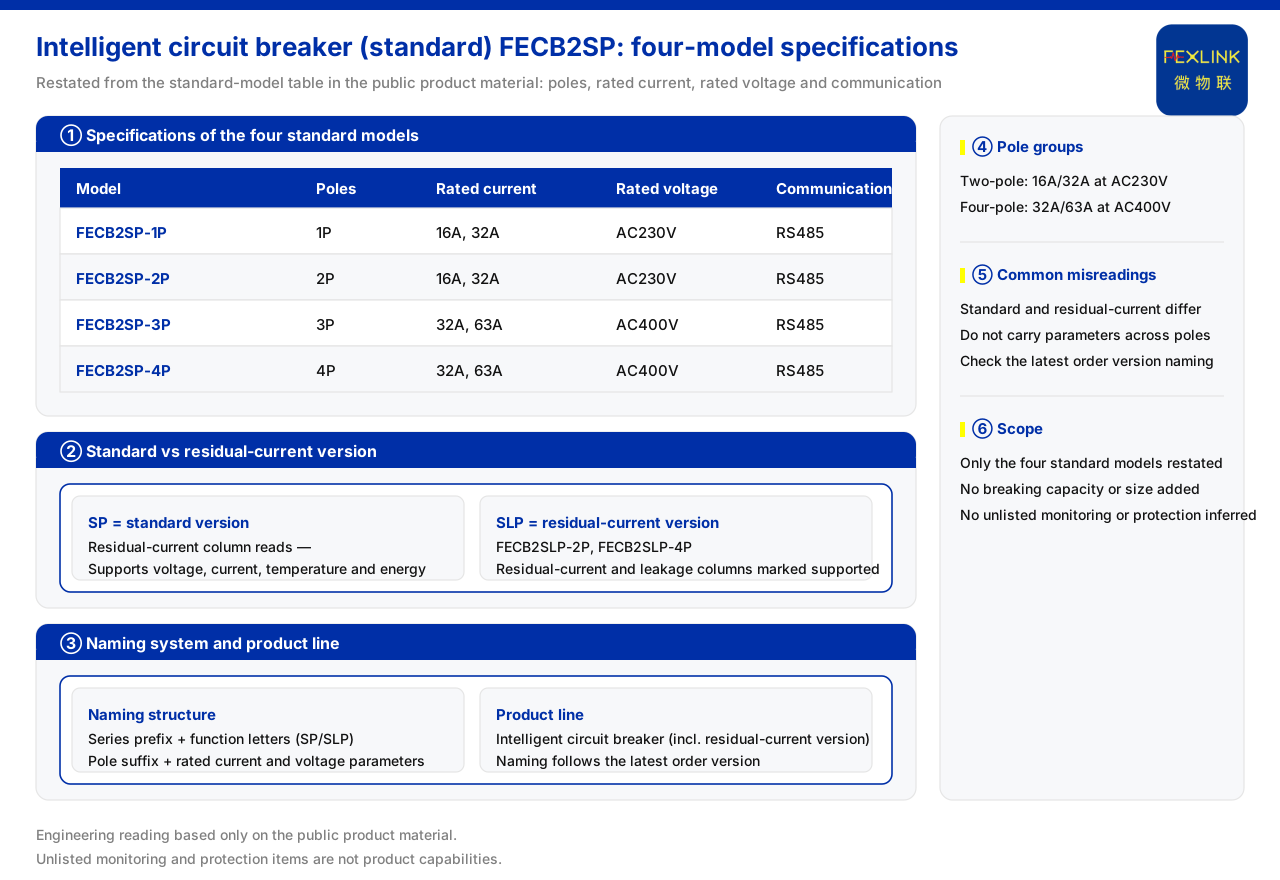
The intelligent circuit breaker (standard model) covers four pole configurations—1P, 2P, 3P, and 4P—through models such as FECB2SP-1P, and all four use RS485 communication. The standard-model specifications listed in the knowledge base concentrate on three dimensions: pole count, rated current, and rated voltage. The 1P and 2P models are rated 16A/32A at AC230V; the 3P and 4P models are rated 32A/63A at AC400V. Read together, these entries show a standard line that grows from a single pole to four poles while keeping one communication format across the whole range. The four models share one format, but they remain separate entries, and each carries its own rated current and voltage group.
Specifications of the four standard models
| Model | Poles | Rated current | Rated voltage | Communication | |:--|:--|:--|:--|:--| | FECB2SP-1P | 1P | 16A, 32A | AC230V | RS485 | | FECB2SP-2P | 2P | 16A, 32A | AC230V | RS485 | | FECB2SP-3P | 3P | 32A, 63A | AC400V | RS485 | | FECB2SP-4P | 4P | 32A, 63A | AC400V | RS485 |
For every standard model in the table, the residual-current protection column is "—", while all of them support voltage, current, and temperature monitoring together with energy metering, and all communicate over RS485. In other words, the standard line covers the common distribution circuit forms from a single pole up to four poles and provides those monitoring items over one communication format. The current and voltage values are not distributed at random across the four models; they group by pole count, which is the organizing principle the next section explains. A reader comparing the four rows should therefore read across a row rather than down a column: the pole count fixes the current and voltage group, and the communication column stays constant for the whole standard line.
How the model system is read
By naming, the standard line and the residual-current line share the same series prefix; they differ in the letter combination that denotes the function. After giving the series and the function, the model separates poles by a pole-count suffix and distinguishes rated current and rated voltage by parameter. The model table in the knowledge base is organized along exactly these dimensions, so within one series the models of different pole counts group in current and voltage: the two-pole models correspond to 16A and 32A at AC230V, and the four-pole models correspond to 32A and 63A at AC400V. This grouping is the reason a parameter taken from one pole class cannot simply be carried over to another; the correspondence is defined model by model, not by the family as a whole. The suffix and the parameter values are thus two expressions of the same underlying structure, one in the model code and one in the table.
Difference between the standard and residual-current versions
The table note in the knowledge base explains that SLP denotes the residual-current version, that is, leakage monitoring plus residual-current protection, while SP denotes the standard version. The intelligent circuit breaker (with residual-current protection) lists FECB2SLP-2P (2P, 16A/32A, AC230V) and FECB2SLP-4P (4P, 32A/63A, AC400V), and for both rows the residual-current protection and leakage monitoring columns are marked "supported". The difference between the two product types therefore centers on whether leakage monitoring and residual-current protection are present; the remaining correspondence of pole count, current, and voltage is read as the model table lists it. The standard and residual-current versions are distinct entries rather than two labels for one product, and the "—" in the standard version's residual-current column is the marker of that distinction. That marker is deliberate: it records the absence of leakage monitoring and residual-current protection, not an unknown value left to be filled in.
Naming and product-line position
The product-line overview in the knowledge base classifies this product class as intelligent circuit breakers and notes that it includes the residual-current version; the product-model quick reference likewise lists the standard version and the residual-current version as the two series of the intelligent circuit breaker. This is the document's own account of where the two series sit, and it is the account this article follows. The two references agree on the series split, so the assignment does not rest on a single passage. The known-information gaps further state that, in the 2025 selection manual, some worksheets (such as the intelligent circuit breaker) differ in naming from the model-rule document, and that the actual naming follows the latest order version. Where a version difference is possible, the latest order version is therefore the reference point, and older naming should not be treated as authoritative.
Common misreadings
One common misreading treats the standard version and the residual-current version as different names for the same model, ignoring the fact that the standard version's residual-current column is "—". A second mixes up the current and voltage correspondence across pole counts, for example applying the parameters that suit the four-pole models to a two-pole model. A third ignores the possible version difference between the selection manual and the model-rule document and does not check against the latest order version. Each of these errors comes from substituting an assumption for the table, and each is avoided by reading the pole count, current, and voltage together rather than in isolation. The reliable check is a row-by-row reading of the model table, with the table note used to interpret the function letters and the version note used to settle which naming to trust.
Scope and limitations
First, this article restates only the four standard models listed in the knowledge base and their pole counts, rated currents, rated voltages, and communication; it does not extend to breaking capacity, leakage actuation values, dimensions, or certification parameters. Second, the difference between the standard and residual-current versions is limited to the table note and the same table—the standard version's residual-current column is "—", and the residual-current version's leakage monitoring and residual-current columns are marked "supported". Third, naming and series assignment are limited to what the knowledge base and the model quick reference list; where a version difference is involved, the latest order version prevails. Fourth, this article does not infer any unlisted monitoring item, protection action, or compliance attribute, and it does not convert the listed specifications into a selection recommendation for a particular circuit.