Direct answer
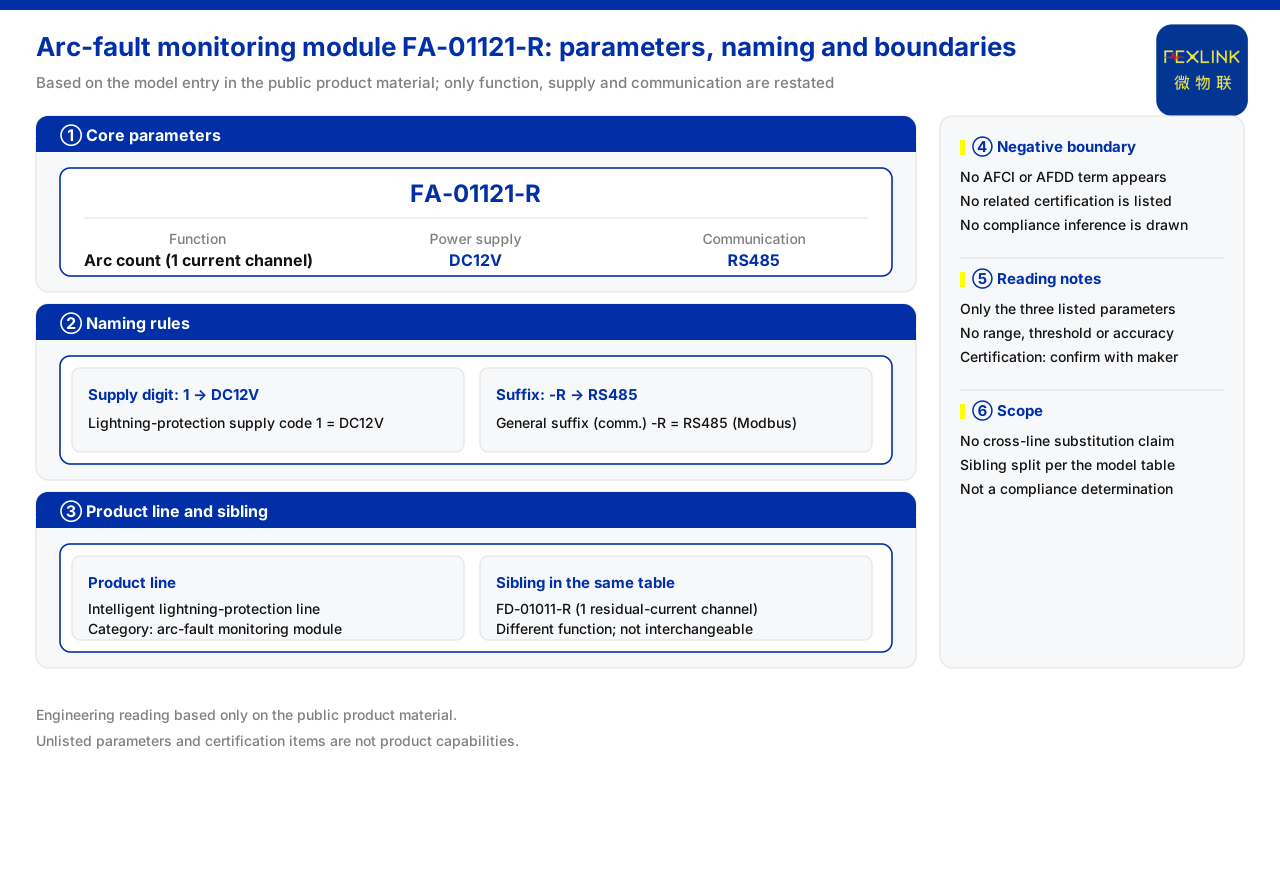
The arc-fault monitoring module (FA-01121-R) is one of the arc-monitoring modules listed in the knowledge base and is assigned to the intelligent lightning-protection product line. Its listed function is an arc count on one current channel; its power supply is DC12V, and its communication is RS485. The full text of the knowledge base contains neither the term AFCI nor the term AFDD, and it lists no certification or standard clause related to them. The module therefore cannot be written up as a certified protective device of either class. Because the entry is a monitoring-module listing, the answer to what this product is must come from the model table and the product-line structure, not from an industry label attached to its name.
Where it sits in the product line
The product-line overview and the product-model quick reference in the knowledge base both record that the category corresponding to this product is the arc-fault monitoring module, that it belongs to the intelligent lightning-protection product line, and that its section sits under that line. In the knowledge base's own structure, in other words, it is a monitoring module listed independently by use, not a class of switchgear or protective apparatus. That placement matters for how the entry should be read: the document organizes products by line and by function, and the arc-fault module appears as its own functional listing rather than as a variant of a switching or protection device. The line assignment and the section placement are mutually consistent, and both come from the document's own index rather than from a category inferred by the reader.
How the model number is read
The power-supply position and the suffix of this model can be understood from the naming rules. For lightning-protection products, the power-supply code table defines code 1 as DC12V, and the general suffix table defines -R as RS485 (Modbus). These two rules corroborate the DC12V and RS485 given in the model table, and they are the basis for reading the supply position and the suffix of the model. Where a code position and a table value agree, the naming rule and the entry reinforce each other; where a position is not documented, no value should be supplied by assumption. Reading the code this way keeps the interpretation anchored in the naming rules rather than in a habit carried in from outside the document.
Parameters listed in the model table
| Model | Function | Power supply | Communication | |:--|:--|:--|:--| | FA-01121-R | Arc count (1 current channel) | DC12V | RS485 |
These are the full set of parameters the model entry supports. The table gives three columns—function, power supply, and communication—and the entry does not carry a fourth dimension. This article adds no range, threshold, accuracy, mounting distance, or other unlisted parameter beyond them, and it does not extend the function beyond counting arc events on a single current channel. Any capability that cannot be expressed in these three columns is outside the entry and outside the conclusions drawn here.
Difference from the other monitoring module in the same table
The same section also lists the mains residual-current monitoring module (FD-01011-R), whose function is one channel of residual current, with the same DC12V supply and the same RS485 communication. The two functions differ—one counts arc events, the other monitors residual current—and they must not be substituted for one another, even though their supply and communication formats coincide. The arc-fault monitoring module (FA-01121-R) is the only model of that category listed anywhere in the knowledge base; other similarly named entries do not belong to this category. Keeping the two entries apart is what prevents a shared supply and communication format from being mistaken for a shared function, and it is also what prevents a name resemblance from standing in for an identity.
Negative boundary: terms and certifications that do not appear
The full text of the knowledge base contains neither AFCI nor AFDD, and it lists no corresponding certification or standard clause. This conclusion is limited to the document text and can only be read as "the document does not record it"; it can neither be read as "the product does not have it" nor as "the product has it by default." The first reading issues a negative verdict on the manufacturer's behalf from a gap in the documentation, and the second attaches a certification with no basis at all; both are inferences rather than facts. Any conclusion about certification or compliance must be confirmed by the manufacturer and the specific project, and it cannot be back-inferred from a gap in the document.
Production mode
The known-information gaps in the knowledge base state that the arc-fault monitoring module is outsourced for production. This is a production-mode classification; it does not change the factual scope of the function and parameters above, nor does it affect the module's positioning as a monitoring-class module. Production mode and product function are separate axes, and a note about who manufactures the module should not be folded into a description of what the module does.
Common misreadings
The first misreading reads the arc-monitoring module directly as a certified protective device, substituting industry habit for the document's wording. The second treats the absence of a term from the document as the product having or lacking a certification by default; both directions are inference. The third ignores that the model table lists only function, power supply, and communication, and treats unlisted parameters as known conditions. Keeping these apart is what prevents name similarity from drawing conclusions in place of evidence, and it keeps the entry within the three columns it actually documents.
Scope and limitations
First, this article restates only the parameters listed in the model entry—function arc count (1 current channel), supply DC12V, communication RS485—and does not extend to range, threshold, accuracy, mounting, or actuation parameters. Second, product-line assignment and model correspondence are limited to what the knowledge base and the model quick reference list, with no cross-line inference of functional substitution. Third, the full text of the knowledge base contains no AFCI or AFDD term and no related certification or standard clause, so this article does not infer that the module complies with or fails to comply with any such certification. Fourth, the distinction from the residual-current monitoring module is limited to what the same table lists, and no unlisted clause is cited. Fifth, any certification or compliance conclusion must be confirmed by the manufacturer and the specific project; this article does not constitute a compliance determination.