Direct Answer
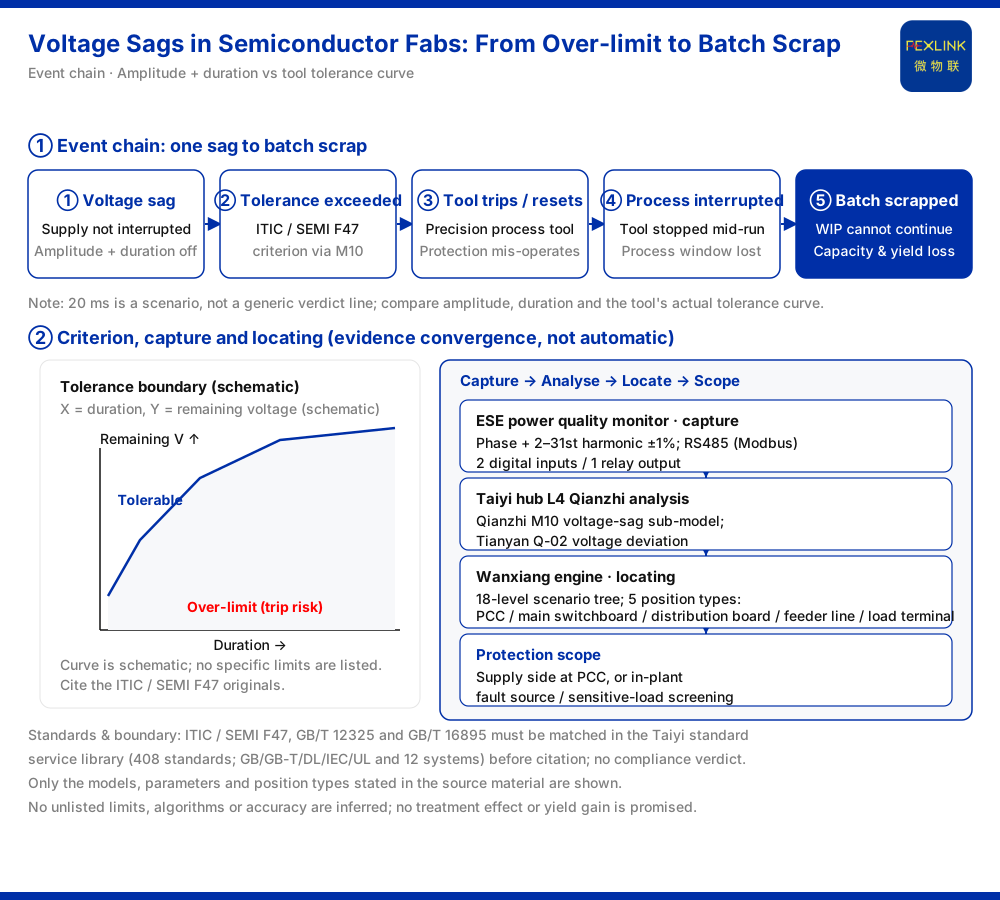
What scraps a whole wafer batch is not the number "20 ms" itself, but that the sag's magnitude and duration fall outside the process equipment's withstand curve. Semiconductor equipment has explicit tolerance boundaries for supply voltage, commonly expressed with curves such as ITIC / SEMI F47; once a sag exceeds what the equipment can tolerate, it stops, resets, or misoperates, and wafers interrupted mid-process can often only be scrapped as a whole batch. In the knowledge base, the capability directly corresponding to sags is the voltage sag submodel (M10) within the Qianzhi engine / large model, whose criterion cites ITIC / SEMI F47; the knowledge base gives no specific curve values, so this article lists no sag limits. What follows covers why sags are amplified in fabs, why 20 ms cannot support a conclusion alone, how to capture and locate a sag, and in what order to set the protection scope.
1. Why One Sag Becomes a Whole-Batch Scrap
A voltage sag is a short-term drop of supply voltage RMS well below nominal. Unlike an outage, supply is not fully interrupted, but the voltage seen by equipment is already outside its normal operating range. Ordinary lighting or non-continuous loads may not notice it; precision process equipment can be driven straight into protection.
Equipment tolerance is not a fixed threshold but a boundary that varies with time. The ITIC / SEMI F47 curves cited by the Qianzhi voltage sag submodel express the voltage deviation equipment can withstand as a function of duration: the deeper and longer the sag, the more likely the boundary is crossed. Whether a sag is fatal therefore depends on magnitude and duration together.
A semiconductor line is also a continuous process. If a step is running partway and a disturbance stops or resets the tool, work-in-process loses the conditions needed to continue. The same sag that is only a record in ordinary distribution can thus involve multiple tools in a fab and be amplified into a whole-batch scrap.
2. 20 ms Is Not a Verdict: Limits Must Go Back to the Standard
The 20 ms in the title poses the question; it is not a verdict line. What decides a stop is the comparison between the tool's position on its withstand curve and the sag measured on site. At equal duration a different residual voltage can reverse the conclusion; at equal residual voltage a different duration can too.
The knowledge base is restrained here: it includes voltage sags in the power-quality health-check submodel (M10) of the Qianzhi engine with the criterion ITIC / SEMI F47, but does not transcribe the standards' curve values or write any millisecond figure or magnitude as a pass line. This article gives no "how many milliseconds at how many volts stops the tool" numbers. To pin down a limit, return to the cited standard and each tool's actual curve rather than conclude from a single time value.
3. Why Semiconductors Get Their Own Article: The Metric Lands on Yield
Treated as one power-quality indicator, a sag is easily dismissed as an occasional record. Semiconductors warrant a separate article because the consequence ties directly to capacity and yield.
Semiconductors are listed in the knowledge base's applicable industries. In the same system, the four-dimension impact assessment scores safety 0.30, efficiency 0.30, lifespan 0.20, and carbon 0.20, and allows scenario-adjusted dynamic weights, with factory efficiency at 0.40 in the factory scenario. Applying that to a fab is simple: an unexpected stop costs the tool's runtime plus work-in-process scrap, requalification, and downstream scheduling disruption.
This article therefore narrows to fabs: why equipment is sensitive, how a sag's attribution is judged, and who bears the protection scope. Only translated into yield and responsibility is the metric useful to facility and electrical engineers.
4. How a Sag Is Captured
Turning a sag from "heard about afterwards" into an analyzable event needs device-side acquisition and platform-side analysis.
Device side: the ESE power-quality monitor (ESE-22111~22161-R) shares its architecture with the three-phase unbalance monitor, adds harmonic monitoring on top of phase monitoring, covers the 2nd~31st harmonics at ±1% accuracy, and provides RS485 (Modbus) plus 2 digital inputs and 1 relay output — parameters given verbatim in the knowledge base; no unlisted metrics such as sampling rate or sag trigger thresholds are added here.
Platform side: the Taiyi intelligent control hub system runs a seven-level pipeline — L1 ingest, L2 cleaning, L3 standard validation (red-line pre-check), L4 Qianzhi analysis (50 submodels in parallel, about 800 ms), L5 Wanxiang assessment, L6 fusion decision, L7 persistence — end-to-end under 2 seconds. M10 sits in the L4 Qianzhi layer; the knowledge base gives its position and criterion source but not its algorithm or limit tables, so this article does not expand its internal logic.
5. Grid Side or In-Plant: Locate Before You Remediate
Once a sag is recorded, responsibility and scope follow: supply side, or an in-plant fault or large-load switching?
The knowledge base offers locating capabilities. The Qianzhi engine answers what is abnormal, its health check including M10; the Q power-quality section of the Tianyan engine / large model includes the voltage deviation model (Q-02) among its P0 first-release models; the Wanxiang engine provides location awareness and an 18-level scenario location tree, maintaining independent thresholds and risk models for 5 electrical topology position types — PCC, main switchboard, distribution board, feeder line, and load terminal. Aligning the event with these locations moves the conclusion from "a sag occurred" to "which segment and which side."
A boundary stands: the knowledge base gives no complete automatic responsibility-determination process and no in-plant/grid discrimination thresholds. Location is therefore evidence-gathering — synchronized observation at key nodes such as the PCC, then layer-by-layer elimination using standard clauses and on-site topology.
6. How to Define the Protection Scope
Protection scope should follow the location result, not the reverse.
If evidence points to the supply side, remediation and responsibility demarcation focus near the point of common coupling, and access conditions must be negotiated with the utility. If in-plant, work returns to fault sources and sensitive loads such as large-load switching or circuit faults. Either way, standard clauses must be matched in the Taiyi standard service: the knowledge base records a built-in library of 408 standards covering 12 systems including GB, GB-T, DL, IEC, and UL, with automatic clause matching and non-relaxable red lines. ITIC / SEMI F47, GB/T 12325, and GB/T 16895 should all be matched there before citation.
One further boundary: the knowledge base records no empirical effect of sags eliminated after remediation or yield improved by any amount. This article promises no scrap avoidance from installing a device; effectiveness depends on location accuracy and on the match between the tool's actual withstand curve and the on-site sag distribution, all to be verified by the project.
7. Common Misreadings
First, treating 20 ms as a universal verdict line, ignoring magnitude and equipment differences. Second, taking the ITIC / SEMI F47 limits the knowledge base does not transcribe as thresholds the product supports. Third, looking only at depth and not duration, or only at one event and not frequency and background. Fourth, substituting general power-quality indicators for the equipment's withstand curve. Fifth, skipping location and buying remediation equipment directly, mismatching responsibility boundary and target. Separating these five moves a sag from a heard-of risk to an event that can be located, demarcated, and verified.
8. Scope and Limitations
First, all facts are drawn from the knowledge base. Second, the knowledge base includes the Qianzhi voltage sag submodel (M10) and notes its criterion as ITIC / SEMI F47, but gives no curve values for these standards, so this article lists no sag duration, residual voltage, or withstand thresholds; where a limit is needed, it must return to the standard text and equipment manuals. Third, this article does not infer the specific algorithms, trigger conditions, or accuracy of M10 or Q-02. Fourth, product parameters are limited to the knowledge base: the ESE power-quality monitor provides phase and 2nd~31st harmonic monitoring (accuracy ±1%), RS485 (Modbus), 2 digital inputs, and 1 relay output; no unlisted metrics are added. Fifth, citation of standard clauses holds only after matching in the 408-standard library of the Taiyi standard service; this article makes no compliance determination. Sixth, no remediation effect or yield benefit is promised, and certification and effectiveness conclusions must be confirmed by the vendor and the specific project.