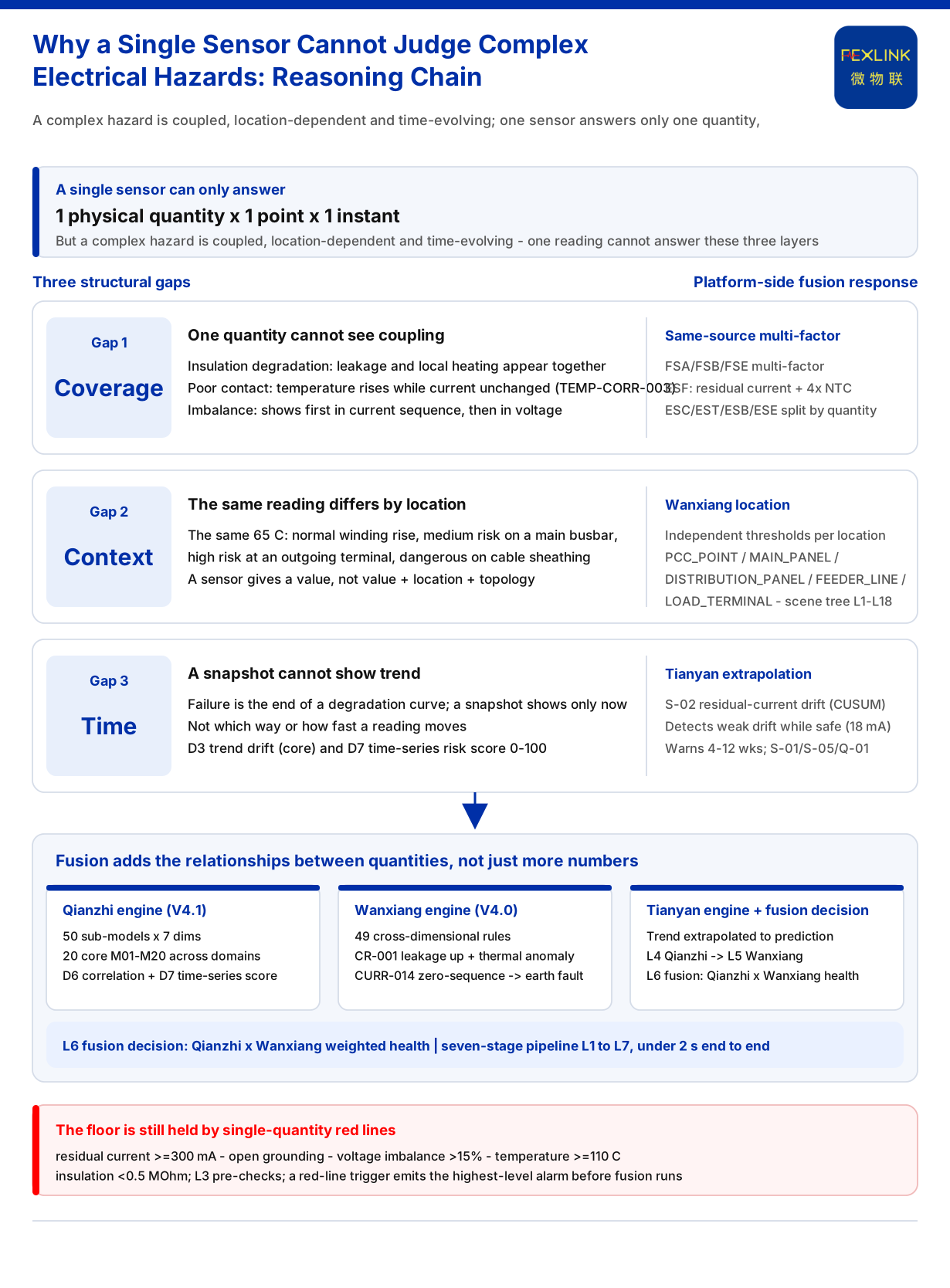
On a distribution site a common intuition says: install sensors at key points, alarm on abnormal readings, and hazards will be seen. In practice the problem is rarely too few alarms; it is that they are unclear. Should a 65 °C reading be acted on? Is 18 mA of residual current a problem? Is a slightly low voltage on one feeder a precursor? A single sensor's single number cannot answer reliably. The reason is not insufficient sensitivity: a complex electrical hazard is a coupled, location-dependent, time-evolving object, while one sensor answers only for one physical quantity, at one point, at one instant.
1. Gap One: Coverage — One Quantity Cannot See Coupling
Complex hazards are seldom an isolated over-limit on one quantity; they are several quantities drifting together or in sequence. Insulation degradation may show up at once as rising leakage and local heating; three-phase load imbalance appears first in current sequence components, then propagates to voltage imbalance and neutral-line heating; poor contact shows up as "rising temperature with current essentially unchanged." A temperature sensor alone sees the temperature rise but not whether leakage moved with it — so the cause cannot be judged.
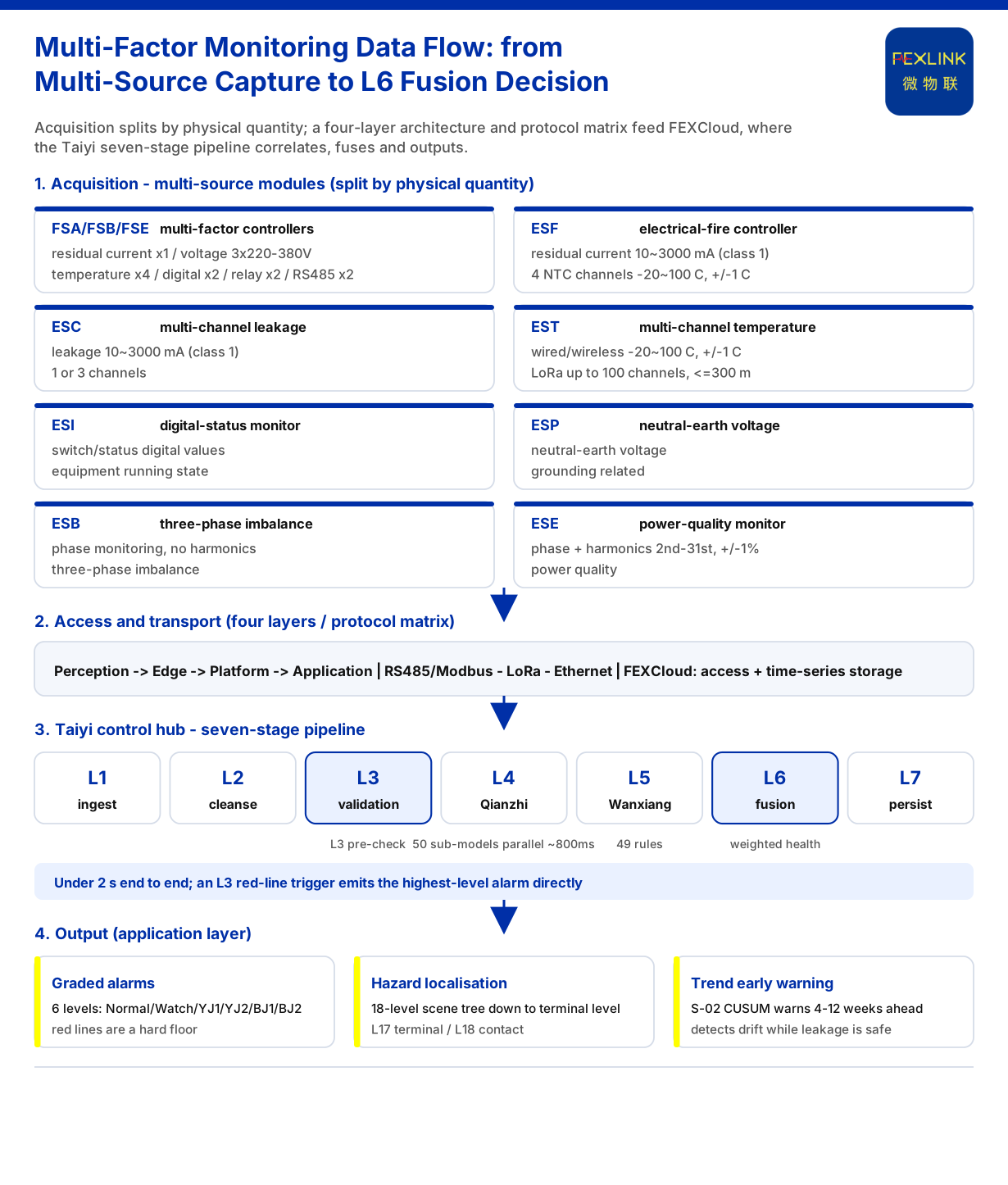
The knowledge base product line is itself a response to this need. The FSA/FSB/FSE multi-factor electrical controllers integrate one residual-current channel, 3×220/380 V voltage, four temperature channels, two digital inputs, two relay outputs, metering and two RS485 ports (Modbus), tiered as FSA (basic metering), FSB (phase) and FSE (phase plus harmonics). The ESF electrical-fire controller captures residual current (10~3000 mA, class 1 accuracy) and four NTC temperature channels (-20~100 °C, ±1 °C) together. Multi-factor means same-source, same-time correspondence at acquisition, not stacked devices.
2. Gap Two: Context — The Same Reading Means Different Things in Different Places
Even with a correct value, a single sensor cannot answer what that value means at that location. The same 65 °C may be normal winding rise on a transformer, medium risk on a main busbar, high risk at an outgoing terminal, and dangerous on cable sheathing. The Wanxiang location awareness is designed for this: it keeps independent thresholds and risk models for five topology location types (PCC_POINT/MAIN_PANEL/DISTRIBUTION_PANEL/FEEDER_LINE/LOAD_TERMINAL) and uses an 18-level scene tree L1-L18 for terminal- or contact-level alarm localisation. A single sensor gives a value; fusion gives the value plus location and topology.
3. Gap Three: Time — A Snapshot Cannot Show Trend
Failure is usually not instantaneous: it is the end point of a degradation curve. A snapshot shows only "now," not "which way and how fast." the seven-dimensional perception matrix makes this explicit: D1 amplitude, D2 rate of change, D3 trend drift (core), D4 anomaly density, D5 fluctuation amplitude, D6 cross-quantity correlation, D7 time-series risk score; D3 and D7 carry the trend a single reading cannot. The Tianyan engine extrapolates further: S-02 residual-current trend drift uses CUSUM to detect a weak mean shift while leakage is still safe (for example 18 mA), warning 4-12 weeks ahead, while S-01, S-05 and Q-01 model resistive-leakage separation, three-phase imbalance and harmonic responsibility attribution.
4. What Fusion Adds Is Relationships, Not Just More Numbers
What multi-sensor fusion really supplies is the relationships between quantities, in three verifiable layers on the platform side.
The first is the Qianzhi engine (V4.1): 50 parameter sub-models (currently 20 core, M01-M20) × seven-dimensional perception, spanning basic vital signs (voltage, current, temperature, leakage, grounding), power-quality checks (harmonics 2nd-50th plus THD, voltage/current imbalance, power factor, sags, fluctuation, inter-harmonics) and deep-hazard mining (resonance risk, insulation state, partial discharge, zero-sequence current, negative-sequence components, flicker synthesis). One dataset is split across domains, then combined by D6 correlation and D7 time-series risk scoring.
The second is the Wanxiang engine (V4.0): 49 cross-dimensional correlation rules across five domains link several quantities, for example, a CR-series rule links leakage up plus temperature anomaly to combined insulation degradation; a TEMP-CORR-series rule links temperature rise with unchanged current to increased contact resistance; a VOLT-series rule links high harmonics with reactive compensation to resonance risk; a CURR-series rule links sustained zero-sequence current to single-phase earth-fault tracing; and a PQ-series rule links simultaneous THD and power-factor deterioration to harmonics disturbing reactive power. None comes from a single quantity; each comes from the relation between two or more.
The third is the Tianyan engine and fusion decision. The seven-stage pipeline runs L1 ingest, L2 cleansing, L3 standard validation (red-line pre-check), L4 Qianzhi analysis (50 sub-models in parallel, about 800 ms per round), L5 Wanxiang assessment, L6 fusion decision (Qianzhi × Wanxiang weighted health) and L7 persistence, end to end in under 2 seconds. As background, the integrated analysis model gives a dynamic weight engine W(t)=W_static×W_context×W_coupling×W_trend and a sigmoid_plus risk function over 238 dimensions (an internal record).
5. The Floor Is Still Held by Single-Quantity Red Lines
Fusion does not deny the value of single-quantity thresholds. In the six-level alarm scheme (normal 85-100, Watch 70-84, YJ1 55-69, YJ2 40-54, BJ1 20-39 to act within 48 h, BJ2 0-19 for immediate shutdown), the five non-bypassable red lines are themselves single-quantity conditions: residual current ≥300 mA (GB 13955), abnormal open grounding resistance (GB 50057), three-phase voltage imbalance >15% (GB/T 15543), line temperature ≥110 °C (GB 16895), insulation resistance <0.5 MΩ (GB/T 16895). Red lines block the safety floor before fusion runs; an L3 trigger emits the highest-level alarm directly, and fusion handles the region below the red lines that a single reading cannot explain. The harmonic fingerprint library matches 14 device fingerprints at cosine similarity >0.85 within 2 hours, so multiple quantities plus fingerprint point to a source better than a single amplitude.
6. Engineering Shape: How Multiple Sources Come In
At the acquisition end, different modules carry different quantities: the ESC multi-channel leakage controller (10~3000 mA); the EST multi-channel temperature controller (wired NTC and wireless active both -20~100 °C, ±1 °C, LoRa up to 100 channels); the ESI digital-status monitor; the ESP neutral-earth voltage monitor; the ESB three-phase imbalance monitor; the ESE power-quality monitor (phase plus 2nd-31st harmonics, ±1%). These feed FEXCloud through the four-layer architecture (perception, edge, platform, application) and the protocol matrix, where the platform side performs correlation and fusion — layered acquisition, unified access and platform-side correlation together, not one "super-sensor."
7. Boundaries: What This Article Does Not Claim
First, "a single sensor struggles to judge complex electrical hazards and multi-sensor fusion is necessary" is this article's organising methodology.
Second, the quantitative indicators (electrical-hazard identification 95%+, alarm compression 80%, 4-12 weeks' warning lead, MTTR reduced 60%) are vendor self-reports; cite them only as vendor capability claims. The 238-dimension model and case data are likewise internal records.
Third, no implementation is given for sensor siting and installation, sampling and reporting frequency, offline caching and backfill, or alarm-ticket grading; no customer case, certification or handling effect is claimed; no model, parameter or clause absent from the knowledge base is invented. Only the GB 13955, GB 50057, GB/T 15543, GB 16895 and GB/T 16895 numbers listed in the knowledge base are cited, without inferring their content.
Fourth, this article covers only the single-sensor-limitation and fusion-necessity landing point and does not absorb others: voltage, current, leakage trend, temperature and poor contact, pre-failure intervention and condition diagnosis are not developed here, and no legacy wording is reused.
Conclusion
A single sensor struggles to judge complex electrical hazards because it answers only for one physical quantity, one point and one instant, while a complex hazard is a coupled, location-dependent, time-evolving object — hence the three structural gaps of coverage, context and time. The fix is not more isolated sensors but making multiple factors same-source at acquisition, building relationships on the platform side, and closing with the L6 fusion decision, while keeping the red lines as a non-bypassable single-quantity floor. Understanding "why one point is not enough and what fusion adds" is what lets a hazard be judged clearly and located accurately before it propagates into failure.