A residual-current device trips after leakage risk has already reached the operating condition — not at the moment the risk first appears. To watch only trips is to see only the tail of the curve. More useful for early warning is how leakage behaved before the trip: was it creeping upward, were its fluctuations becoming regular, did it track humidity or load, and how long did the anomaly last? This article answers three questions: why leakage is a slow variable, what a trend should look at, and how "reading the trend" holds up at product and platform level.
1. A trip is a result, not a starting point
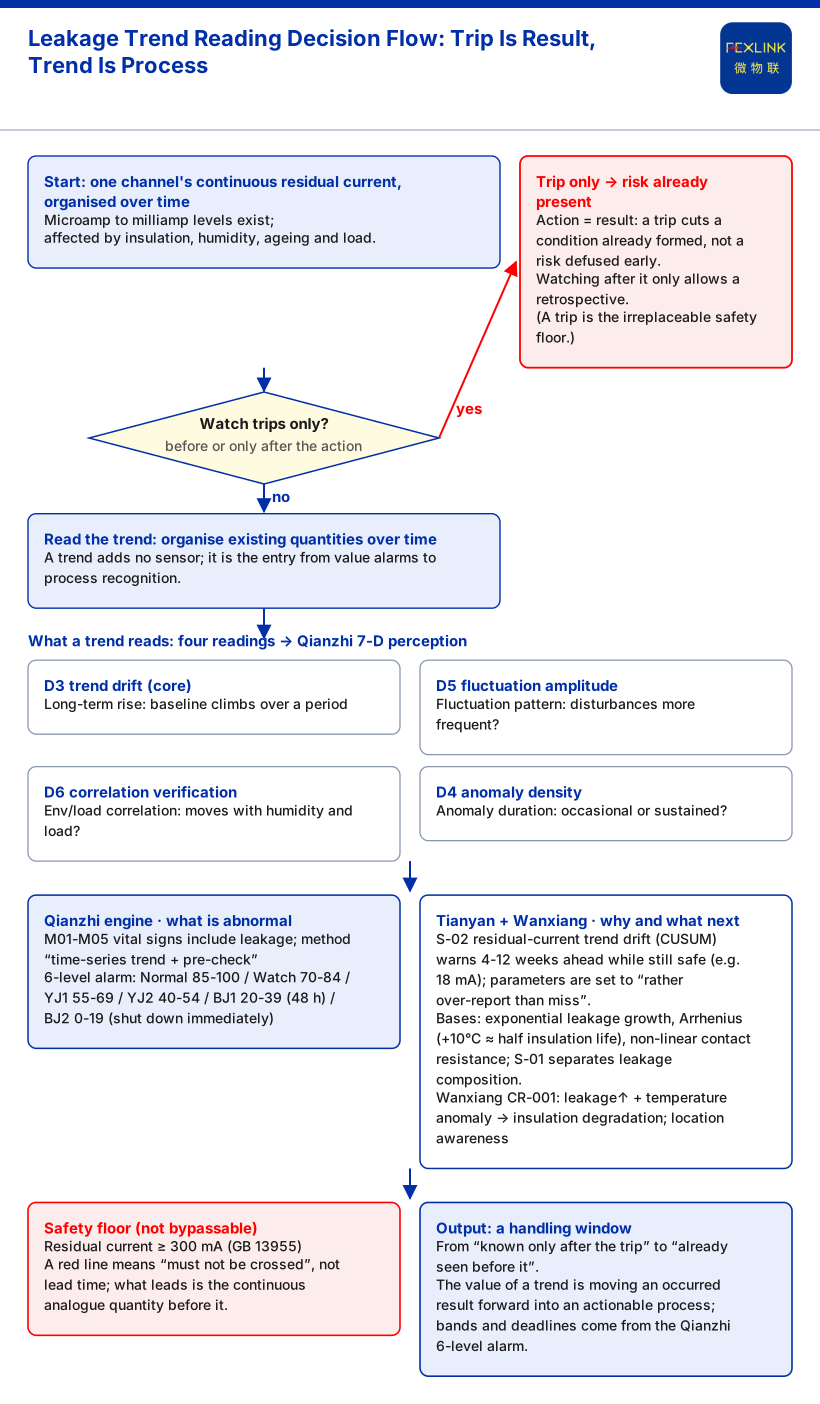
That residual-current devices, residual-current-operated protective devices and air-circuit breakers act when a limit is exceeded or a fault occurs is the irreplaceable floor of the safety chain. But the action itself means the risk has already "arrived": a trip cuts off a condition already formed rather than defusing a risk not yet formed. Observation after the trip is only a retrospective; before it, there is a handling window.
The knowledge base states the floor plainly through its red lines: residual current ≥ 300 mA (GB 13955), together with abnormal open-circuit grounding resistance, three-phase voltage imbalance, line temperature and insulation resistance, forms five red lines that may not be bypassed. A red line means "must not be crossed", not lead time; what can actually lead is the continuous analogue quantity before it.
2. Leakage is not a static number
Leakage is often handled as an instantaneous reading, but it is a continuous quantity that changes with operating conditions. The product ranges in the knowledge base themselves show several levels:
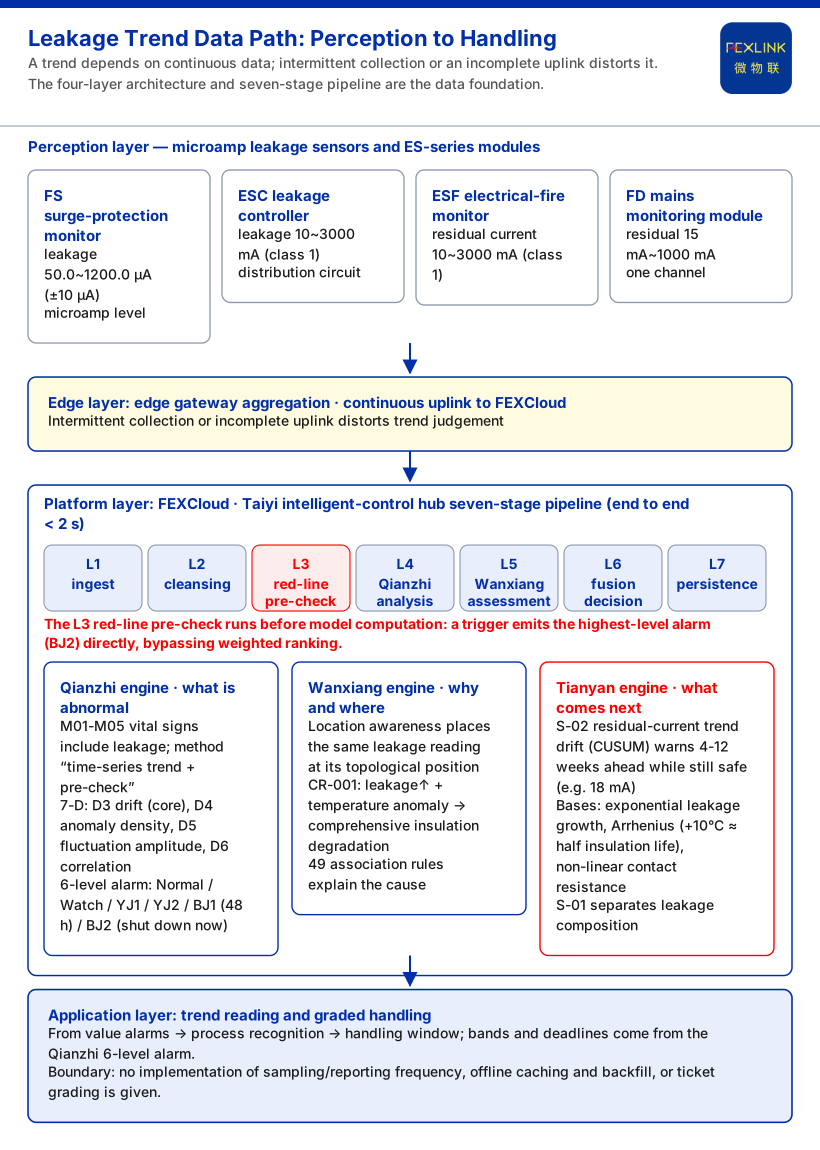
On the surge-protection side, the FS surge protective device monitor's leakage-current range is 50.0~1200.0 μA (±10 μA), at the microamp level; on the distribution-circuit side, the ESC multi-channel leakage controller monitors 10~3000 mA (class 1 accuracy), the ESF electrical-fire controller has the same 10~3000 mA residual current (class 1 accuracy), and the FD mains (residual-current) monitoring module provides one residual-current channel of 15 mA~1000 mA. From microamps to milliamps, the observation scale and application scenario differ.
Leakage changes because multiple factors act on it: insulation state, ambient humidity, equipment ageing, wiring quality and load characteristics. The knowledge base records that the Tianyan engine lists "exponential leakage-growth patterns" among the theoretical bases for predictive analysis, among the Wanxiang engine's 49 association rules, a CR-series rule directly gives the combined clue "leakage↑ + temperature anomaly → comprehensive insulation degradation". These entries point to one engineering fact: leakage tends to rise slowly and then accelerate, and a single-point reading cannot show which part of the curve it is on.
3. What exactly a trend should look at
"Reading the trend" does not end with drawing the numbers as a line. Combined with the Qianzhi engine's seven-dimensional perception matrix in the knowledge base, a leakage trend contains at least several distinguishable readings: first, long-term rise, a baseline climbing over a period; second, fluctuation pattern, whether amplitude disturbances become more frequent; third, environmental and load correlation, whether the reading moves together with humidity and load; fourth, anomaly duration, whether the deviation from normal is occasional or sustained. These correspond to D3 trend drift (core), D4 anomaly density, D5 fluctuation amplitude and D6 correlation verification.
From a single reading, a short fluctuation may be no more than normal disturbance; only by organising the same leakage channel over time does its "direction" become visible. A trend adds no sensor; it reads existing quantities over time — the entry from "value alarms" to "process recognition".
4. From value to trend: what Qianzhi and Tianyan each read
The Qianzhi engine answers "what has become abnormal". Among the 20 specialist sub-models, the basic vital signs M01-M05 explicitly include leakage, with the method "time-series trend + pre-check". Leakage must therefore both be read as a trend over time and be aligned in real time with the floor. On top of this sits the six-level alarm scheme — Normal (85-100), Watch (70-84), YJ1 (55-69), YJ2 (40-54), BJ1 (20-39, handle within 48 h), BJ2 (0-19, shut down immediately) — where each band maps to a different handling timescale.
The Wanxiang engine answers "why and where". Through location awareness and association rules, it places the same leakage reading on a specific topological position and explains the cause with combined rules such as the CR series.
The Tianyan engine answers "what comes next". Its signature model, S-02 residual-current trend drift (CUSUM), can detect a weak mean shift while leakage is still in the safe range (for example 18 mA), warning 4-12 weeks ahead, with a parameter strategy of "rather over-report than miss". Its theoretical bases include, besides exponential leakage growth, the Arrhenius equation (a +10 °C rise roughly halves insulation life) and the non-linear growth curve of contact resistance; the S-01 resistive-leakage separation in the same block is used to distinguish the composition of leakage.
The division of labour between Qianzhi's seven dimensions and Tianyan's S-02 is clear: the former answers "how far off is it now, and in which direction", the latter "how long can it hold at this trend, and when should action be taken".
5. For a trend to hold, the data path is the premise
A trend depends on continuous data; if collection is intermittent and the uplink incomplete, any trend judgement is distorted. The knowledge base defines the monitoring system as a four-layer architecture — perception, edge, platform, application — where the perception layer includes microamp-level leakage sensors and ES-series monitoring modules, and data is uplinked through the edge gateway to the FEXCloud platform layer. The Taiyi intelligent-control hub's seven-stage pipeline (L1 ingest → L2 cleansing → L3 red-line pre-check → L4 Qianzhi analysis → L5 Wanxiang assessment → L6 fusion decision → L7 persistence) runs end to end in under 2 seconds, and an L3 red-line trigger emits the highest-level alarm directly. With a stable path, a leakage trend is not a curve pieced together after the fact.
6. Boundaries: what this article does not claim
Second, the quantitative value indicators (such as electrical-hazard identification 95%+, alarm compression ratio 80%, warning lead time 4-12 weeks, fault-localisation time days→2 hours, MTTR −60%) are all vendor self-reports; they may be cited only as vendor capability claims.
Third, the "90% of charging fires stem from undetected hazards" and the 238-dimension integrated model are likewise internal records, and serve only as background.
Fourth, no implementation is given for sampling and reporting frequency, offline caching and backfill, or alarm-ticket grading; no customer case, certification or effect is claimed; no model, parameter or standard clause absent from the knowledge base is invented. Only the GB 13955, GB 50057, GB/T 15543, GB 16895 and GB/T 16895 designations listed in the knowledge base are cited, without inferring clause content.
Fifth, this article covers only "leakage"; it does not take the voltage, current or temperature landing points, nor repeat the general case for handling hazards before failure. Its sole landing point is "why leakage must be read as a trend, not only as a trip".
Conclusion
To see only trips compresses leakage risk into an action that has already happened; to read the trend accepts that leakage is a slow variable and reads how it rises, fluctuates, correlates and persists. Use FS to cover microamp-level leakage current, ESC, ESF and FD to cover milliamp-level residual current, Qianzhi's seven-dimensional perception and M01-M05 leakage sub-models to read the trend, and to guard the floor; then use Tianyan S-02 to move the warning 4-12 weeks ahead. All of this becomes an actionable judgement through the four-layer architecture and the seven-stage pipeline. The value of a trend is to turn "known only after the trip" into "already seen before the trip".