Electrical failures rarely appear out of nowhere. Burnt equipment, tripped lines, smoke in a cabinet, an overheating socket, even a fire — in engineering terms these are often the end point of a degradation process. Waiting for failure is not a safety slogan: by the time it happens, equipment damage, downtime and fire risk have usually formed, and the room to act has shrunk to a minimum. Hazards are worth handling early because before that end point they leave continuously observable traces: rising leakage current, climbing temperature, harmonic distortion, trend drift. This article answers why these traces can be monitored, why they are worth acting on before failure, and what "early" actually rests on.
1. Failure Is the End Point; the Hazard Is Already "Drawing a Curve" Before It
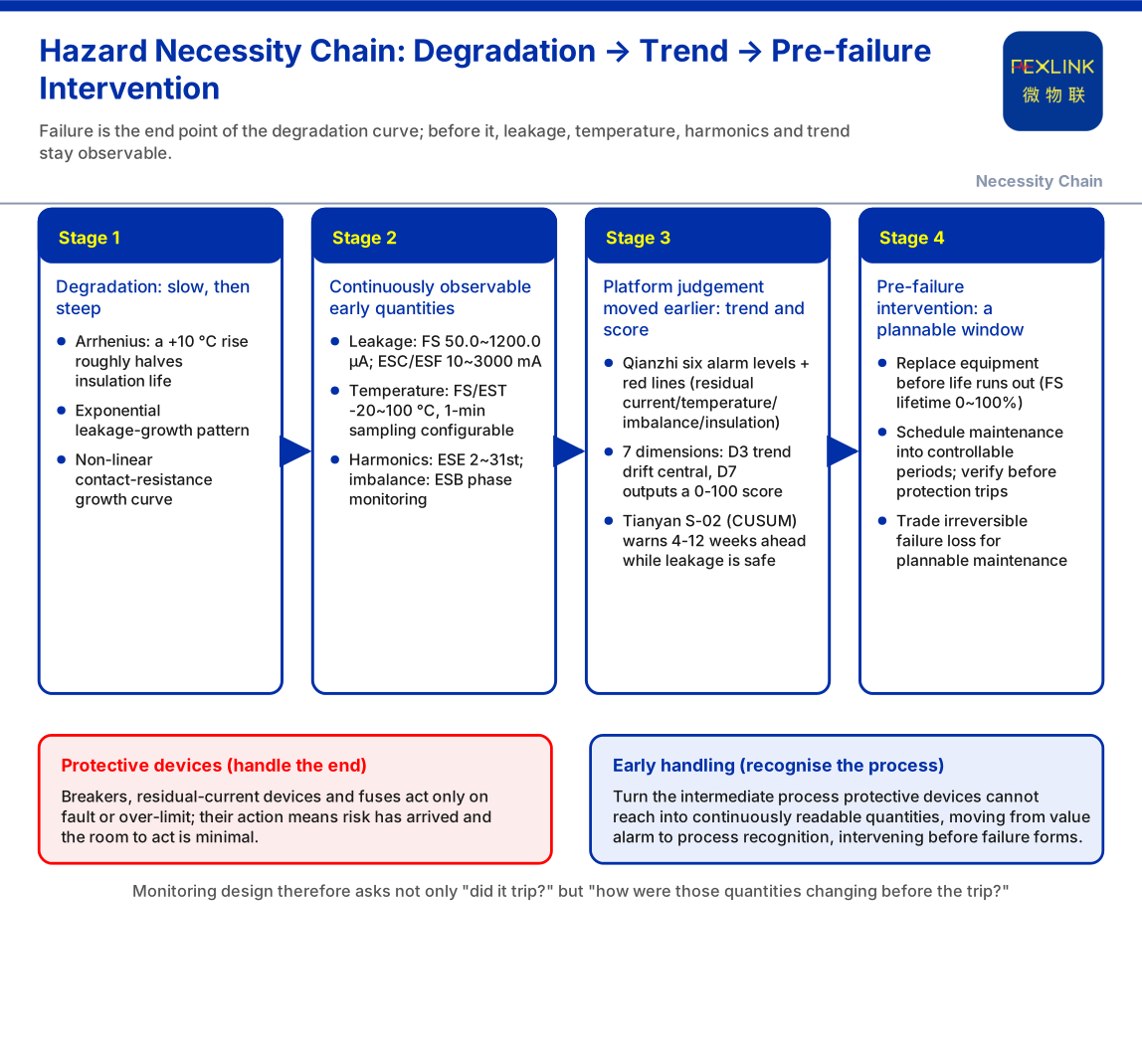
Conventional maintenance sees results. But degradation is not instantaneous: the knowledge base records three theoretical bases for the Tianyan engine's predictive analysis — the Arrhenius equation (a +10 °C rise roughly halves insulation life), an exponential leakage-growth pattern, and a non-linear contact-resistance growth curve. Their shared meaning: degradation tends to be slow first and then accelerate. Discover it only in the steepest final segment and the handling window is already compressed; move observation forward to the flat part of the curve and there is time to act rather than scramble.
The knowledge base, in the charging-safety scenario, also records that "90% of charging fires stem from undetected hazards," and the integrated intelligent analysis model for electrical hazards supports 238-dimension parameter assessment. Both are internal records, yet they point in one direction: an observable accumulation process lies between a hazard and a fire.
2. Protective Devices Handle the "End"; Early Handling Watches the "Process"
Circuit breakers, residual-current devices and fuses act on fault or over-limit conditions; they are the safety chain's floor and irreplaceable. But when they act, risk is usually already at or near the threshold — protection operating means risk has "arrived." What can genuinely move earlier is turning the intermediate process that protective devices cannot reach into a continuously readable quantity. That requires monitoring the physical quantities that appear during degradation, not tracing back only after a trip. Monitoring design should therefore ask not only "did it trip?" but "how were those quantities changing before the trip?"
3. Four Early Quantities That Can Be Continuously Observed
The knowledge base gives explicit products and parameter ranges — precisely what makes "early" feasible.
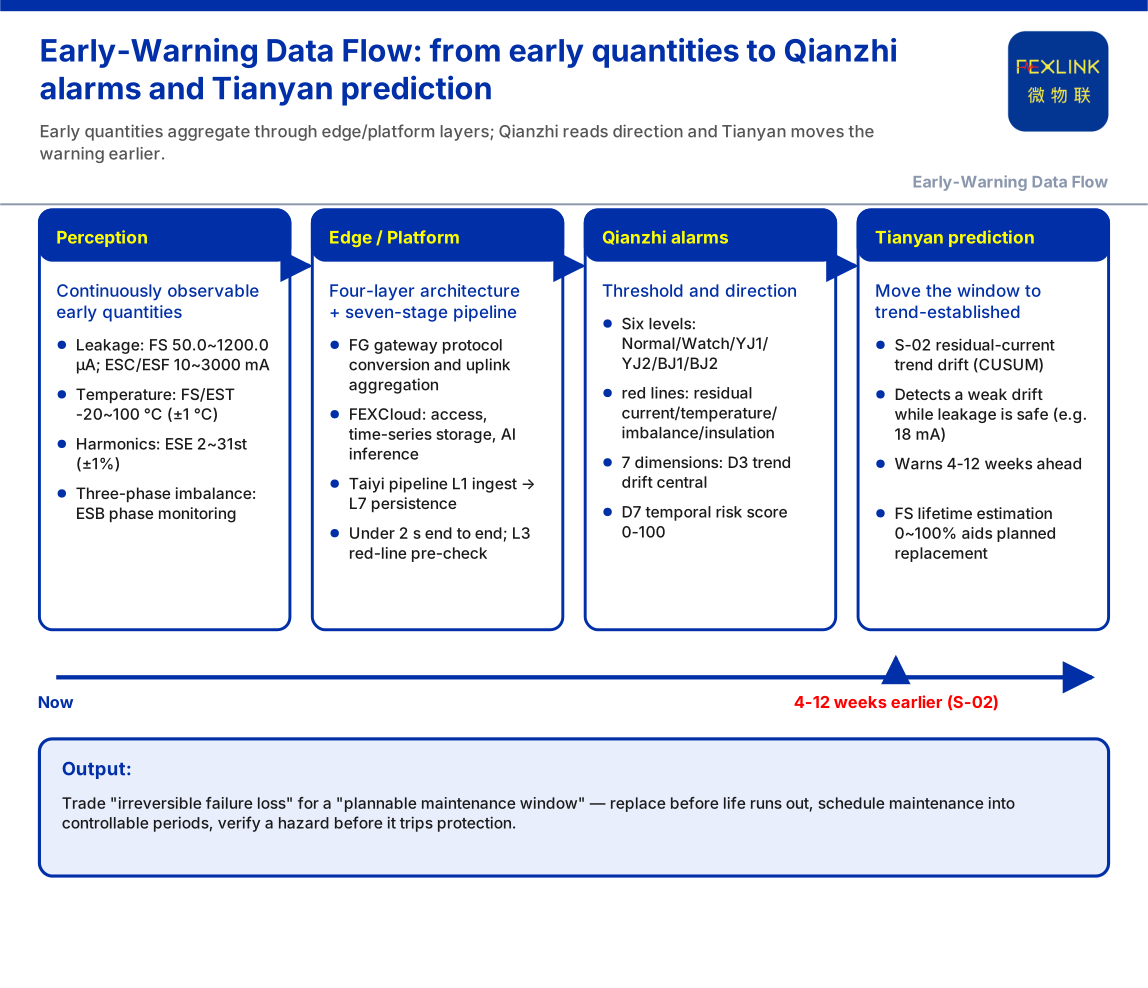
Leakage current (residual current): the FS surge protective device monitor covers 50.0~1200.0 μA (±10 μA); the ESC multi-channel leakage controller monitors 10~3000 mA (class 1 accuracy); the ESF electrical-fire controller uses the same 10~3000 mA residual current (class 1 accuracy). Rising leakage is often tied to insulation decline, damp or grounding faults, and as a continuous analogue quantity it suits trend reading.
Temperature: FS covers -20~100 °C (±1 °C); the EST multi-channel temperature controller uses wired NTC and wireless active sensing, both -20~100 °C (±1 °C), with wireless LoRa up to 100 channels, a configurable 1-min sampling period and a working distance of no more than 300 m; ESF likewise carries NTC sensing. Temperature commonly accompanies poor contact, loose terminals and oxidation; a slow climb deserves more caution than a momentary high.
Harmonics and three-phase imbalance: the ESE power-quality monitor adds harmonic monitoring to phase monitoring (2nd–31st harmonics, ±1% accuracy); the ESB three-phase imbalance monitor provides phase monitoring. These quantities reflect hazard clues at the load and supply-quality level; a single reading may simply be normal fluctuation.
Trend: any single point above may be mere disturbance; only linking those points into a time series reveals "drift." Trend is not a new sensor but a way of organising existing quantities over time, and the entry from "value alarm" to "process recognition."
4. From "Single-Point Thresholds" to "Trend and Score"
Instantaneous thresholds alone make early handling hard to justify: a short voltage dip need not be dangerous, and a current surge may be a normal start. The Qianzhi engine offers two layers. One is the non-bypassable red line: residual current ≥300 mA (GB 13955), three-phase voltage imbalance >15% (GB/T 15543), line temperature ≥110 °C (GB 16895), insulation resistance <0.5 MΩ (GB/T 16895). The other is seven-dimensional perception, in which D3 trend drift is central and D7 outputs a 0-100 time-series risk score. The former guards the floor that must not be crossed; the latter measures distance from it and direction of travel.
An even earlier layer comes from the Tianyan engine: S-02 residual-current trend drift (CUSUM) detects a weak mean shift while leakage is still safe (for example 18 mA) and warns 4-12 weeks ahead. Its value is not a louder alarm but moving the decision window from "near threshold" to "trend established." Correspondingly, the six-level alarm scheme splits urgency across time scales: normal 85-100, Watch 70-84, YJ1 55-69, YJ2 40-54, BJ1 20-39 (act within 48 hours), BJ2 0-19 (immediate shutdown). The earlier the band, the more room to act — the direct meaning of early handling.
5. What "Early" Means in Engineering Terms
The benefit of early handling is converting irreversible failure loss into a plannable maintenance window: replace equipment before life runs out, schedule maintenance into controllable periods, verify a hazard before it trips protection. The FS provides lifetime estimation of 0~100%; the predictive analysis answers "how much longer can this device last, when will it fail, which window should maintenance take". Both point to one thing: giving replacement and maintenance lead time, rather than starting diagnosis only after a shutdown.
The data path is the premise. The knowledge base defines the monitoring system as a four-layer architecture — perception, edge, platform, application; the Taiyi intelligent-control hub's seven-stage pipeline (L1 ingest → L2 cleansing → L3 red-line pre-check → L4 Qianzhi analysis → L5 Wanxiang assessment → L6 fusion decision → L7 persistence) runs end to end in under 2 seconds, and an L3 red-line trigger emits the highest-level alarm directly. Taiyi is positioned to move from "repair after the fact" to "foresee before the fact". Without continuous collection and uplink, "early" has no basis.
6. Boundaries: What This Article Does Not Claim
It is not an operating procedure and cannot replace site safety rules.
Second, the quantitative indicators in the knowledge base (electrical-hazard identification 95%+, alarm compression 80%, 4-12 weeks' warning lead, fault localisation from days to 2 hours, MTTR reduced 60%, comprehensive energy savings 8-20%) are vendor self-reports. Cite them only as vendor capability claims, never as effect guarantees, handling deadlines or procurement grounds.
Third, the "90% of charging fires stem from undetected hazards" and the 238 dimensions are likewise internal records; they are background only, not deterministic effect assertions.
Fourth, no implementation is given for sampling and reporting frequency, offline caching and backfill, or alarm-ticket grading; no customer case, certification or handling effect is claimed; no model, parameter or clause absent from the knowledge base is invented. Only the GB 13955, GB 50057, GB/T 15543, GB 16895 and GB/T 16895 numbers listed in the knowledge base are cited, without inferring their content.
Fifth, landing points of registered or planned articles are not reused: the lightning-protection roadmap and the single-quantity topics on voltage, current, leakage, temperature and arc are not developed. This article answers only "why must this be handled before failure" and its monitorable basis.
Conclusion
We cannot wait for failure because failure is only the end point of degradation, and before it leakage current, temperature, harmonics and trend are continuously observable. Cover these quantities with FS, ESC, EST, ESE and ESB; hold the floor and read direction with Qianzhi's red line and seven-dimensional perception; move the warning 4-12 weeks earlier with Tianyan S-02; then turn data into actionable judgement through the four-layer architecture and seven-stage pipeline. The value of early handling is replacing "irreversible failure loss" with a "plannable maintenance window" — the technical basis for electrical safety moving from passive protection to proactive warning.