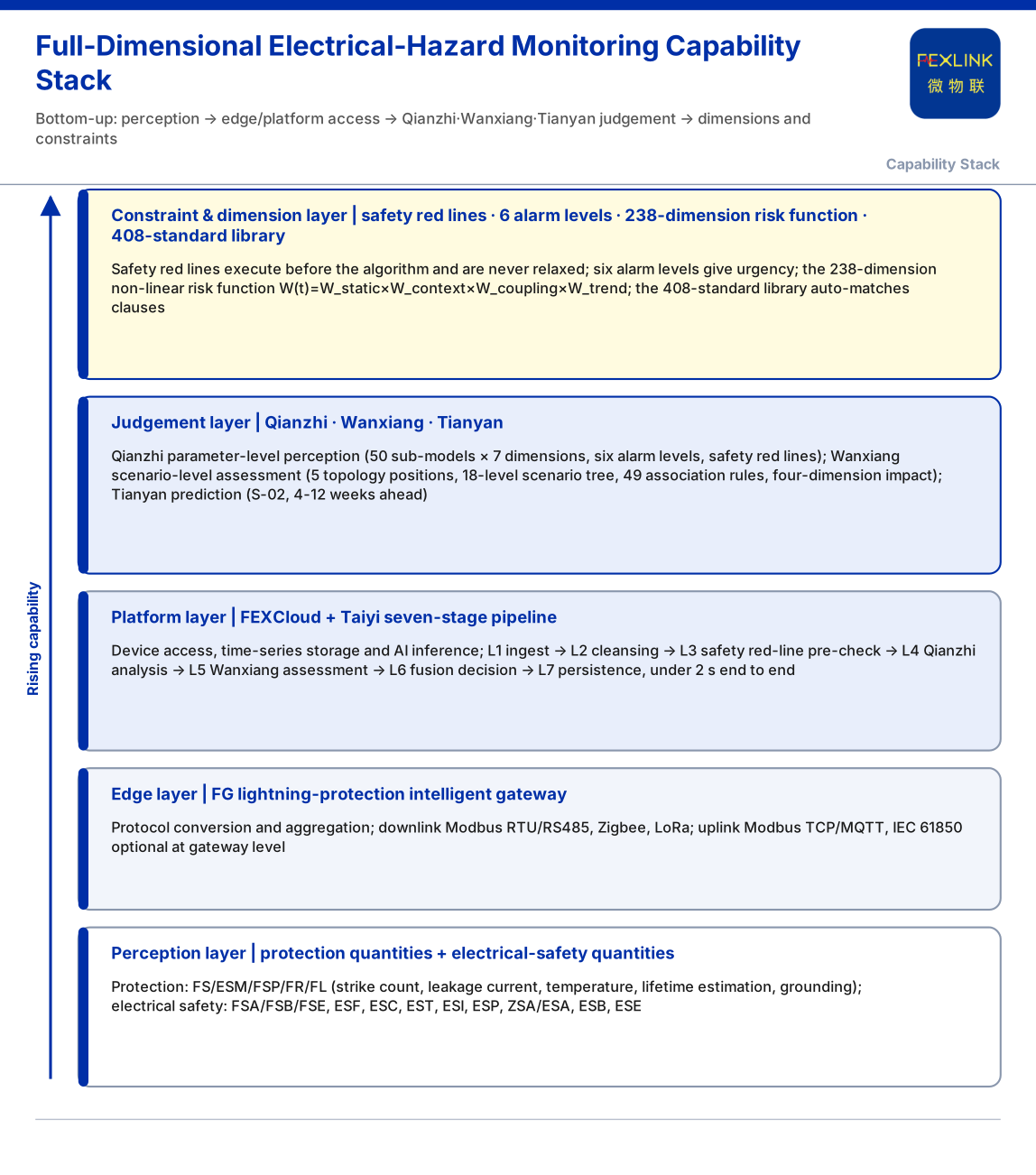
Smart lightning protection matters for more than whether the surge protector still works: it turns high-energy impulses, protective-device state and grounding paths — once invisible — into continuously sampled, uploadable, reviewable engineering data (the knowledge base's FS, ESM, FSP, FR, FL, FG). If the protection layer is already datafied, why should distribution- and consumption-side quantities — leakage, temperature, arc, neutral-to-earth voltage, three-phase imbalance, harmonics — not live in the same monitoring and judgement system? Capability evolves by bringing these multi-dimensional quantities into one framework, ending in "full-dimensional electrical-hazard monitoring".
1. Why lightning protection is the starting point
It handles the hardest class of problem — high-energy impulses, protective state, grounding paths — hardest to trace after an incident, best turned into data in advance.
The event quantity is direct: the knowledge base records the FS strike count as 0~9999 (minimum trigger 0.1 kA), FL-01222 and FL-01212 span 1 kA~120 kA with energy monitoring, while FL-11122 spans 0.1 kA~1 kA. Device state is broader: the FS covers remote signalling, air-switch and grounding status, leakage (50.0~1200.0 μA), temperature (-20~100 °C), voltage (0~400.0 V) and lifetime estimation (0~100%); the ESM is a full-element terminal including humidity, and the FSP provides a remote-signalling input and strike counting. Grounding is the safety floor: the FR-01311 uses the three-electrode method, DC12V and outdoor installation, and gives a system-level grounding-monitoring unit range of 0-200 Ω (standard).
The fourth layer is the data path: the four-layer architecture (perception/edge/platform/application) and the protocol matrix (downlink Modbus RTU/Zigbee/LoRa; uplink Modbus TCP/MQTT; IEC 61850 optional at gateway level) let data aggregate and uplink through the FG gateway. The path already works, giving later expansion somewhere to land.
2. Doing only lightning protection has bounded answers
The protection layer can answer "was it hit, is protection still effective, is the grounding floor intact" — but an electrical incident need not originate in lightning. The digital electricity-consumption and electrical-safety line covers the other set of questions.
The FSA/FSB/FSE split into meter, three-phase-balance and power-quality versions (the latter two adding phase and harmonics), sharing one residual-current channel, 3×220/380 V voltage, four temperature channels, two digital inputs, two relay outputs and two RS485 ports. More specialised: ESF electrical-fire controller residual current 10~3000 mA, class 1 accuracy, NTC -20~100 °C; ESC multi-channel leakage controller, also 10~3000 mA; EST wired and LoRa wireless temperature sensing, up to 100 channels; ESI dry-contact inputs; ESP neutral-line voltage monitoring.
The knowledge base's ZSA/ESA meters, ESB three-phase imbalance monitor and ESE power-quality monitor add metering and power quality, ESE covering 2~31 harmonics at ±1%. Only alongside the protection quantities can one ask whether an anomaly is a lightning consequence, device ageing, load change or a distribution-quality problem.
3. Early warning is not "a few more sensors"
More measurement points only buy visibility, not judgement: a single threshold struggles to separate normal fluctuation, measurement noise and real degradation, and simultaneous small changes are easy to miss. The knowledge base gives the path from "quantity" to "judgement".
The first layer is parameter-level perception: the Qianzhi engine combines 50 parameter sub-models (currently 20 core M01-M20) × 7 perception dimensions with six alarm levels (normal, attention, YJ1, YJ2, BJ1, BJ2) and five red lines — residual current ≥300 mA (GB 13955), grounding-resistance open circuit (GB 50057), three-phase voltage imbalance >15% (GB/T 15543), line temperature ≥110 °C (GB 16895), insulation resistance <0.5 MΩ (GB/T 16895) — each carrying a standard-clause citation and confidence.
The second is scenario-level assessment: the Wanxiang engine adds position awareness, with independent thresholds and risk models for five topology positions — point of common coupling, main distribution panel, distribution panel, feeder line, load terminal — an 18-level scenario tree and 49 cross-dimensional association rules saying "why and where", weighting safety/efficiency/lifetime/carbon by scenario (default 0.30/0.30/0.20/0.20). The same 65 °C is not the same risk in different positions.
The third is prediction: the Tianyan engine plans 61-67 models across four boards S/Q/E/C; S-02 residual-current trend drift (CUSUM) detects a weak drift while leakage is still safe, warning 4-12 weeks ahead; Q-01 follows IEEE 1459; E-01 is non-intrusive load monitoring. Judgement moves from "is it abnormal now" to "when might it become abnormal".
4. What "full-dimensional" actually covers
"Full-dimensional" is not an adjective; it points to institutionalised dimensions. At the risk-function level, the system gives the dynamic weighting engine W(t)=W_static×W_context×W_coupling×W_trend and the sigmoid_plus non-linear risk function, supporting 238-dimensional electrical-parameter assessment; the system converges with Taiyi intelligent control, and the Qianzhi sub-models iterate from it. 238 dimensions expresses how many quantities, in how many contexts, under what couplings take part in judgement.
At the impact level, Wanxiang's four-dimensional assessment gives one anomaly different weights by scenario; at the standard level, the Taiyi standard service offers a 408-standard library (12 systems including GB/GB-T/DL/IEC/UL) and auto-matches clauses, red lines executing before the algorithm and never relaxed. Protection and electrical-safety data are not parallel lines: they share the four-layer architecture and protocol matrix, take the same weights inside the 238-dimension function, and are perceived, assessed and predicted in Qianzhi/Wanxiang/Tianyan — landing on one hazard portrait.
5. Three steps, each with a precondition
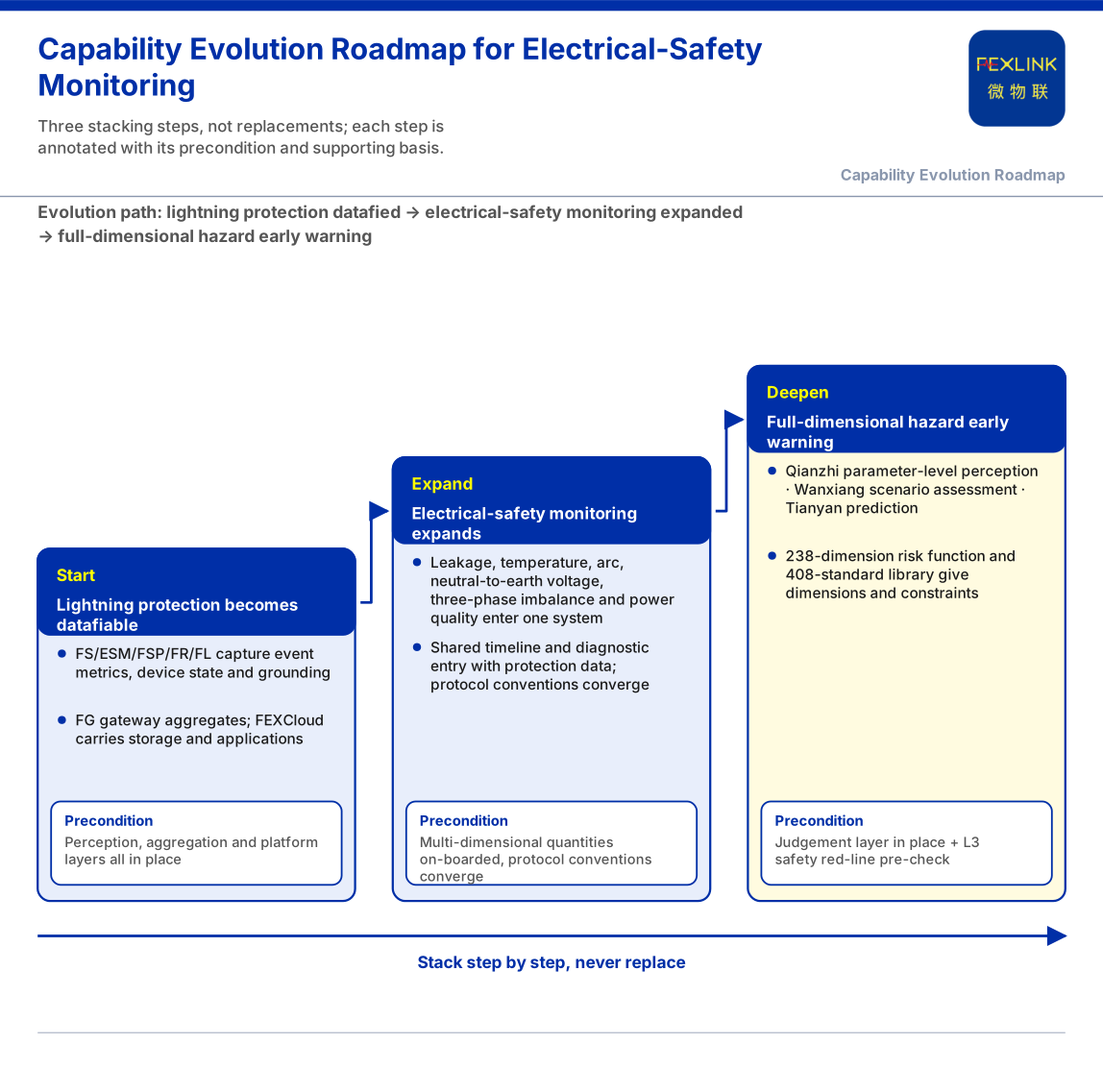
Step one, "lightning protection becomes datafiable": all three layers — perception, aggregation, platform — must be in place: FS/ESM/FSP/FR/FL collect, FG aggregates, FEXCloud carries storage and applications.
Step two, "electrical-safety monitoring expands": the leakage, temperature, arc, neutral-to-earth voltage, three-phase imbalance and power-quality quantities must enter the same system and protocol conventions converge. The point is whether these quantities share one timeline and one diagnostic entry point with the protection quantities.
Step three, "full-dimensional hazard early warning": a judgement layer must be in place — Qianzhi's parameter-level perception and alarm grading, Wanxiang's scenario and association assessment, Tianyan's predictive models, plus the dimensions and constraints from the 238-dimension risk function and the 408-standard library. Taiyi organises these into a seven-stage pipeline (L1 ingest to L7 persistence) targeting under 2 seconds end to end, with L3 the red-line pre-check. Early warning then upgrades from a single-point alarm to a system-level hazard portrait.
6. Where this path lands
This capability is not bound to one industry. In the scenario mapping, substation/traction-substation grounding-grid online monitoring runs on grounding (FR-01311, FG gateway, FEXCloud); low-voltage distribution-cabinet electrical-fire warning runs on residual current and temperature (ESF, ESC, EST); power-quality/harmonic treatment centres on ESE with the Tianyan engine. The electrical-hazard early-warning system focuses on charging safety, covering two-wheel electric and new-energy vehicles. These scenarios share one trait: judgement depends on combining protection and electrical-safety quantities, and on a judgement layer picking them up.
Boundaries: what this article does not claim
The knowledge base gives neither the path nor stage-division criteria, implementation steps or migration path.
Second, the quantitative value indicators (electrical-hazard identification 95%+, alarm compression 80%, warning lead 4-12 weeks, MTTR -60%, etc.) are vendor self-reports; cite them only as vendor capability claims, never as evolution effects, procurement grounds or external commitments.
Third, this article gives no per-stage cost, ROI, deployment volume, migration period or effect data, claims no customer case, certification or standards conformity, and invents no model, parameter or standard clause absent from the knowledge base.
Fourth, it does not reuse other articles' landing points: why failure cannot be waited for, the order of protection versus equipotential/grounding retrofit, or commercial topics such as legacy upgrade, O&M, data visibility, inspection, pricing, profitability, value perception and service models; PV-site drivers, wind-turbine-blade event diagnosis and data-centre integration are scenario specials. This article answers only the cross-scenario capability-evolution path.
Conclusion
Smart lightning protection matters not only because it protects one layer, but because it proves electrical risk can be datafied. Bring distribution- and consumption-side quantities into one framework, let Qianzhi, Wanxiang and Tianyan raise the dimension level by level, and institutionalise the dimensions with the 238-dimension risk function, four-dimensional impact and 408-standard library — then "full-dimensional electrical-hazard monitoring" becomes an explainable goal. The next step is not replacing a system, but letting the starting point already in place keep growing.