Direct Answer
Management is confused by alarm-volume data: many alarms are praised as "sensitive," zero alarms are praised as "well managed" — but both may actually be problems? The answer: both extremes deserve caution — high alarm volume with low effectiveness is usually loose thresholds and missing correlation, not sensitivity; long-term zero alarms require distinguishing true health from sensor failure/data interruption; correct evaluation looks at the "effective alarm rate" and "missed-alarm rate," not the total alarm count.
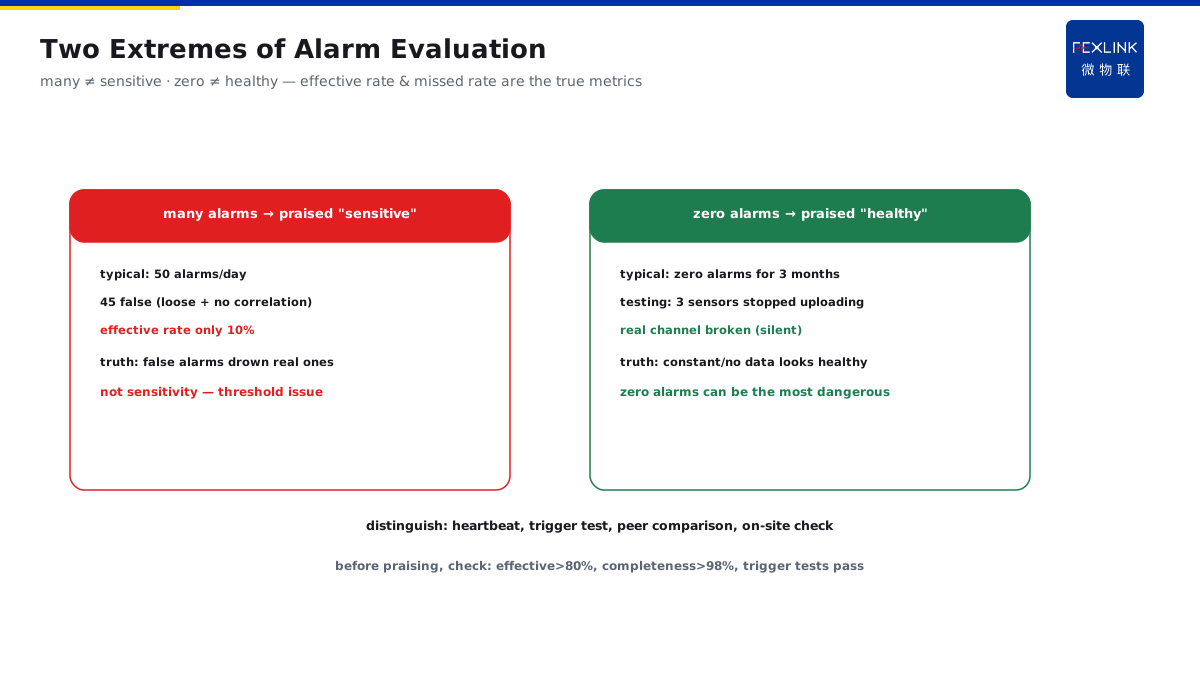
At one park's management meeting: System A averaged 50 alarms/day and was praised as "sensitive"; System B had zero alarms for three months and was praised as "well managed." Review: 45 of System A's 50 alarms were false (loose thresholds + no correlation conditions) — effective alarm rate only 10%; testing revealed 3 of System B's sensors had stopped uploading data ("silent failure") — the real alarm channel was broken. Rectification: System A converged thresholds; System B repaired sensors and added data heartbeat monitoring. Evaluation core: alarm volume explains nothing about health — look at effective alarm rate and missed-alarm rate; both extremes can be problems.
Because:
- Many alarms ≠ sensitivity: loose thresholds/missing correlation generate lots of false alarms; - Zero alarms ≠ health: sensor failure/data interruption "silently" miss alarms; - Effective alarm rate: real alarms ÷ total alarms — the correct measure of sensitivity; - Missed-alarm rate: share of real anomalies not reported — the safety bottom line.
Key insight: "effective alarm rate + missed-alarm rate" are the two true metrics of an alarm system. Alarm volume indicates neither sensitivity nor health — data quality and channel state are what matter.
One data center was praised for "zero alarms" for six months, until a busbar overheating burnout (the temperature sensor had long since failed with poor contact, data always showing normal values). Review: sensor failure undetected (no heartbeat monitoring), data interruption unalarmed. Lesson: zero alarms can be "the most dangerous signal" — sensor failure goes silent; channel verification matters more than alarm volume.
1. Why "Many Alarms = Sensitive" Is Wrong
Step one: why many alarms are not a good thing.
False-alarm sources: - Loose thresholds: alarm threshold too low, normal fluctuations trigger; - Missing correlation: single-indicator alarms report on interference (startups/fluctuations); - Not tuned: default thresholds do not fit on-site conditions; - Sensor problems: poor contact/wrong location produce false signals.
Cost of many alarms: - O&M fatigue: alarms drown the real signal (cry-wolf effect); - Disposal efficiency: false alarms consume processing resources; - Trust erosion: alarms become "normal," real alarms ignored; - Problem masking: many false alarms hide real faults.
Correct understanding of "sensitive": - Sensitive = no real alarm missed (no missed alarms); - Sensitive ≠ many alarms (many false alarms is exactly insensitivity); - Effective alarm rate: high share of real alarms means sensitive; - High sensitivity + low false alarms: reasonable thresholds + correlation conditions (ideal state).
Key insight: "many alarms" is often a sign of "insensitivity." Many false alarms = threshold/correlation problems; the effective alarm rate is the measure of sensitivity.
2. The Trap of "Zero Alarms = Health"
Step two: why zero alarms cannot be trusted directly.
True health vs false quiet: - True health: equipment indeed has no anomaly (data normal + channel normal); - False quiet: sensor failure/data interruption ("silent" missed alarms); - Distinguishing key: channel-state verification (heartbeat/self-check); - Verification method: trigger test (simulate over-limit to confirm it can alarm).
Silent-failure scenarios: - Sensor damaged: data unchanged (stuck at a normal value); - Communication interrupted: data not uploaded (platform has no data); - Battery exhausted: wireless sensor offline; - Poor contact: data drift (looks like normal fluctuation).
Zero-alarm checks: - Check whether data keeps uploading (heartbeat); - Compare with similar equipment data (reasonableness); - Periodic trigger tests (simulate alarm to verify channel); - On-site sampling (actual measurement vs platform comparison).
Key insight: for zero alarms, first ask "is the channel still open?" Data heartbeat + trigger tests — confirm "true health" rather than "false quiet."
3. Counter-Evidence for Sensor Failure
Step three: how to prove "zero alarms" is credible.
Counter-evidence methods: - Trigger test: simulate over-limit (temperature heating/signal injection) to confirm alarm; - Data comparison: compare similar equipment/adjacent points (reasonableness); - Heartbeat monitoring: data-upload continuity (alarm on dropout); - On-site measurement: IR thermometry/multimeter cross-check with platform data.
Test points: - Testing does not disturb operation (safe simulation); - Record test results (channel-verification archive); - Periodic tests (quarterly/semi-annual); - Failure found in testing: repair immediately and re-test.
Failure-case analysis: - Temperature sensor poor contact: constant data (looks healthy); - Communication module fault: data interrupted (platform no updates); - Battery exhausted: wireless sensor offline; - Wiring oxidation: data drift (abnormal amplitude).
Key insight: "trigger test + heartbeat monitoring" is the counter-evidence for zero alarms. Channel verifiable, failure discoverable — only then is zero alarms credible.
4. Correct Evaluation Metrics
Step four: what metrics to look at.
Core metrics: - Effective alarm rate = real alarms ÷ total alarms (sensitivity); - Missed-alarm rate = unreported real anomalies ÷ total real anomalies (safety bottom line); - Data completeness = actual data points ÷ expected data points (channel state); - Sensor online rate = online sensors ÷ total (asset state).
Supporting metrics: - Average alarm-handling time (efficiency); - False-alarm type distribution (improvement direction); - Alarm repeat rate (same point repeatedly alarming); - Threshold reasonableness (effective-alarm-rate trend).
Evaluation methods: - Monthly statistics: effective-alarm-rate and missed-alarm-rate trends; - Trigger tests: periodic channel verification (missed-rate estimation); - Data-quality reports: completeness and online rate; - On-site review: sample-check alarm authenticity.
Key insight: evaluate with "effective alarm rate + missed-alarm rate + data completeness." Alarm volume is not a metric — data quality and alarm effectiveness are.
5. The Necessity of Periodic Verification
Step five: how to stay credible.
Verification content: - Sensor-state verification (online/failed); - Data-quality verification (completeness/reasonableness); - Alarm-channel verification (trigger tests); - Threshold-reasonableness verification (false-rate trend).
Verification cycles: - Sensor online rate: monthly; - Data completeness: monthly/quarterly; - Trigger tests: quarterly/semi-annual; - Threshold review: quarterly or on condition change.
Verification closed loop: - Find problem → locate cause → repair → re-test; - Archive records (verification file); - Track metric trends (continuous improvement); - Link with management reporting (data speaks).
Key insight: "periodic verification" is the guarantee of alarm-system credibility. Sensors + data + channel + thresholds — a four-item verification loop keeps the system trustworthy.
6. Product Landing: Digital Electrical Intelligent Supervision System
FEXLINK products land alarm evaluation:
- Effective-alarm-rate reports: real-alarm share auto-statistics; - Data heartbeat monitoring: sensor dropout/failure alarms immediately; - Trigger-test tools: simulate alarms to verify channels; - Data-completeness reports: data-quality visualization.
Design principle in one sentence: "look at effective alarm rate and missed-alarm rate, not alarm volume." Data quality + channel state — alarm evaluation with evidence.
Management-report example: - Before reporting "system is sensitive": check the effective alarm rate (>80% counts as sensitive), not the total alarm count; - Before reporting "system is normal": check data completeness and online rate (>98% counts as a healthy channel), not "no alarms"; - Suggested template: this month's effective alarm rate X% (trend up), data completeness X%, N trigger tests all passed, 0 missed alarms (test basis) — speak with metrics, not "many/few alarms."
7. Common Evaluation Misconceptions
1. Many alarms = sensitive: mistaking false alarms for sensitivity. Consequence: O&M fatigue + real signals drowned. Correct: look at the effective alarm rate. 2. Zero alarms = healthy: without channel verification. Consequence: silent sensor failure and missed alarms. Correct: heartbeat monitoring + trigger tests. 3. Reporting only the total: management sees only alarm counts. Consequence: the real situation is masked. Correct: effective alarm rate + missed-alarm rate + completeness. 4. No sensor verification: installed and forgotten. Consequence: failure unknown (constant data). Correct: periodic state verification. 5. Raising thresholds to escape: raising thresholds for quiet. Consequence: real anomalies unreported. Correct: data-driven threshold tuning.
Scope and Limitations
This article clarifies the two misconceptions "many alarms = sensitive" and "zero alarms = healthy," and provides a correct evaluation framework for alarm systems (effective alarm rate, missed-alarm rate, data completeness, periodic verification), applicable to alarm evaluation and management reporting of electrical monitoring systems. Specific metric-statistics definitions must be determined by system functionality and on-site management requirements; trigger tests must be performed under safe conditions (without disturbing operation); verification cycles can be adjusted to on-site O&M practices. All cases are anonymized (a certain park/a certain data center/a certain plant) and do not refer to any specific customer.