Direct Answer
Insulation Resistance, Withstand Test, Dielectric Loss (tanδ) — these three indicators all say "how good is the insulation," but they measure completely different things:
- Insulation Resistance: applies low DC voltage (500V/1000V/2500V) to check if insulation is conductive overall — answers "is there a short/moisture now?"; - Withstand Test: applies high voltage (2-3x rated) for 1 minute — answers "can the insulation handle operating voltage?"; - Dielectric Loss (tanδ): applies operating voltage to measure insulation loss — answers "is the insulation aging?"
Key insight: Insulation resistance checks "conductive or not," withstand checks "can it hold," tanδ checks "is it aging." All three must pass before energizing.
At one substation acceptance test, cable insulation resistance was 5000 MΩ (looked high), and the owner said "this high, definitely no problem." But dielectric loss measured 3.5% (standard <1.5%), indicating the cable was already fully moisture-aged. Later during withstand test, at 2.1x rated voltage it broke down — the cable had a factory defect all along; high insulation resistance only meant the insulation had not fully punctured yet.
1. Voltage Levels of the Three Tests
Many people think insulation testing is just "measure some voltage," but the three tests differ by tens of times in voltage level:
Insulation Resistance Test - Applied voltage: 500V / 1000V / 2500V (DC); - Duration: 1 minute; - Measurement: insulation resistance (MΩ / GΩ); - Answers: is the insulation overall shorted, moist, or contaminated?
Withstand Test - Applied voltage: 2-3x rated voltage (AC or DC); - Duration: 1 minute; - Measurement: pass / breakdown; - Answers: can insulation handle operating overvoltage?
Dielectric Loss Test - Applied voltage: operating voltage (rated); - Duration: continuous; - Measurement: tan delta (%); - Answers: how much loss does the insulation material itself have, how aged is it?
Simple rule: insulation resistance uses low voltage, withstand uses high voltage, tanδ uses rated voltage to look at loss.
2. Common Causes of Low Insulation Resistance
When insulation resistance reads low (e.g., <1000 MΩ), there are three common causes:
1. Moisture - Feature: insulation resistance drops sharply as temperature rises; - Cause: poor cable terminal sealing, water got in; - Fix: dry and retest.
2. Contamination - Feature: insulation resistance varies widely with humidity; - Cause: surface dust, salt spray on insulators; - Fix: clean and retest.
3. Aging - Feature: insulation resistance persistently low, and tanδ also high; - Cause: insulation material long-term thermal/electrical stress aging; - Fix: assess life, schedule replacement.
Key: low insulation resistance does not necessarily mean broken — first distinguish moisture/contamination vs aging. Moisture can be saved, aging needs replacement.
3. What Does a Passed Withstand Test Mean
Withstand test is the "harshest" one — directly applies high voltage for 1 minute.
Pass means: - No obvious weak spots in insulation (no voids, no cracks); - Insulation can handle operating overvoltage (e.g., 2-3x transient overvoltage); - OK to energize.
Fail means: - Internal insulation defects (voids, cracks, impurities); - These defects may develop into breakdown under operating voltage; - Cannot energize, must investigate.
Key: withstand test is the "final gate" — even if insulation resistance and tanδ both pass, if withstand fails, you still cannot energize.
4. tanδ Values and Aging Stages
Dielectric loss (tanδ) is the most "sensitive" of the three — it can see whether insulation is "aging," not just "conductive."
Common criteria: - tanδ < 0.5%: insulation excellent, new equipment level; - 0.5% < tanδ < 1.0%: insulation normal, running for years; - 1.0% < tanδ < 2.0%: insulation starting to age, needs attention; - tanδ > 2.0%: insulation clearly aged, recommend scheduling replacement.
Key: insulation resistance can be very high, but tanδ already high — this means insulation overall is still conductive, but the material itself is already aged. That is why the three tests must be read together.
5. Combining Three Test Results
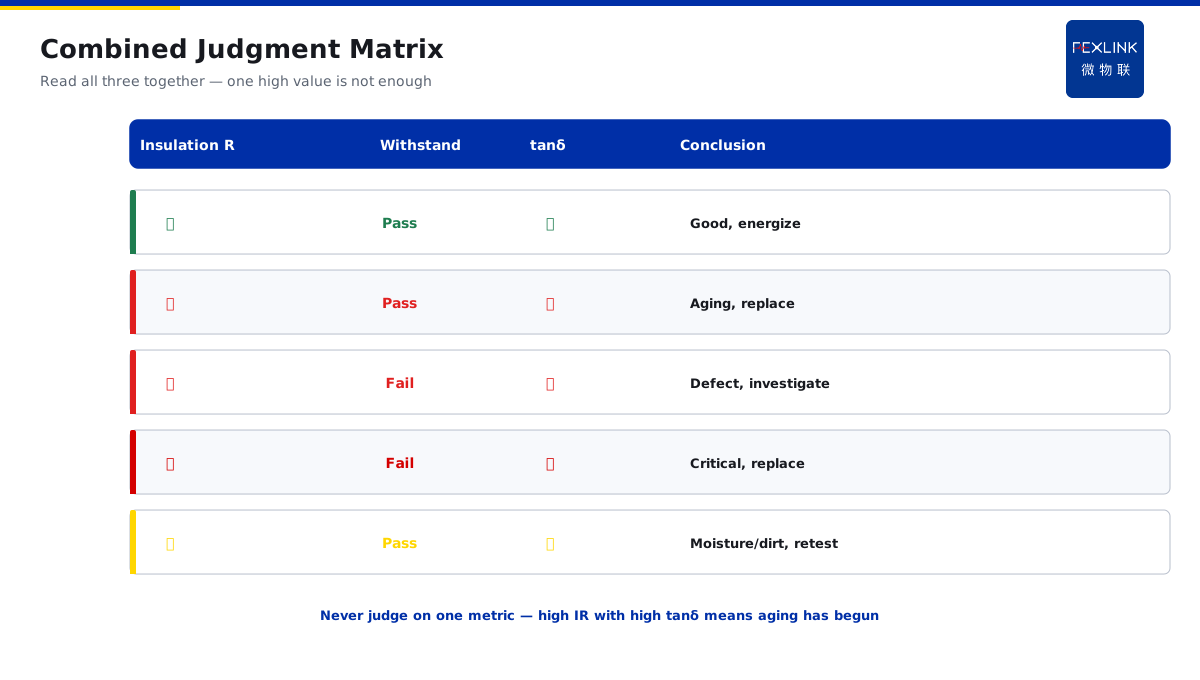
Only by combining all three indicators can you give a complete judgment:
| Insulation R | Withstand | tanδ | Conclusion |
|---|---|---|---|
| High | Pass | Low | Good, energize OK |
| High | Pass | High | Aging, plan replacement |
| High | Fail | High | Defect, investigate |
| Low | Fail | High | Severe fault, must replace |
| Low | Pass | Low | Moisture/contamination, clean and retest |
Memorize this matrix. Never conclude from one test alone.
6. Can Online Monitoring Replace Offline Tests
Owners often ask: with online monitoring now, do we still need offline tests?
Answer: not completely replaceable, but can reduce frequency.
- Offline tests (insulation resistance, withstand, tanδ): accurate, but need shutdown; - Online monitoring (residual current, temperature, partial discharge): real-time, but only shows trends.
FEXLINK ESE power quality monitor + EST-22920-R multi-channel temperature controller is an online monitoring combo: - ESE tracks residual current trend (persistently rising residual current = insulation aging); - EST-22920-R monitors cable terminal temperature (rising temperature = partial discharge).
Online monitoring cannot tell you "did withstand pass," but it can tell you "is insulation degrading recently." If degrading, schedule offline test — you will not miss defects.
7. A Real Case
One 110kV substation, cable acceptance test: - Insulation resistance: 8000 MΩ (very high); - tanδ: 0.3% (excellent); - Withstand test: at 2.0x rated voltage, broke down at 45 seconds.
Owner asked: insulation resistance so high, why did withstand still break down?
Answer: insulation resistance measures "overall conductive or not," withstand measures "any local weak spots." This cable overall insulation was excellent, but there was a tiny bubble in the middle (a factory defect). During withstand, the bubble partially discharged, then broke down.
If only insulation resistance had been measured, this defect would never have been found. That is why all three tests are essential.
8. Three Common On-Site Mistakes
Mistake 1: high insulation resistance means energize. High insulation resistance only means "overall not shorted," not "no local defects." Must do withstand and tanδ to confirm.
Mistake 2: withstand passed means ignore tanδ. Withstand passed only means "can hold now," not "insulation not aged." High tanδ means insulation is aging, just not to breakdown level yet.
Mistake 3: high tanδ means immediately replace equipment. High tanδ does not necessarily mean equipment is broken — could be high temperature, high humidity. Retest under same temperature/humidity, confirm persistently rising before replacing.
9. One Sentence to Remember
Insulation resistance checks "conductive or not," withstand checks "can it hold," tanδ checks "aging or not." Three tests, three dimensions, none dispensable.
That is the correct way to read insulation test reports.
10. Common Questions
Q: Can I do insulation resistance only? A: No. Insulation resistance only finds "severe moisture/short," cannot find "local defects" or "early aging." Important equipment must do all three.
Q: What is the relationship between online residual current and insulation resistance? A: Residual current is the inverse of insulation resistance (I = U/R). Persistently rising residual current means persistently dropping insulation resistance — insulation is aging. FEXLINK ESE monitor indirectly judges insulation status through residual current trend.
11. Why This Matters
Insulation testing is one of those topics that sounds academic but has a very practical bottom line: equipment life and safety. Most facilities do acceptance tests once, then forget about insulation for decades. But insulation ages every day, every transient, every switching operation.
The three tests are not redundant. They are complementary. Insulation resistance catches the obvious. Withstand catches the dangerous. tanδ catches the slow. Missing any one means you are flying blind on one dimension of insulation health.
This article gave you the fundamentals. Apply them to your next acceptance test. Teach them to your maintenance team. Share them with your electrical engineer.
Stay safe. Stay professional. Stay curious.
12. How to Build a Testing Routine
A good insulation testing routine is not about testing more often. It is about testing smart. New cables get tested at installation, then again at one year, then every three to five years. Transformers get tested annually. Switchgear gets tested every three years. The schedule changes based on condition, not on calendar.
Online monitoring is the glue that holds this routine together. If residual current trends flat, you can extend the offline test interval. If residual current trends up, you bring the offline test forward. This is condition-based maintenance, and it saves money while improving safety.
The FEXLINK platform helps by combining offline test records with online trend data. You see the full history of each asset, not just one snapshot. You compare this year's tanδ to last year's. You watch the insulation resistance trend over five years. You catch the slow decline before it becomes a fast failure.
Start today. Pull your last insulation test report. Compare it to the one before that. Is the trend good? If yes, great. If no, plan an offline test. Stay safe.
Final Thoughts
Insulation testing is not glamorous. It is not the kind of work that wins awards. But it is the work that keeps the lights on. It is the work that prevents fires. It is the work that protects people.
Do it right. Do it regularly. Do it with care.