Direct Answer
Online monitoring reports "partial discharge," but cannot tell which type or how serious — because the waveform fingerprints of the four types are completely different, and risk levels differ greatly.
Many factories install partial discharge monitoring and panic when they see discharge. But not all discharge is dangerous:
- Corona discharge: at HV electrode tips, most common, safest; - Surface discharge: on insulation surfaces, medium risk; - Internal discharge: in internal voids, high risk; - Floating discharge: at loose metal parts, highest risk, fastest growth.
Key insight: same "partial discharge," four types have 10x+ different risk. Corona may last years with no issue, floating discharge breaks down in months. Do not just ask "is there discharge," ask "which type is it."
One substation, online monitoring reported PD exceeded threshold. Operators panicked, thinking something bad was about to happen. Then they analyzed the PRPD map, found it was corona discharge (HV lead tip), not internal discharge. Scheduled planned maintenance, no emergency shutdown. If they had not identified the type and did emergency shutdown, losses would have been hundreds of thousands.
1. Four Types of Discharge Locations
Four types of discharge, completely different locations:
Corona discharge - Location: HV electrode tips, wire burrs; - Cause: electric field concentrated at tip, ionizes surrounding air; - Feature: most common, safest, usually does not develop.
Surface discharge - Location: insulation material surfaces (like bushing surface); - Cause: surface pollution + moisture, uneven electric field; - Feature: medium risk, slowly develops.
Internal discharge - Location: voids or impurities inside insulation material; - Cause: manufacturing defects or aging creates voids; - Feature: high risk, slowly expands, eventually breakdown.
Floating discharge - Location: loose metal parts (like loose screws); - Cause: part at floating potential, creates sparks; - Feature: highest risk, fastest growth, breaks down in months.
Key: different locations, completely different risk. Corona is in air, internal is inside insulation, floating is at loose parts.
2. PRPD Phase Distribution Characteristics
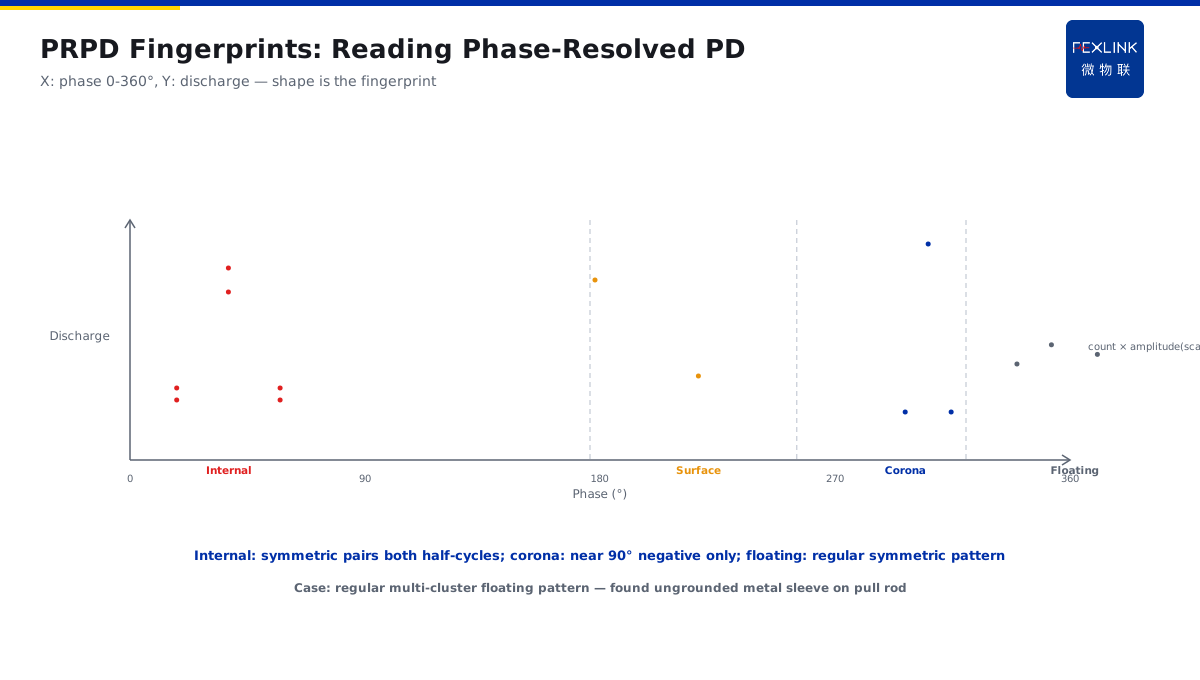
How to distinguish four types? Look at PRPD (Phase Resolved Partial Discharge) map.
Corona discharge - Both positive and negative half-cycles; - Concentrated near voltage peaks (90° and 270°); - Relatively small amplitude, high repetition rate.
Surface discharge - Mainly one half-cycle; - Starts from voltage rise edge; - Medium amplitude, medium repetition rate.
Internal discharge - Symmetric positive and negative half-cycles; - Starts from both rise and fall edges; - Medium amplitude, low repetition rate.
Floating discharge - Asymmetric positive and negative half-cycles; - Large amplitude, high repetition rate; - Very characteristic, can be recognized at a glance.
Key: PRPD map is the discharge "fingerprint". Different discharge types have completely different map features, compare and you know which one it is.
3. Amplitude and Repetition Rate Differences
Besides phase distribution, amplitude and repetition rate also differ:
| Discharge type | Amplitude | Repetition rate | Risk |
|---|---|---|---|
| Corona | Small (tens pC) | High | Low |
| Surface | Medium (hundreds pC) | Medium | Medium |
| Internal | Medium (hundreds pC) | Low | High |
| Floating | Large (thousands pC) | High | Highest |
Key: do not just look at amplitude. Corona has small amplitude but high repetition, floating has large amplitude and high repetition. Must combine phase distribution to judge.
4. Risk Ranking and Development Speed
Risk ranking of four discharge types:
Highest risk: floating discharge - Development speed: fastest, months; - Cause: loose part spark discharge, high energy, fast erosion; - Must handle immediately.
High risk: internal discharge - Development speed: medium, years; - Cause: internal voids slowly expand; - Plan maintenance.
Medium risk: surface discharge - Development speed: slower, years; - Cause: surface pollution + moisture; - Schedule cleaning.
Lowest risk: corona discharge - Development speed: slowest, almost no growth; - Cause: tip corona, usually does not affect operation; - Just observe.
Key: same partial discharge, risk differs 10x+. Corona no panic, floating must act now.
5. Multi-Frequency Sensor Identification
How to use online monitoring to distinguish four types? Multi-frequency sensors.
Different discharge types have different signal frequencies: - Corona discharge: higher frequency; - Surface discharge: medium frequency; - Internal discharge: lower frequency; - Floating discharge: very wide frequency range.
Multi-frequency sensors measure multiple bands at once: - High band strong = corona; - Medium band strong = surface; - Low band strong = internal; - All bands strong = floating.
FEXLINK ESE power quality monitor supports multi-frequency partial discharge monitoring — no extra equipment needed, one device covers multiple discharge type identification.
6. A Real Case
One factory, switchgear PD monitoring reported exceeded threshold: - Operator panicked: should we shut down? - Analyzed PRPD map: asymmetric half-cycles, large amplitude, high repetition; - Judged: floating discharge; - Shutdown inspection: found a loose screw, part at floating potential; - Tightened screw, discharge disappeared.
If they had not analyzed the map and just shut down, not knowing where the problem was, would have to disassemble the whole switchgear, take a full day. With map analysis, directly located that screw, done in half an hour.
7. Three Common On-Site Mistakes
Mistake 1: panic whenever there is discharge. Not all discharge is dangerous. Corona is very common, no panic. Look at which type.
Mistake 2: only look at amplitude. Large amplitude is not necessarily most dangerous, small amplitude is not necessarily safe. Combine phase distribution and frequency band.
Mistake 3: no PRPD analysis. Only know "there is discharge," not which type, cannot judge how serious it is.
8. One Sentence to Remember
Four types of partial discharge: corona safest, floating most dangerous. Look at PRPD map, know at a glance which type and how serious.
Do not panic whenever there is discharge, distinguish types, treat differently.
9. Common Questions
Q: How many pC of partial discharge is normal? A: Not about the pC number, it is about discharge type. Corona hundreds pC is normal, floating tens pC is dangerous. Must combine PRPD map to judge.
Q: Can PD monitoring identify discharge type? A: Yes. Through PRPD phase distribution analysis + multi-frequency sensors, can distinguish four discharge types. FEXLINK ESE power quality monitor supports this.
10. Why This Is Becoming More Important
As equipment gets older and grids get more complex, partial discharge is becoming a bigger concern. Utilities need to know not just "is there discharge," but "which type, how fast is it growing, when should we act."
That is the difference between alarm and actionable intelligence. FEXLINK provides that intelligence, not just alarms.
Stay safe. Stay professional. Stay curious.
11. Quick Checklist
Before you panic about your next partial discharge alarm, run through this checklist:
1. Do you know which type of discharge it is, or just that there is "discharge"? 2. Have you looked at the PRPD phase distribution pattern? 3. Do you know the development speed for that discharge type? 4. Have you planned what to do based on risk level? 5. Do you have multi-frequency sensors, or just one band?
If you answered "no" to most of these, your PD monitoring is just generating noise, not actionable intelligence. You will panic at every alarm, or ignore all alarms — both bad outcomes.
The FEXLINK platform solves this. ESE monitor does PRPD analysis, identifies discharge type, estimates growth speed, and tells you what to do next. Not just "there is discharge," but "this is floating discharge, growing fast, plan inspection within a month."
12. How to Build a Routine
A good PD monitoring routine starts with baseline. When you install the monitor, record what normal looks like for that switchgear. Is there slight corona at the lead tips? That is normal, record it. Then track how the PRPD pattern changes over time.
When the pattern starts shifting from corona toward floating — you know something is loosening. When internal discharge starts appearing — you know insulation is degrading. You schedule an inspection. You compare to historical data. You decide whether to act now or plan later.
This is condition-based partial discharge management. It saves money, reduces risk, and avoids the panic of "switchgear failed unexpectedly, production stopped."
Start today. Identify your oldest critical switchgear. Install PD monitoring with PRPD analysis. Build your baseline. Then you can make smart maintenance decisions, not expensive emergency ones.
Final Thoughts
Partial discharge is the early warning sign of insulation failure. Most switchgear failures start with small discharge, growing over months or years. If you catch it early, you fix it cheaply. If you wait for failure, you pay a lot.
But catching it early means knowing which discharge you are looking at. Not just "there is discharge," but "which type, how fast, what to do."
That is what good PD monitoring does. Do it smart. Do it early. Do it with data.
Your switchgear will thank you. Your production team will thank you. Your budget will thank you. Stay safe, and keep monitoring.
See you in the next article. Take care, and remember: partial discharge tells a story — read it early, read it right.