Smart Lightning Protection

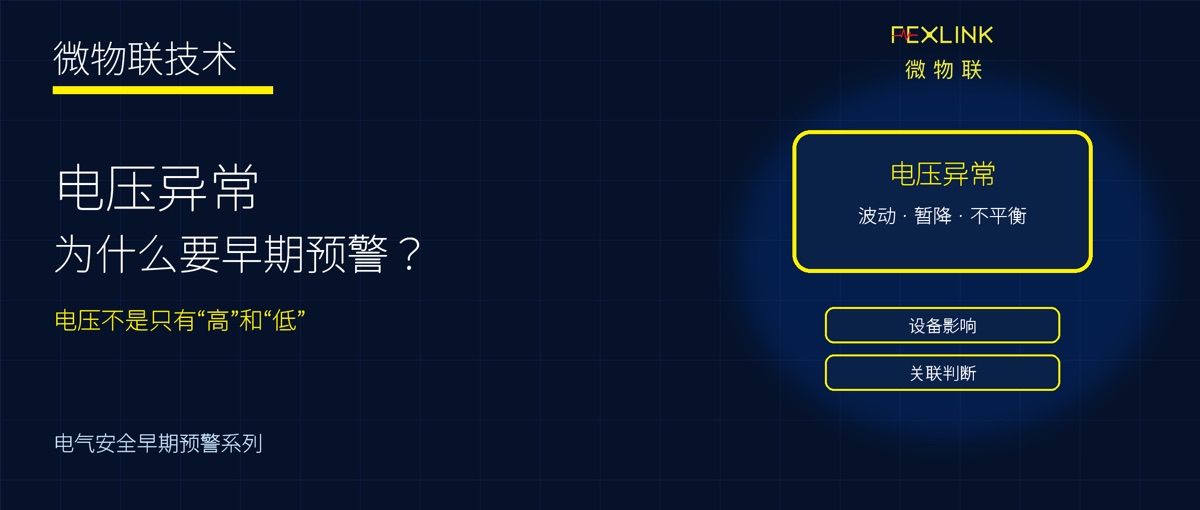
Why Is Voltage Abnormality an Early Signal of Many Electrical Hazards?

When most people think of voltage abnormalities, overvoltage and undervoltage come to mind first. But in real distribution systems, voltage abnormalities take far more forms than these two. Voltage fluctuations, short-term sags, three-phase imbalance, and frequent disturbances can all reflect power supply quality, load changes, or line condition issues. For early warning of electrical safety, voltage is not an isolated value but an entry point into the operating state of the system. A single brief fluctuation does not necessarily mean risk, but if fluctuations recur together with device alarms or current abnormalities, further assessment is required.

2026-08-18 Smart Lightning Protection FEXLINK 5 min

Key Points

Definition

When most people think of voltage abnormalities, overvoltage and undervoltage come to mind first. But in real …

Core Principle

For early warning of electrical safety, voltage is not an isolated value but an entry point into the operating…

Applicable Scenarios

Power supply modules, variable-frequency drives (VFDs), communication equipment, EV charging stations, lightin…

FEXLINK Capabilities

FEXLINK believes the value of voltage abnormality monitoring lies not in "alarming the moment a value is excee…

Why Is Voltage Abnormality an Early Signal of Many Electrical Hazards?
Voltage abnormalities are not only "high" and "l
Fig. 1: Why should voltage abnormalities be given early warning?

1. Voltage abnormalities are not only "high" and "low"

When most people think of voltage abnormalities, overvoltage and undervoltage come to mind first. But in real distribution systems, voltage abnormalities take far more forms than these two. Voltage fluctuations, short-term sags, three-phase imbalance, and frequent disturbances can all reflect power supply quality, load changes, or line condition issues.

For early warning of electrical safety, voltage is not an isolated value but an entry point into the operating state of the system. A single brief fluctuation does not necessarily mean risk, but if fluctuations recur together with device alarms or current abnormalities, further assessment is required.

Fig. 2: 1. Voltage abnormalities are not only "high" and "low"

2. What equipment do voltage abnormalities affect?

Power supply modules, variable-frequency drives (VFDs), communication equipment, EV charging stations, lighting systems, and precision control equipment are all sensitive to voltage fluctuations. Overvoltage may deliver an impact, undervoltage may cause equipment restarts or instability, and sags may briefly disturb control systems.

At many sites, equipment faults do not necessarily show up directly as voltage exceeding limits; they show up as unstable operation, frequent restarts, protective trips, or communication interruptions. Without voltage process data, it is very difficult to reconstruct the causes during accident review.

Fig. 3: 2. What equipment do voltage abnormalities affect?

3. Why should we not look only at instantaneous values?

Short-term voltage fluctuations may come from load start-up and shutdown or from disturbances on the supply side. Judging with a single threshold alone easily produces false alarms while missing small recurring fluctuations.

What is more valuable is to look at trends, duration, and frequency. For example, repeated voltage sags during a certain period indicate possible load inrush or power quality problems in the system during that time window; widening differences among the three phase voltages may affect motors, variable-frequency drives, and three-phase loads.

Fig. 4: 3. Why should we not look only at instantaneous values?

4. Voltage abnormalities must be correlated with other indicators

A voltage abnormality is only a clue on its own; it must be looked at together with current, temperature, leakage current, and device alarms. Voltage fluctuations accompanied by current inrush may be related to load start-ups or shutdowns; voltage imbalance accompanied by temperature rise may reflect abnormal three-phase loads or contact conditions.

Therefore, the focus of digital voltage monitoring is not recording a single curve, but placing the voltage curve within a broader electrical condition diagnosis framework.

Fig. 5: 4. Voltage abnormalities must be correlated with other indicators

5. How digital monitoring improves recognition capability

Digital monitoring can record voltage changes over the long term, identify fluctuation frequency, duration, and anomalous periods, and correlate them in time with device alarms.

FEXLINK believes the value of voltage abnormality monitoring lies not in "alarming the moment a value is exceeded," but in judging from multidimensional data whether the system is moving into an unstable state.

Conclusion: Moving electrical safety from results-based management to process-based management

If issues are addressed only after a fault occurs, much of the loss has already been done; if risk can be seen early in the state change, O&M has the chance to act in advance.
Fig. 5: Four things to watch for voltage risk

FAQ

When most people think of voltage abnormalities, overvoltage and undervoltage come to mind first. But in real distribution systems, voltage abnormalities take far more forms than these two. Voltage fl
Power supply modules, variable-frequency drives (VFDs), communication equipment, EV charging stations, lighting systems, and precision control equipment are all sensitive to voltage fluctuations. Over
Short-term voltage fluctuations may come from load start-up and shutdown or from disturbances on the supply side. Judging with a single threshold alone easily produces false alarms while missing small
A voltage abnormality is only a clue on its own; it must be looked at together with current, temperature, leakage current, and device alarms. Voltage fluctuations accompanied by current inrush may be

Want a deeper look at FEXLINK solutions?

Contact the FEXLINK solutions team for customised solutions and technical support.