Compliance points for lightning-protection monitoring at fuel and gas filling stations
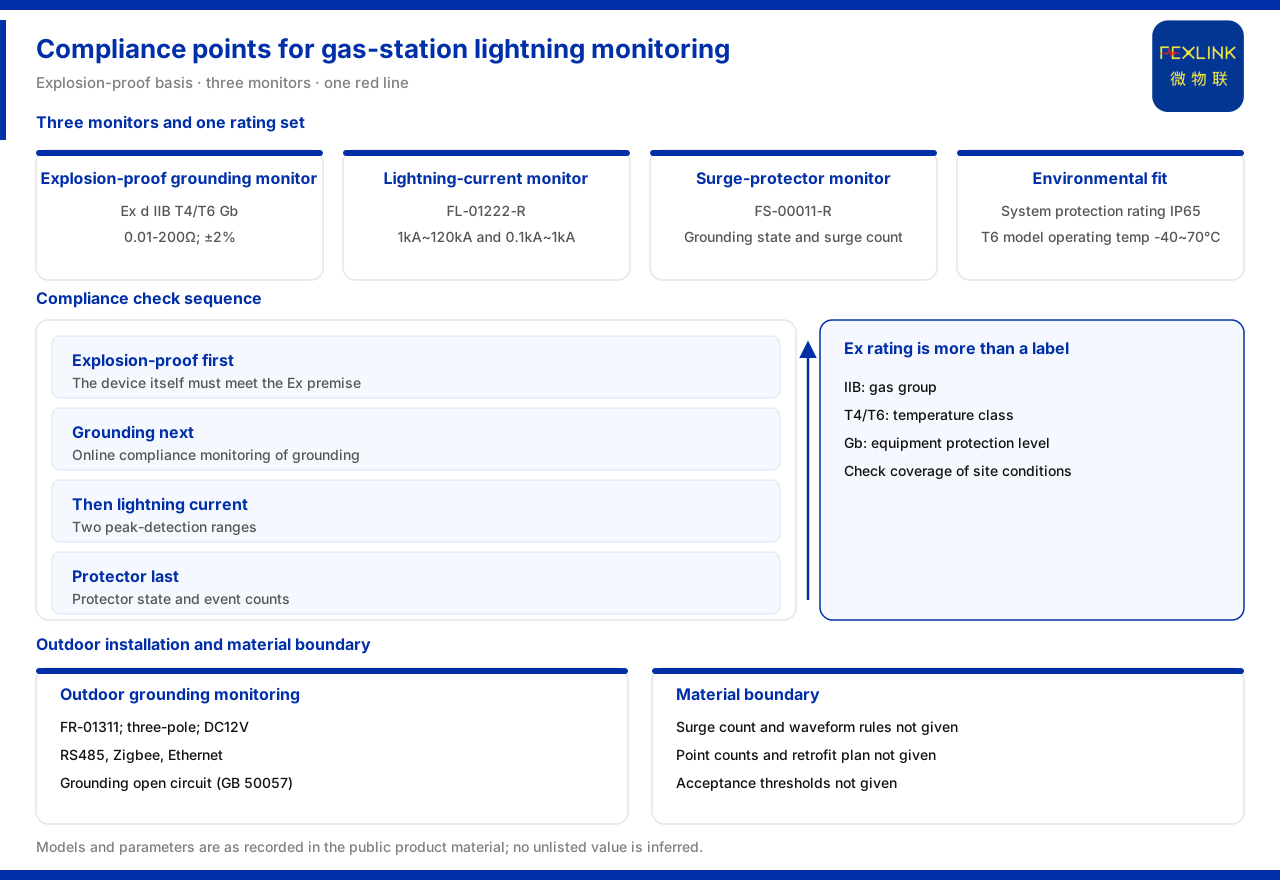
Direct answer: fuel and gas filling stations are flammable and explosive premises, and their lightning-protection monitoring is constrained by two classes of requirement at the same time, explosion protection and grounding. The material lists oil-tank-area and petrochemical lightning and explosion protection as a typical scenario, and gives a recommended combination of explosion-proof grounding resistance monitoring, lightning-current monitoring and surge protective device state monitoring. Among them, the explosion-proof grounding resistance monitoring has a rating formulation of Ex d IIB T4/T6 Gb, a range of 0.01-200 Ω and an accuracy of ±2%; lightning-current monitoring provides two peak detection tiers, 1 kA to 120 kA and 0.1 kA to 1 kA; and the surge protective device monitor has grounding-state and lightning-strike-count monitoring capability. The order for compliant implementation is to confirm first that the device itself meets the explosion-proof precondition, and then to put in place the three classes of monitoring: grounding, lightning current and protective device.
Compliance point one: the device itself must meet the explosion-proof precondition
A fuel and gas filling station contains a flammable and explosive gas atmosphere, and the electric sparks or high surface temperatures produced by ordinary devices in normal operation or in a fault may become an ignition source. The first layer of compliance is that the monitoring device itself must satisfy the explosion-proof precondition of that environment before monitoring function is discussed. The explosion-proof grounding resistance monitoring unit given by the material has an explosion-protection rating of Ex d IIB T4/T6 Gb, a range of 0.01-200 Ω and an accuracy of ±2%.
A common misreading here is to treat explosion protection as a label. An explosion-protection rating contains information such as the gas category and the temperature group, and different groups correspond to different applicable conditions. Selection therefore cannot simply write the words explosion-proof; the specific rating should be confirmed as well, and it should be checked whether it covers the gas category and temperature group of the site.
Compliance point two: online compliant monitoring of grounding resistance
Grounding is the last reliance of lightning protection and is also a fixed item in the compliance inspection of a fuel and gas filling station. The material gives the range of 0.01-200 Ω and the accuracy of ±2% for the explosion-proof grounding resistance monitoring unit: 0.01-200 Ω covers a grounding resistance range from very small to relatively large, and suits online observation of the change trend of grounding-grid state. For online monitoring of the grounding grid of a filling station, the material also points out that the FR grounding resistance monitor (for example FR-01311) uses outdoor three-electrode installation, with DC 12 V supply and communication selectable as RS485, Zigbee or Ethernet.
Outdoor three-electrode installation suits an independent outdoor grounding grid. The coexistence of DC 12 V supply and multiple communication methods gives the site more room for adaptation: where wired communication is available, RS485 or Ethernet can be used, and where cabling is inconvenient, Zigbee can be considered. Installation method and communication method often constrain each other with the explosion-proof requirements, so this content should be checked together with the explosion-protection rating and the protection rating at the scenario-confirmation stage.
Compliance point three: recording lightning-current events
The lightning current / transient current monitor (for example FL-01222-R) given by the material provides two peak detection ranges: 1 kA to 120 kA and 0.1 kA to 1 kA. The span of the two tiers shows that it faces both the capture of strong lightning current and the observation of smaller transient currents, and can cover the recording needs from whether a large-current strike occurred to whether there is a weaker transient disturbance.
In selection, note that the peak tier is a division of detection range, not a direct conclusion about lightning energy. The material gives two ranges and does not give rules for strike-count statistics, waveform analysis or energy conversion, so conclusions such as cumulative lightning energy should not be derived from the peak range.
Compliance point four: protective-device state and grounding state
The surge protective device monitor has grounding-state and lightning-strike-count monitoring capability. In a fuel and gas filling station it carries the observation task of whether the protective device is still in a protective state and whether it has experienced a lightning-strike event. The material also points out that the FS surge protective device monitor (for example FS-00011-R) can monitor parameters such as leakage current, voltage, temperature, lightning-strike count and life prediction, so that a state picture of the protective device itself can be built from several angles.
Unlike the current capture of lightning-current monitoring, surge protective device monitoring leans more towards the state of the protective device itself and event counting. For a place such as a filling station with limited maintenance windows and high shutdown cost, being able to keep continuous knowledge of protective-device state without a power outage is of practical significance.
Environmental adaptability and installation
The material points out that the protection rating of the grounding resistance monitoring system is IP65, and that the operating temperature of the explosion-proof T6 version is -40 to 70°C. IP65 means dust-tight and water-jet protection, suitable for outdoor or semi-outdoor installation; the operating temperature window of -40 to 70°C shows that the T6 version can adapt to a wide range of climatic conditions. Protection rating and temperature window are direct indicators of environmental adaptability, and at a place such as a filling station with much wind, much rain and large temperature differences they need to be checked first.
The same scenario material also gives the temperature-group formulation with T4/T6 in parallel, indicating that this monitoring capability can cover two temperature-group configurations. In engineering selection, the explosive gas category and ignition temperature that may actually occur on site should be confirmed, and it should be checked that they fall within the allowed range.
One grounding red line that cannot be bypassed
The material lists abnormal open circuit of grounding resistance as a red-line condition that cannot be bypassed, with the basis pointing to GB 50057. The grounding system is the last reliance of lightning protection, and once the grounding path is abnormally open, all the preceding monitoring and protection may lose their foundation. This item is therefore especially critical in the filling-station scenario: it concerns not only equipment protection but also the lightning-protection integrity of the whole explosion-proof area.
What the material confirms is the priority level of the item and its standard basis; it does not set a numeric threshold for a specific station area that can be applied directly. In implementation, the task is to use online monitoring to keep continuous knowledge of grounding-grid resistance, and, once an abnormal trend or sign of open circuit appears, to review and handle it immediately according to the established project procedure rather than discovering it at a routine test.
On-site check list
1. Confirm the scenario attribute and the scope requiring explosion-proof devices. 2. Confirm whether the field gas category and temperature group fall within the coverage of Ex d IIB T4/T6 Gb. 3. Check whether IP65 and -40 to 70°C satisfy the field climate and installation environment. 4. Use explosion-proof grounding resistance monitoring, lightning-current monitoring and surge protective device state monitoring as a reference combination, and confirm point by point. 5. Bring abnormal open circuit of grounding resistance into high-priority screening, based on GB 50057. 6. Confirm separately on site, and record, any counts, retrofit schemes or acceptance thresholds not given by the material.
Summary
The compliance points for lightning-protection monitoring at fuel and gas filling stations can be summed up as three classes of monitoring, one set of ratings and one red line. The three classes of monitoring are explosion-proof grounding resistance monitoring, lightning-current monitoring and surge protective device state monitoring; the set of ratings is the Ex d IIB T4/T6 Gb, the range of 0.01-200 Ω and the accuracy of ±2% of the explosion-proof grounding resistance monitoring, plus the IP65 protection rating of the system and the -40 to 70°C operating temperature of the T6 version; the lightning-current monitor provides two peak detection tiers of 1 kA to 120 kA and 0.1 kA to 1 kA; the red line is abnormal open circuit of grounding resistance, based on GB 50057. Outdoor grounding monitoring can use three-electrode installation, DC 12 V supply and RS485, Zigbee or Ethernet communication.
For engineering staff, the prudent approach is to confirm the explosion-protection rating and the protection and temperature conditions first, then complete the three classes of monitoring capability, and finally bring the open-circuit risk into priority screening; for review and delivery, it should be checked whether the scheme treats measuring-point counts, retrofit schemes or acceptance thresholds not given by the material as established conclusions. Checking the environmental preconditions and the monitoring capabilities separately is what makes a lightning-protection monitoring scheme for a fuel and gas filling station hold up.