Is the monitoring element fully equipped or on demand? Element trade-offs seen from the model rule
Direct answer: from the existing product material it can be seen that lightning-protection and electrical-safety monitoring products differentiate models by "element combination" rather than offering only a fully equipped version. The model rule of the intelligent lightning-protection monitoring terminal (a model such as ESM-21001-R) contains a form-factor position, where form 1 is the basic four-element version and form 2 the flagship multi-element version; the surge protective device monitor (a model such as FS-00011-R) differentiates by the combination of voltage channels, leakage-current channels, temperature channels, switching values and the grounding/lightning position. In other words, "full" and "on demand" coexist in the product line - there are models with more elements and models with fewer. The material gives no cost value of each monitoring element and establishes no quantified cost-benefit model or selection decision rule for "full versus on-demand elements", so the element trade-off must be judged separately against the scenario and budget.
The significance of this conclusion for engineering selection is that the number of elements is an existing difference at the model level, not a capability temporarily added or removed with a configuration switch. To be "fully equipped", one must choose a model with a complete set of element positions; to be "on demand", one must pick among models with fewer elements. Only by understanding the model rule can one know whether an element is "optional" or "not present from the start".
How the model rule encodes elements
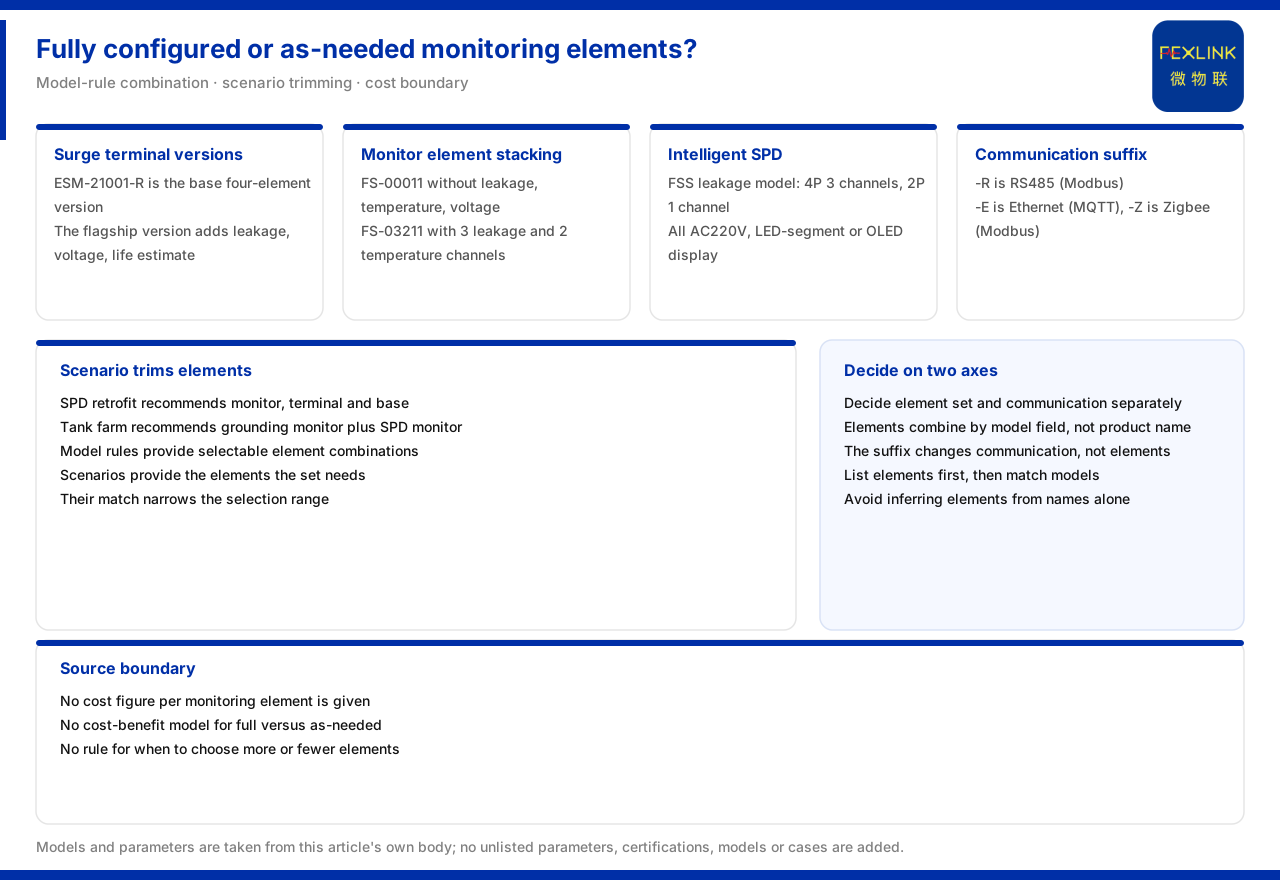
The model rule of the intelligent lightning-protection monitoring terminal contains a form-factor position, where form 1 corresponds to the basic four-element version and form 2 to the flagship multi-element version. Taking models as observation points: ESM-21001-R has only elements such as switching values, grounding, lightning strike, temperature and humidity; while ESM-11112-R, ESM-11312-R, ESM-21112-R and ESM-21312-R of the intelligent lightning-protection monitoring terminal add monitoring items such as leakage current, voltage and lifetime estimation. The difference in element count is reflected in different positions of the model rule.
The combination on the surge protective device monitor side is more intuitive: FS-00011 does not contain leakage current, temperature or voltage; FS-03211 contains 3 leakage-current channels and 2 temperature channels; FS-33211 further adds 3 voltage channels and lifetime estimation. Reading down the models shows elements are stacked level by level. The intelligent surge protective device (FSS) shows the same rule: the 4P type of the leakage-current model has 3 leakage-current channels and the 2P type has 1 channel; the whole series is supplied at AC220V, with a digital-tube or OLED display. Within one product, elements increase or decrease with the pole count.
Placing these models together yields a methodology: elements are not fixed by "product name" but combined by "model position". First determine which elements are needed, then return to the model rule to match, which is more effective than choosing a product first and adding elements afterwards.
Communication method is an independent variable unrelated to elements
The material uses a general suffix to define the communication method: -R is RS485 (Modbus), -E is Ethernet (MQTT), and -Z is Zigbee (Modbus). The key point is that the suffix changes only the communication method, not the element combination. The same monitoring module can choose among -R, -E and -Z for communication while the element positions stay unchanged.
This is important for the "full or on-demand" judgement: the choice of communication method forms a cost variable independent of the element grade. In other words, even with the same set of elements, different communication methods may bring different access costs. Selection should decide "element combination" and "communication method" as two separate dimensions, not compare them mixed together.
The scenario decides element trimming
In its typical application scenarios and selection comparison, the material gives differentiated recommendations: existing-SPD retrofit recommends the combination of the surge protective device monitor, the intelligent lightning-protection monitoring terminal and the SPD lightning-protection base (FSP); the oil-tank area recommends the combination of explosion-proof grounding and lightning-current monitor with the surge protective device monitor. Different scenarios correspond to different element emphases, showing monitoring elements need trimming by scenario rather than being fully equipped as a rule.
The logic of scenario trimming matches the model rule: the model rule provides "which element combinations are selectable", and the scenario provides "which elements this combination needs". Once the two are matched, the selection range narrows. Conversely, assuming from the start that "all elements must be better" may pay extra element cost for a scenario that needs neither leakage current nor lifetime estimation; while seeking to save at all costs may miss a monitoring item the scenario genuinely needs.
Why element trade-offs cannot rest on the product name alone
Element trade-offs easily go wrong because a product name usually reflects only the series, not the element combination. The multi-channel temperature intelligent controller centres on the temperature channel count, but its model rule also carries a humidity position and output positions; the intelligent lightning-protection monitoring terminal centres on monitoring, but form 1 and form 2 differ in element count. The same name with different elements is normal in model-rule design.
Therefore, if a scheme writes "use a certain series to realise a certain element monitoring", it must further state whether the element position of the chosen model actually contains that element. This is especially true when the same series contains models with and without humidity: writing only the series name is not enough to support the conclusion. Matching the element list to the model positions one by one is an effective way to avoid "the name is right but the element is missing".
The cost and balance model the material does not give
The material lists model elements and parameters but gives no cost value of each monitoring element. It also establishes no quantified cost-benefit model of "full elements versus on-demand elements", still less a decision rule for when to choose more elements and when to choose fewer.
This means "full or on-demand" cannot be settled from the material alone. What the material can answer is "which elements a model has" and "which product combinations a scenario recommends"; what it cannot answer is "what one more element costs and how much benefit it brings". The element trade-off should therefore be a decision reviewed separately against budget, maintenance goals and site needs, not a conclusion written into a scheme as directly derived from the material.
A checklist to complete before implementation
1. List the elements first. Clarify the monitoring items the site genuinely needs, distinguishing necessary items from optional extensions. 2. Return to the model-rule match. Screen models by form-factor position or element position, not infer elements from the product name. 3. Decide the communication method separately. Choose among -R, -E and -Z according to the site link, not mixed with the element combination. 4. Compare combinations by scenario. Refer to the scenario recommendations in the material to determine the pairing of the monitoring side, the gateway side and the matching base. 5. Review cost and benefit separately. The material has no element cost or balance model, and the relevant trade-offs should be confirmed against budget and recorded.
Summary
Monitoring elements in the product line are combined based on the model rule: the intelligent lightning-protection monitoring terminal separates the basic four-element version from the flagship multi-element version, the surge protective device monitor stacks voltage, leakage-current and temperature elements level by level, and the intelligent surge protective device increases or decreases leakage-current channels with the pole count; the communication suffix changes only the communication method, not the element combination. The scenario recommendations further show elements need trimming by scenario. What the material can support is "which element combinations exist" and "which scenario combinations are recommended"; what it cannot support is the element cost and the cost-benefit balance model.
For an engineer, the safe approach is to define the element list first, match by the model rule next, and correct by scenario last; for review and delivery, one should check whether a scheme treats "full" as the default optimum or uses a cost model the material does not have as a selection basis. Keeping "element selectability" and "cost judgement" apart makes the selection both grounded and controllable.