How are humidity monitoring of the intelligent lightning-protection monitoring terminal and the multi-channel temperature intelligent controller configured?
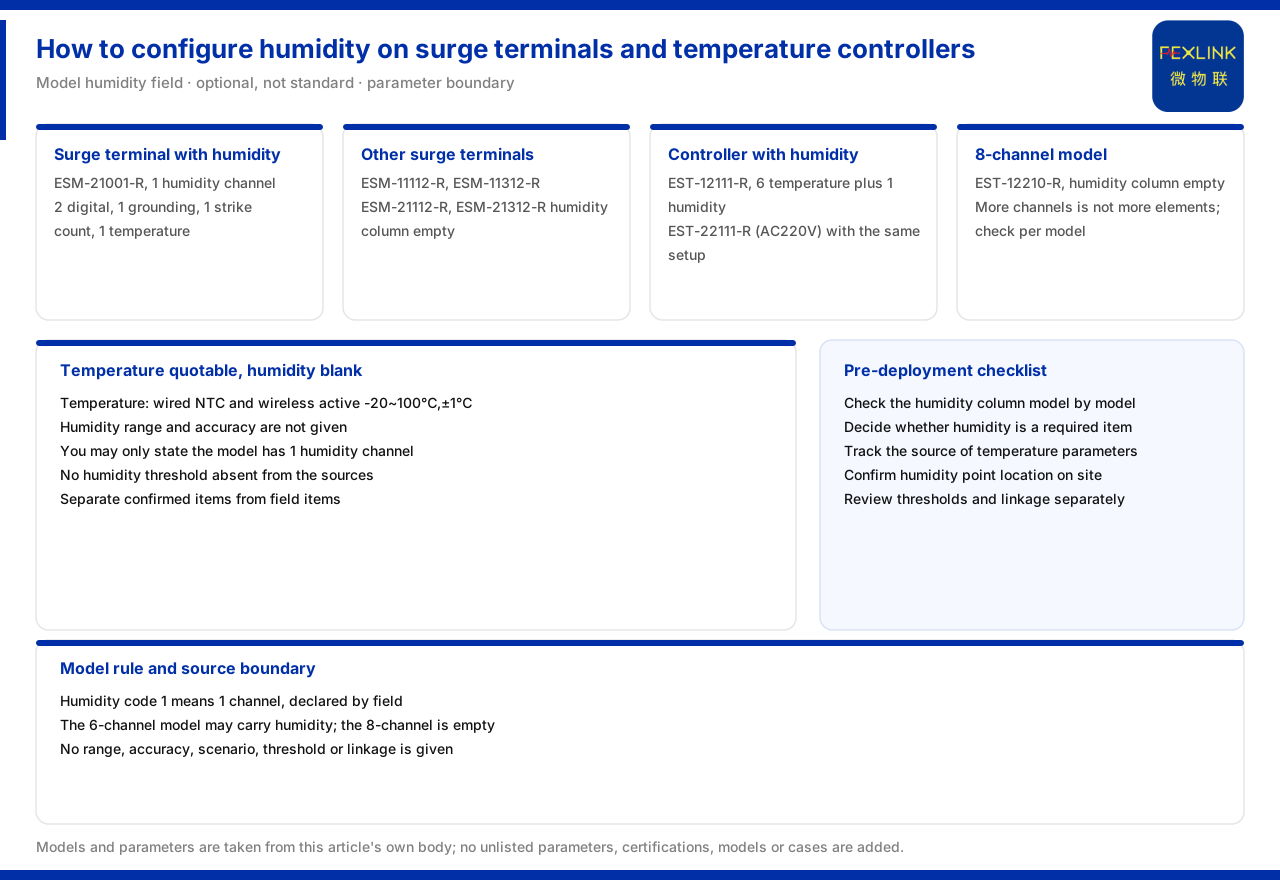
Direct answer: on "which models carry humidity monitoring" the existing product material gives a clear answer, while on "whether humidity should be configured and what threshold to set" it gives no rule. The intelligent lightning-protection monitoring terminal (a model such as ESM-21001-R) marks one humidity-monitoring channel in the model table, while the other models of the intelligent lightning-protection monitoring terminal, such as ESM-11112-R, ESM-11312-R, ESM-21112-R and ESM-21312-R, have an empty humidity column. The multi-channel temperature intelligent controller (a model such as EST-12111-R) has a humidity position in its model rule, where humidity code 1 means one humidity-monitoring channel, showing humidity can be an optional monitoring element of the temperature controller. In other words, humidity monitoring is "optional" rather than "standard" in both product classes, and selection must confirm it model by model.
It should be stated at the same time that the material gives the temperature parameters of the multi-channel temperature intelligent controller but gives no humidity-sensor measurement range or accuracy; nor does it give, by application scenario, the applicable boundary of humidity monitoring, the trigger threshold, or a rule for "when humidity monitoring should be added". The model-level "whether it exists" can therefore be answered from the material, while the engineering-level "whether to have it and how to set it" must return to the site.
Why humidity is an optional element in the model table
Placing humidity in an "optional" position is the result of the product line differentiating models by element combination. The basic form of the intelligent lightning-protection monitoring terminal contains state quantities such as switching values, grounding status and lightning-strike count, and humidity is not present on all models; the core element of the multi-channel temperature intelligent controller is the temperature channel count, and humidity must be declared through a separate position in the model rule.
This "declared by position" approach means whether a model carries humidity depends on whether its humidity column in the model table is 1, not on the product name or the series it belongs to. If an engineer judges only by names such as "temperature controller" or "lightning-protection monitoring terminal", it is easy to mistake a model without humidity for one with it, or to require humidity data from a model that never contains it. Checking model by model is the first and also the easiest step to avoid such misjudgement.
Reading the humidity bit from the model rule
The model rule of the multi-channel temperature intelligent controller encodes elements such as measurement method, temperature channel count, humidity position and output into the model, where humidity code 1 corresponds to one humidity-monitoring channel. Taking the 6-channel temperature grade as an example, EST-12111-R (DC5V) and EST-22111-R (AC220V) are both 6-channel temperature plus one humidity channel, plus one relay output; while the 8-channel temperature grade of the multi-channel temperature intelligent controller, such as EST-12210-R, has an empty humidity column.
There is a rule here that is easily overlooked: a higher temperature channel count does not equal a more complete set of monitoring elements. The 8-channel temperature grade leaves humidity empty, while the 6-channel temperature grade instead carries one humidity channel; the two form a model difference of "whether humidity is included", not a simple "higher versus lower configuration". Selection should therefore not reason from a high temperature channel count down to a low one, but list humidity separately as a selection condition.
The difference on the intelligent lightning-protection monitoring terminal side is more direct: the humidity of ESM-21001-R is 1, and it also contains 2 switching values, 1 grounding status, 1 lightning-strike count and 1 temperature; the other models leave the humidity column empty. Humidity is thus currently an element only a few models on this product line carry. If humidity is listed as a necessary monitoring item, one should first screen out the models whose humidity column is 1, rather than choosing a series first and then finding a way to add humidity.
The temperature parameters are complete, the humidity parameters are still blank
The material treats temperature relatively completely: the wired NTC and wireless active temperature measurement of the multi-channel temperature intelligent controller both range from -20~100 °C at ±1 °C. By contrast, the material gives no measurement range, accuracy or response characteristic of the humidity sensor, and does not say in what form humidity data participates in alerts or recording.
This information asymmetry directly determines how detailed a scheme can be. The range, accuracy and channel count related to temperature can be cited as definite parameters in a scheme; on the humidity side, one can only write "this model has one humidity-monitoring channel", after which citable basis is lacking. If a scheme contains specific values for humidity range, alarm threshold or control logic, it should first confirm where those values come from, rather than deriving "humidity can be defined the same way" from "temperature can be measured".
Three questions the material does not answer
First, which scenarios must be equipped with humidity. The material marks the humidity column only at the model level and gives no applicable boundary of humidity monitoring by application scenario. In other words, it does not tell us "which environments and which devices should be fitted with humidity monitoring".
Second, at what humidity value an action should be triggered. The material gives no humidity trigger threshold and no linkage rule between humidity and dehumidification, heating or alerting. A logic commonly seen in engineering, such as "start dehumidification when humidity exceeds the limit", is content that needs separate confirmation.
Third, how humidity fits with other elements. The intelligent lightning-protection monitoring terminal also has switching values, grounding status, lightning-strike count and temperature, while the multi-channel temperature intelligent controller also has temperature and relay output; how these elements jointly form a judgement inside one device is not developed by the material. Writing these questions into a scheme as settled conclusions would exceed the product factual boundary.
A checklist to complete before implementation
1. Check the humidity column model by model. First confirm whether the humidity position of a candidate model in the model table is 1, separating "sounds similar" from "actually carries it". 2. Clarify whether humidity is a necessary monitoring item. If it is not necessary, one can directly choose a suitable temperature channel count among models without humidity; if it is necessary, compare only among models with humidity. 3. Distinguish the source when recording temperature parameters. The temperature range and accuracy can be cited from the material, while on the humidity side only "has one humidity-monitoring channel" is stated. 4. Confirm the humidity measuring-point location and representativeness on site. The material gives no installation-location rule, and the point should be chosen against the actual cabinet or device environment. 5. Review thresholds and linkage separately. The humidity threshold, dehumidification or heating linkage, and the weight of humidity in an alert should all be confirmed separately on site and recorded.
Summary
Humidity monitoring is optional in both product classes: among the intelligent lightning-protection monitoring terminals only a few models mark humidity as 1 in the model table, while the multi-channel temperature intelligent controller declares it through the humidity position in the model rule, with the 6-channel temperature grade able to carry one humidity channel and the 8-channel temperature grade leaving it empty. What the material can support is "which models carry humidity" and the temperature parameters; what it cannot support is the humidity range and accuracy, the applicable scenario, the trigger threshold and the linkage rule.
For an engineer, the safe approach is to lock the models with humidity from the model table first and leave the measuring point, threshold and linkage to on-site confirmation; for review and delivery, one should check whether a scheme contains humidity parameters or decision rules that the material does not have. Keeping "confirmable items" and "items to confirm on site" apart means a humidity configuration is neither missed nor over-promised.