Direct answer
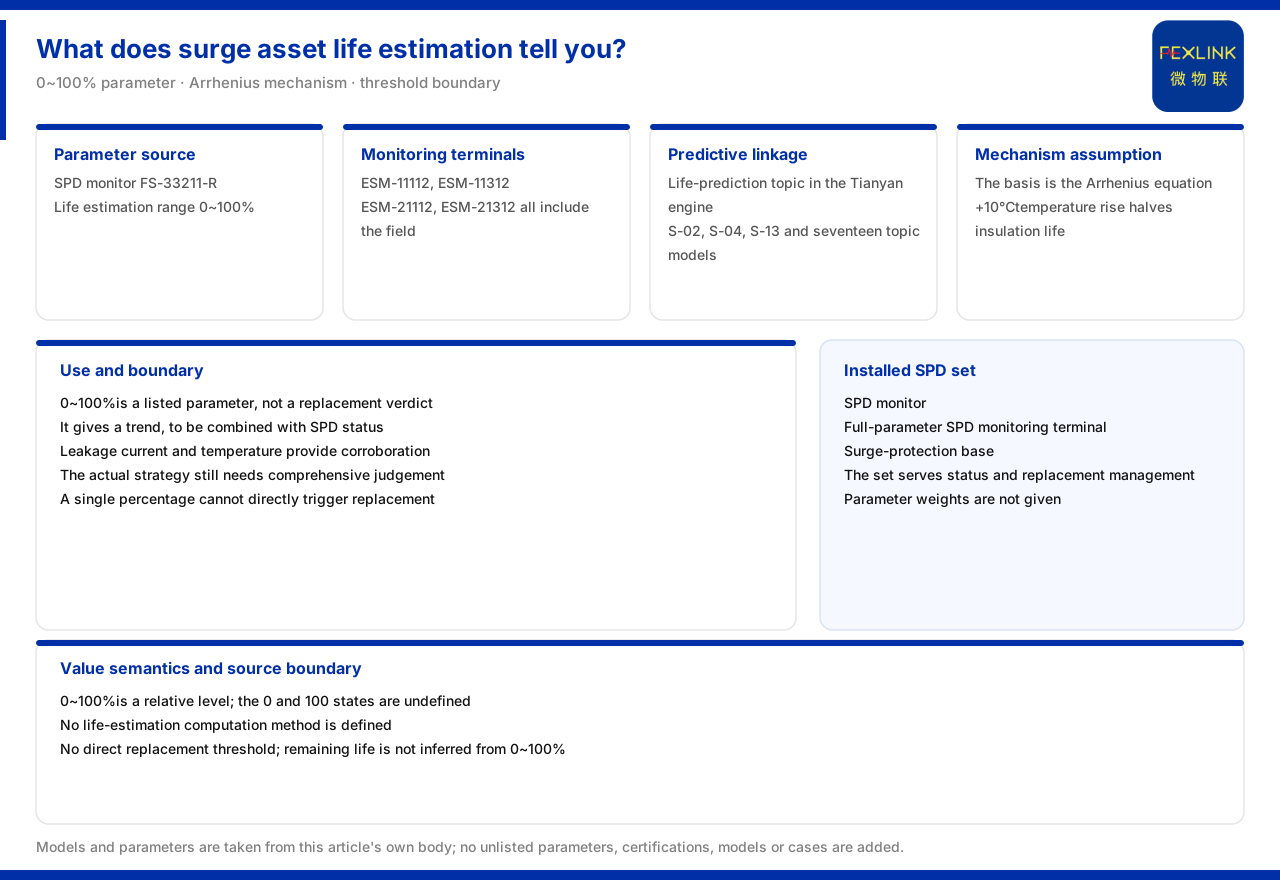
On what lightning-protection asset lifetime-estimation data can show, the product knowledge base states: the parameters of the surge protective device monitor (FS-33211-R) list a lifetime estimation with a range of 0~100%, which can assist a replacement decision; several models of the intelligent lightning-protection monitoring terminal (ESM-11112-R) also carry a lifetime-estimation function. The supporting link on the data side falls on the equipment-lifetime-prediction special topic of the Tianyan engine, whose theoretical basis is the Arrhenius equation, that is, a temperature rise of 10 °C shortens insulation lifetime by about half. But the material does not define the calculation method of lifetime estimation and gives no threshold that can directly trigger replacement. The 0~100% is therefore a listed parameter, not a replacement conclusion; treating it as the sole basis does not hold, and the actual strategy must still combine SPD state, leakage current and temperature. This article explains the use and boundary of lifetime estimation.
1. The parameter source of lifetime estimation
In the key parameters of the surge protective device monitor, the product knowledge base lists a lifetime-estimation range of 0~100%. This is the direct parameter source of "lightning-protection asset lifetime-estimation data". It shows the value is presented as a percentage, ranging from zero to one hundred.
In the model table of the surge protective device monitor, the grade FS-33211-R, FS-33211-Z and FS-33211-E provides three voltage channels and includes a lifetime-estimation function position. Comparing the parameter with the model shows that lifetime estimation is not a general description standard across the series, but a capability with a clear model attribution.
2. Lifetime estimation also appears on the monitoring terminal
Beyond the monitor, in the model table of the intelligent lightning-protection monitoring terminal, ESM-11112-R, ESM-11312-R, ESM-21112-R and ESM-21312-R all mark a lifetime-estimation function position. This shows lifetime estimation appears not only on a single-point monitor but also on the all-parameter SPD monitoring terminal.
The meaning of covering several models is that lifetime estimation can be acquired together with lightning-protection monitoring devices at different levels, rather than depending on one dedicated meter. It is part of the monitoring data and comes from the same source as parameters such as voltage and current. For an asset manager, this means there is no need to add a dedicated meter at every SPD: as long as the monitoring device itself carries the function position, lifetime estimation is obtained together with the other state data.
3. Linkage with predictive maintenance
The product knowledge base groups equipment-lifetime prediction and predictive maintenance under the special topics of the Tianyan engine, listing topics such as S-02, S-04 and S-13 and seventeen topic models. This shows lifetime-estimation data is not an isolated reading but an input that can connect to a predictive-analysis link.
Keeping acquisition and prediction apart is clearer: the monitoring device acquires the lifetime-estimation parameter, and the Tianyan engine uses it at the prediction layer. The material gives this linkage, not how the model derives a conclusion from the parameter internally.
4. Mechanism assumption: temperature rise and insulation lifetime
The theoretical basis given under the Tianyan engine entry is the Arrhenius equation, expressed as a temperature rise of 10 °C shortening insulation lifetime by about half. This relation defines the mechanism assumption behind lifetime prediction: temperature is the key variable accelerating insulation ageing.
Mechanism and conclusion must be kept apart. The Arrhenius relation describes a general law, not a conversion formula for one device's lifetime percentage. The material does not explain how on-site temperature history is substituted to obtain the specific 0~100% value, and this article does not infer it.
5. Combination with existing-SPD status monitoring
In its typical application scenarios, the product knowledge base lists the recommended combination for SPD status monitoring (existing-SPD retrofit) as the surge protective device monitor, the all-parameter SPD monitoring terminal and the SPD lightning-protection base. This shows the object served by lifetime-estimation data is the state and replacement management of existing SPDs.
The existence of the combination suggests lifetime estimation should be understood within the whole status monitoring: it belongs, with leakage current, voltage, temperature and lightning-strike count, to part of the SPD status picture, not to a replacement criterion separate from the other parameters. The material gives the combination relationship, not the weight of each parameter.
6. The meaning and boundary of zero to one hundred
The semantics of the 0~100% range are clear: it represents a relative level. But the material does not explain what physical states zero and one hundred correspond to, nor the speed or non-linearity of the change. A single percentage therefore cannot tell "how much counts as due for replacement".
Only by putting the value back into the system can a judgement form: lifetime estimation provides a trend, SPD state provides the present, and leakage current and temperature provide corroboration. The material supports this combined view but does not support issuing a replacement instruction directly from a single threshold. This article cites the listed 0~100% parameter without giving it a decision meaning beyond the material.
7. Material boundary: no algorithm and no threshold
The product knowledge base does not define the calculation method of lifetime estimation and gives no threshold that can directly trigger replacement. The 0~100% exists only as a listed parameter of the monitor and the monitoring terminal. Any statement such as "replace below a certain percentage" therefore exceeds the material boundary.
Making this boundary clear has two effects: it prevents treating a parameter as a conclusion, and it prevents treating a prediction result as a maintenance instruction. The value of lifetime estimation is to provide a reference and a trend; the actual replacement still needs a combined judgement of device state, operating environment and maintenance rules.
8. The relation between lifetime estimation and other parameters
The model table shows lifetime estimation usually appears alongside other function positions rather than forming a product on its own. The monitor grade FS-33211 provides three voltage channels while including lifetime estimation; several models of the intelligent lightning-protection monitoring terminal also mark lifetime estimation in the same row. This shows that in the structure of the material, lifetime estimation is one column of the device capability matrix, not the device's only selling point.
Reading this column in the context of the whole row helps understand its position: parameters such as voltage and current describe the device's current operating state, while lifetime estimation attempts to point to a trend evolving over time. The two dimensions differ and cannot replace each other. The material does not specify which prevails when trend and state disagree, and gives no weight for either.
In actual use, the safer approach is therefore to regard lifetime estimation as one trend input in the status picture, referenced alongside the other parameters, rather than extracting it alone as a conclusion. The material provides exactly this parallel relationship, not a separate decision rule.
Scope and limitations
First, this article restates only what the product knowledge base lists. The lifetime-estimation range, the models carrying the function, the linkage with predictive maintenance, the Arrhenius relation, the existing-SPD status-monitoring combination and the material boundary are all cited as recorded.
Second, the material defines neither the calculation method of lifetime estimation nor a threshold that can directly trigger replacement; this article gives no replacement threshold and does not infer remaining device lifetime from 0~100%.
Third, the Arrhenius relation is cited as listed; this article does not use it for on-site lifetime conversion or an effect promise.
Fourth, the specific replacement strategy must be judged by combining device state and maintenance rules; this article provides no selection or maintenance-decision calculation.