Direct Answer
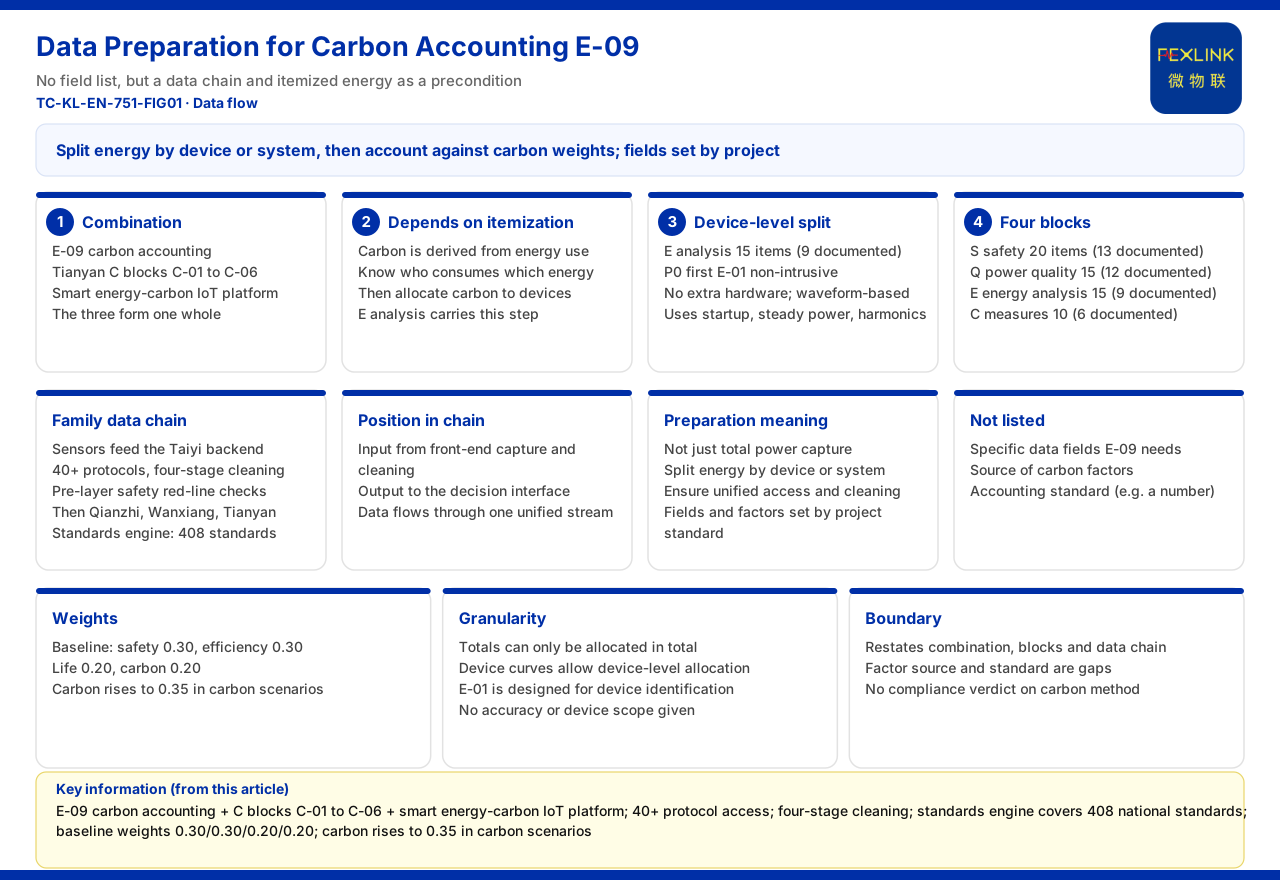
On "what data E-09 carbon accounting requires," the product documentation gives no field list to copy directly, but it gives the chain the data passes through and the selection combination to which it belongs. E-09 carbon accounting is listed in the "energy saving and carbon management" scenario combination, alongside the Tianyan C block (C-01 to C-06) and the smart energy-carbon IoT platform. It is built on itemized energy-use data and carbon-emission weight assessment: first use energy analysis to separate load by device or system, then perform accounting against the carbon-emission weight. The documentation does not list the specific data fields, carbon-factor sources, or accounting standards required by E-09, so this article explains the logical path of data preparation and does not invent an input list.
The Position of E-09 in the Combination
In the "energy saving and carbon management" product combination, the Tianyan C block handles energy-saving countermeasures, E-09 handles carbon accounting, and the smart energy-carbon IoT platform carries data hosting and presentation. The three form a whole: without itemized energy-use data, carbon accounting lacks an allocation basis; without the countermeasures block, the accounting result is hard to turn into action. The documentation writes E-09, the C block, and the platform in the same combination, showing that carbon accounting is not a standalone tool but one link in a chain. The documentation gives no data-interface details between E-09 and the C block.
Why Carbon Accounting Depends on Itemized Energy Use
Carbon emission is a derived quantity of energy consumption. Only after knowing which energy is consumed by whom and where can the corresponding carbon emission be allocated to a device or system. The E energy-use analysis block of the Tianyan engine carries this step; it plans 15 models (9 in the documented definition), of which the P0 first-release model is E-01 non-intrusive load monitoring. E-01 is characterized by needing no additional hardware and identifying specific devices through the current waveform, based jointly on start-up signature, steady-state power, and harmonic signature. Device-level decomposition gives carbon accounting a chance to move from "one number for the whole building" to "allocation by device or system." The documentation does not state how the decomposition result maps to a carbon factor.
What Stages the Data Passes from Field to Accounting
The family data chain given by the documentation is: sensor data enters the Taiyi back end, which provides access for more than 40 protocols and four-level cleaning; then it reaches the front-end layer for safety red-line pre-check; then it passes in order through Qianzhi, Wanxiang, Tianyan, and the standard engine covering 408 national standards; and finally it reaches the decision interface. Carbon accounting sits on this chain, its input coming from front-end acquisition and cleaning and its output going to the decision interface. This chain shows that the data on which carbon accounting depends is not acquired in isolation but is transmitted and processed in a unified data flow. The documentation gives no latency or storage requirement between the stages.
The Relation Between Energy-Use Analysis and Other Blocks
The Tianyan engine V2.0 plans four blocks: S safety analysis 20 items (13 in the documented definition), Q power quality 15 items (12 in the definition), E energy-use analysis 15 items (9 in the definition), and C energy-saving countermeasures 10 items (6 in the definition). The E block provides energy-use decomposition and is the data basis of carbon accounting; the C block provides countermeasures, its P0 first-release model being C-01 reactive-power compensation optimization. Carbon accounting stands on the E block and is also affected by the measures of the C block: after a measure is implemented, the energy-use structure changes and the carbon-accounting result changes with it. The documentation gives no calculation method for this linkage.
Carbon Emission in the Four-Dimension Weight
The baseline weights of the four-dimension impact assessment are safety 0.30, efficiency 0.30, lifetime 0.20, and carbon emission 0.20; in a carbon-assessment scenario the dynamic weight of carbon emission rises to 0.35. This shows that carbon emission is parallel to the other dimensions by default but is weighted higher in projects aimed at carbon assessment. When preparing carbon-accounting data, first clarify whether the project is a carbon-assessment scenario to judge the relative importance of the carbon dimension. The documentation gives no switching rule for dynamic weights and no source of carbon-factor values.
The Practical Meaning of Carbon-Accounting Data Preparation
Applying the above to "preparing data" means data preparation is not merely collecting total electricity but decomposing energy use by device or system and ensuring the data passes through a unified access and cleaning flow. The more than 40 protocol accesses and four-level cleaning listed in the data chain mean that field data from diverse sources can first be normalized and then enter the analysis stage. As for which fields to prepare and which carbon factors to use, the documentation does not answer, and these belong to content determined by the project against accounting standards.
Decomposition Granularity Determines How Fine the Accounting Can Be
The credibility of a carbon-accounting result depends largely on the granularity of the energy-use data. If only the total electricity of a whole building or plant is available, carbon emission can only be allocated by total, without distinguishing the contribution of different workshops or devices; if device-level curves can be obtained through non-intrusive load monitoring, carbon emission can be aggregated by device and support finer emission-reduction decisions. The P0 first-release model of the E energy-use analysis block is designed for device identification, which makes finer granularity possible. The documentation gives no decomposition accuracy or range of identifiable devices, so it cannot promise that a certain class of device can always be separated.
Data Items the Documentation Does Not List
The documentation does not list the specific data fields required by E-09 carbon accounting, gives no source of carbon factors, and gives no accounting standard (such as a standard number like GB/T 32150). These three are the inputs most needed when compiling a carbon-accounting plan. Their absence means any statement about "which fields are needed," "what value the factor takes," or "which standard to account by" lacks documentation support. The fields and factors of carbon accounting should be determined by the project against applicable accounting standards and competent-department requirements. At the preparation stage, at least four things should be made clear — data source, acquisition frequency, itemized granularity, and responsibility boundary — so that definitions can be aligned during accounting.
Common Misunderstandings
The first misunderstanding is to treat carbon accounting as a calculation that only takes total electricity, ignoring itemized energy use as a precondition. The second is to skip the cleaning and pre-check stages of the data chain, believing field data can be used directly for accounting. The third is to treat the four-dimension weights as fixed, ignoring the rise of the carbon weight in a carbon-assessment scenario. The fourth is to read the standard engine's coverage of 408 national standards as meaning the carbon-accounting standard is already fixed, ignoring that the documentation does not indicate which accounting standard E-09 uses. Separating these four keeps the direction of data preparation from drifting.
Boundary Statement
First, this article restates only the position of E-09 in the selection combination, the block composition and P0 models of the Tianyan engine, the four-dimension impact weights, and the family data chain, and does not extend to unlisted data fields. Second, carbon-factor sources and accounting standards are documentation gaps that must be fixed by the project and applicable standards, and this article does not infer them. Third, this article does not constitute a compliance judgment on carbon-accounting methods.