Direct Answer
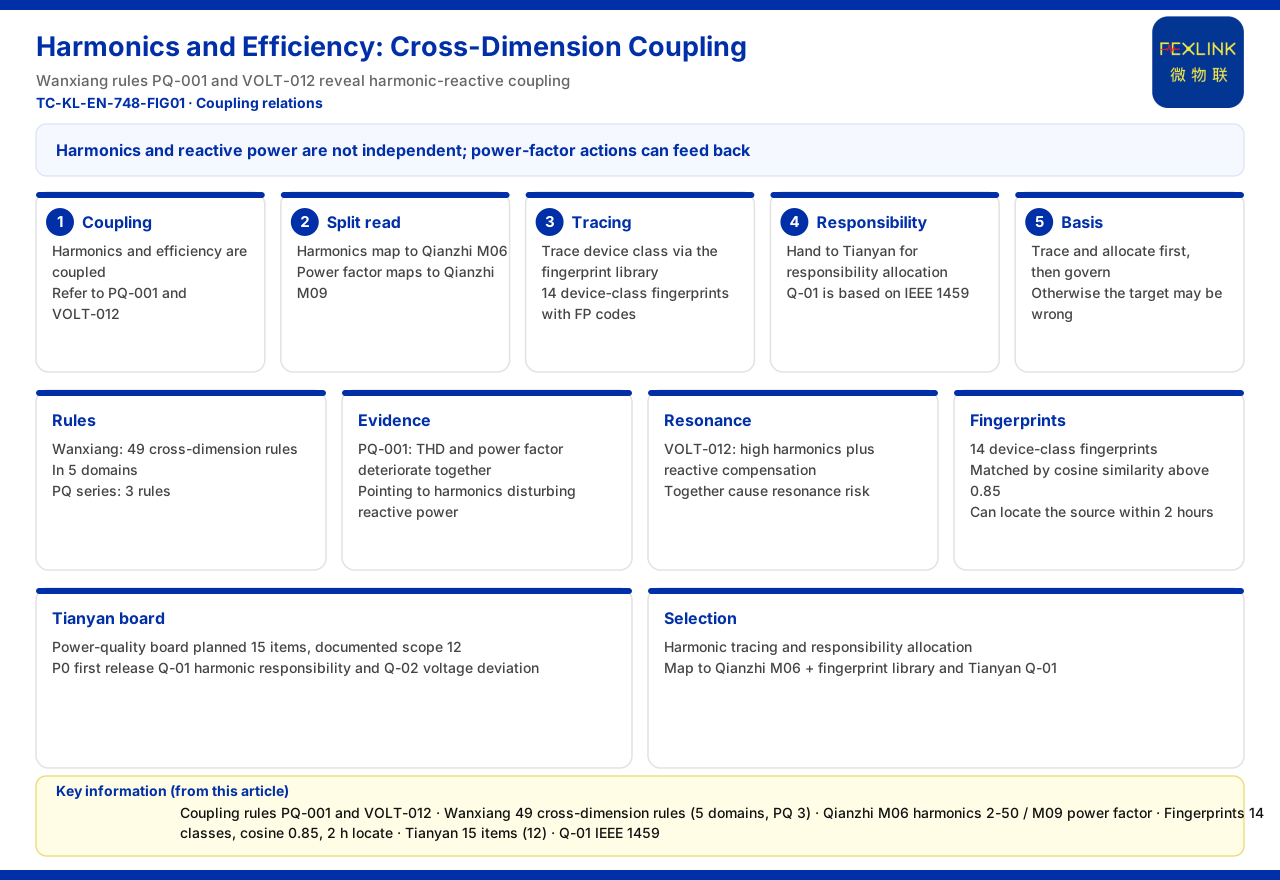
Harmonics and energy efficiency influence each other because the product knowledge base places them in the same set of cross-dimensional association rules rather than treating them as two unrelated specialities. The Wanxiang engine plans 49 cross-dimensional association rules, divided into 5 domains, of which the PQ series has 3. PQ-001 describes a simultaneous deterioration of total harmonic distortion and power factor, pointing to the coupling in which harmonics disturb reactive power. That is, once harmonics rise, it is often not a single indicator that worsens but reactive power and power factor changing together; likewise, treating only one of them will often not restore the other automatically. The product knowledge base gives no quantifiable loss-conversion formula between harmonics and energy efficiency, confirming only the qualitative coupling relation described by PQ-001. This article therefore states only the coupling rule, the division of data between Qianzhi and Tianyan, and the treatment order, without inferring a quantitative result.
1. The Evidence of Coupling: One Association Rule
The product knowledge base organises the cross-dimensional association rules of the Wanxiang engine into 5 domains, namely the CR series with 7, the TEMP-CORR series with 7, the VOLT series with 15, the CURR series with 14 and the PQ series with 3, plus the EE series with 3. Although the PQ series has only 3, it directly concerns power-quality topics. Among these, PQ-001 is expressed as a simultaneous deterioration of total harmonic distortion and power factor, pointing to harmonics disturbing reactive power. The wording shows the problem is handled as a coupling phenomenon: total harmonic distortion and power factor are two indicators placed in the same condition and consequence rather than judged separately. This rule is the starting point for viewing harmonics and energy efficiency jointly.
2. Resonance Risk: The Other Side of Coupling
Another association rule of the product knowledge base, VOLT-012, describes high harmonics and the switching-in of reactive-power compensation acting together to cause resonance risk. This rule adds the other side of the coupling: reactive-power compensation is itself a common means of improving power factor, but switching in compensation under high harmonic levels may introduce resonance risk. Putting PQ-001 and VOLT-012 together reveals a clear logic: harmonics and reactive power are not independent problems, and an action to improve power factor may in turn affect the harmonic environment. The product knowledge base gives only the qualitative relation of these two rules and does not give the harmonic order, capacity or impedance conditions that trigger resonance, so this article cites only the rule descriptions and adds no numerical conditions.
3. Two Specialities on the Qianzhi Side
At the perception layer, the Qianzhi engine of the product knowledge base lists harmonics and power factor as different speciality sub-models: harmonics corresponds to M06, covering the second to fiftieth order plus total harmonic distortion, and power factor corresponds to M09. The two belong to the same power-quality physical-examination group but sit in different sub-models. This contrasts with the Wanxiang coupling rules: the perception layer measures them separately and forms separate items, and the judgement layer links them with association rules. Measurement needs separate items for a clear convention, while analysis needs association to restore causality. The product knowledge base does not give the judgement thresholds of M06 and M09, so this article cites only the speciality division and coverage and adds no threshold.
4. Harmonic Tracing and the Fingerprint Library
The Qianzhi engine of the product knowledge base has a harmonic fingerprint library containing 14 classes of equipment fingerprints, such as three-phase rectifiers, six-pulse inverters, uninterruptible power supplies, charging piles and photovoltaic inverters, each corresponding to an FP-series number. The matching method is a cosine similarity greater than 0.85, and it is recorded that the pollution source can be locked within 2 hours. This shows harmonics can be not only measured but traced to an equipment class. Combining tracing with the coupling rules makes treatment targeted: know the equipment class, judge whether it also affects reactive power and energy efficiency, then arrange treatment. The product knowledge base does not give the detailed discriminating features of each fingerprint entry, so this article cites only the number of classes, the matching method and the time convention.
5. The Division of Responsibility on the Tianyan Side
The Tianyan engine of the product knowledge base has a power-quality section planning 15 items, with a document convention of 12, whose P0 first release includes Q-01 harmonic responsibility division and Q-02 voltage deviation. Q-01 is based on IEEE 1459. Responsibility division matters because, in a distribution system shared by multiple parties, the cost sharing of harmonic treatment requires first determining the pollution source and the attribution of responsibility. Connecting Q-01 with the M06 of Qianzhi and the fingerprint library: the perception layer provides the harmonic level and source clues, and the Tianyan side completes the responsibility division, together supporting the treatment decision. The product knowledge base does not give the calculation formula for responsibility division, so this article cites only the model name and the standard basis.
6. Harmonic Tracing in the Selection Comparison
In the product selection and capability comparison of the product knowledge base, harmonic tracing and responsibility division correspond to Qianzhi M06 plus the fingerprint library and to Tianyan Q-01. That is, this capability is not completed by a single product but is the result of coordination between the perception and judgement sides. For the energy-efficiency topic, if harmonic treatment is to land as an efficiency gain, tracing and responsibility division must come first; otherwise the treatment object may be wrong and the investment may miss the actual loss source. The product knowledge base does not give the investment or return convention of this combination, so this article cites only the capability correspondence and does not expand it into a project scheme.
7. Boundaries to Keep and the Reading Order
The above can be reduced to a reading order. First, confirm that harmonics and energy efficiency are a coupling problem, referring to the two association rules PQ-001 and VOLT-012. Second, read the two specialities of harmonics and power factor separately on the Qianzhi side. Third, when necessary, use the harmonic fingerprint library to trace to the equipment class. Fourth, hand the tracing result to the Tianyan harmonic responsibility-division model to form a treatment basis. The boundary to keep is that the product knowledge base confirms only the qualitative coupling relation described by PQ-001 and gives no quantifiable loss-conversion formula between harmonics and energy efficiency; the specific loss must be checked separately against measured data, no quantitative result may be inferred from the product knowledge base, and treating harmonics must not be equated directly with an energy-efficiency gain.
Applicability and Limits
First, this article restates only what the product knowledge base lists, and its factual boundary is the record of the association rules of the Wanxiang engine, the power-quality physical-examination group and harmonic fingerprint library of the Qianzhi engine, the power-quality section of the Tianyan engine and the selection comparison.
Second, the division of the 49 cross-dimensional association rules of the Wanxiang engine into 5 domains and the coupling description of PQ-001 are cited under the convention listed in the product knowledge base; this article adds no trigger values.
Third, the description of VOLT-012, in which high harmonics and the switching-in of reactive-power compensation cause resonance risk, is cited under the convention listed in the product knowledge base.
Fourth, the fact that harmonics is M06 of the Qianzhi engine, covering the second to fiftieth order plus total harmonic distortion, and that power factor is M09, is cited under the convention listed in the product knowledge base.
Fifth, the 14 classes of equipment fingerprints in the harmonic fingerprint library, the cosine similarity greater than 0.85 and the locking of the pollution source within 2 hours are cited under the convention listed in the product knowledge base; this article adds no discriminating features.
Sixth, the planning of 15 items in the Tianyan power-quality section with a document convention of 12, and Q-01 harmonic responsibility division based on IEEE 1459 and Q-02 voltage deviation, are cited under the convention listed in the product knowledge base.
Seventh, the correspondence of harmonic tracing and responsibility division to Qianzhi M06 plus the fingerprint library and to Tianyan Q-01 is cited as listed in the selection comparison of the product knowledge base, and this article does not expand it into a project scheme.
Eighth, the product knowledge base gives no quantitative loss-conversion formula between harmonics and energy efficiency; this article accordingly states no quantitative result. It explains only the information and reading order within the product knowledge base and is not a commitment to treatment or energy-efficiency gain for a specific project; the latest product materials and formal documents prevail.