Direct Answer
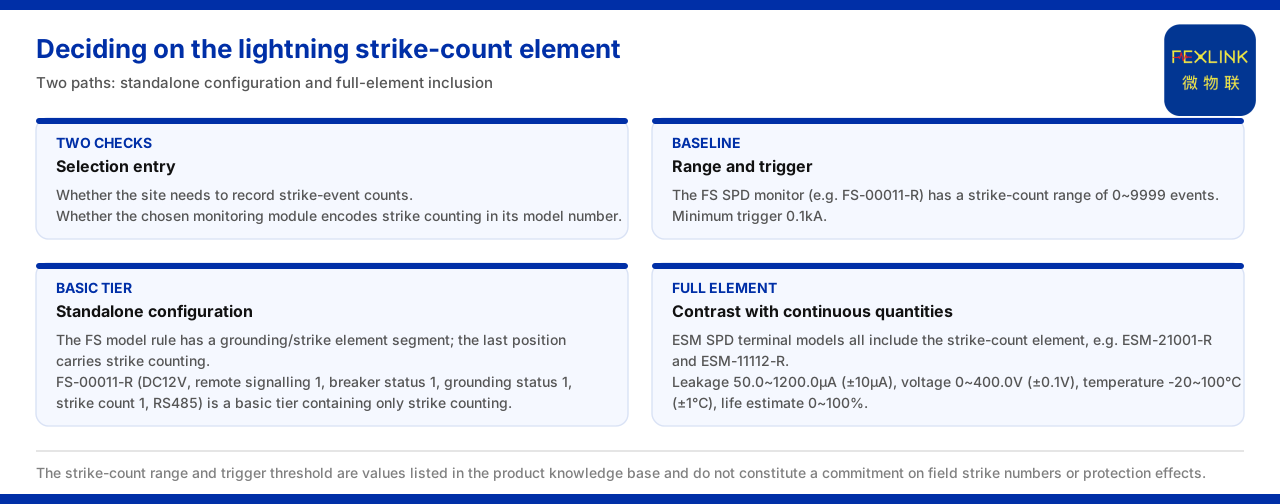
The choice of a lightning-strike counting element can start from two decision points: whether the site needs to record the number of lightning-strike events, and whether the monitoring module to be selected encodes lightning-strike counting into its model. The product knowledge base records that the FS surge protective device monitor (for example FS-00011-R) has a lightning-strike counting range of 0 to 9999 counts and a minimum trigger of 0.1 kA; its model rule takes "grounding/lightning strike" as an independent element segment, and a basic tier containing only lightning-strike counting exists, showing that lightning-strike counting can be configured on its own. If a more all-parameter SPD monitoring is needed, the models of the ESM intelligent lightning-protection monitoring terminal (for example ESM-21001-R) all contain the lightning-strike counting element. Therefore, whether to select lightning-strike counting depends on whether it is treated as an independent monitoring item or is brought in together with elements such as leakage current, voltage and temperature.
1. The Position of Lightning-Strike Counting in the Product System
Lightning-strike counting is not an abstract function but a parameter explicitly listed in the product knowledge base. The product knowledge base records that the lightning-strike counting range of the FS surge protective device monitor is 0 to 9999 counts and the minimum trigger is 0.1 kA. These two values form the basic convention of the lightning-strike counting element: the upper limit determines the order of magnitude of events that can be recorded, and the minimum trigger determines the smallest current threshold that can be counted. Checking these two items first during selection tells whether the module covers the order of magnitude of lightning-strike events expected on site.
Lightning-strike counting also appears in the model rule. The product knowledge base records that the FS model rule is FS–[voltage channels][leakage-current channels][temperature channels][digital input][grounding/lightning strike]–[communication], and the last element includes lightning-strike counting. This means lightning-strike counting is not an add-on function but a fixed position in the model arrangement. The model rule arranges the elements by segment, so during selection one can read directly from the model whether lightning-strike counting is included without confirming it separately.
2. The Basic Tier Shows That Lightning-Strike Counting Can Be Configured Independently
A key piece of support is the basic-tier model. The product knowledge base records that FS-00011-R (DC12V, one remote signal, one air-switch state, one grounding state, one lightning-strike count, RS485) is the basic tier containing only lightning-strike counting. The existence of this model shows that lightning-strike counting can be configured independently of other elements such as leakage current, voltage and temperature.
This has direct meaning for selection. If the site only needs to record the number of strikes, the basic tier suffices and no additional configuration is needed for other elements; if the site also needs leakage current, temperature and other monitoring, a model containing those element segments should be chosen. The existence of the basic tier makes "lightning-strike counting only" an executable configuration rather than an all-in-one machine. Conversely, if a model already contains other elements, that does not mean lightning-strike counting is weakened; it is still an independent segment in the model rule.
3. Comparison with the Conventions of Other Elements
When choosing lightning-strike counting, it is often judged together with other elements. The product knowledge base records that the other key parameters of the FS surge protective device monitor are: leakage current 50.0 to 1200.0 microamps (plus or minus 10 microamps), voltage 0 to 400.0 volts (plus or minus 0.1 volts), temperature minus 20 to 100 degrees Celsius (plus or minus 1 degree Celsius) and life estimation 0 to 100 percent. These parameters, together with lightning-strike counting, form the convention list of monitoring elements.
Putting lightning-strike counting back into this list, it is an "event counting" element, while leakage current, voltage and temperature are "continuous quantity" elements, and life estimation is an inference about device condition. Classifying the elements during selection makes it clearer which class of data the site needs: for lightning-strike events, configure lightning-strike counting; for operating condition, configure continuous-quantity elements. After classification, the segment choice of the model has a correspondence, and lightning-strike counting needs no further explanation within it.
4. Lightning-Strike Counting in All-Parameter Scenarios
When a scenario requires more comprehensive SPD monitoring, lightning-strike counting usually appears together with other elements. The product knowledge base records that the models of the ESM intelligent lightning-protection monitoring terminal (SPD monitor) all contain the lightning-strike counting element (1), for example the basic four-element version ESM-21001-R and the flagship multi-element version ESM-11112-R. That is, in the models of this product line, lightning-strike counting is one of the elements included by default.
This design contrasts with the FS basic tier: FS allows "lightning-strike counting only", while ESM brings lightning-strike counting into an all-parameter whole. During selection, if the site already plans all-parameter SPD monitoring, lightning-strike counting can be obtained along with the model; if the site only needs lightning-strike counting, the basic tier is more appropriate. The difference between the two paths lies in element quality, not in lightning-strike counting itself, so the path can be chosen by the site's data objective.
5. How Lightning-Strike Counting Enters the System
The lightning-strike counting element finally has to be aggregated into the monitoring system. The product knowledge base records that the perception layer of the general four-layer architecture of the monitoring system contains the FS and ES series monitoring modules, and the lightning-strike counting element is thereby uploaded to the edge layer and the platform layer. This shows that lightning-strike counting is not an isolated reading but one of the acquisition contents of the perception layer, which then enters the platform through the intermediate layers.
Understanding this path helps judge where lightning-strike counting lands: it is acquired by a perception-layer module and then transmitted upward according to the system architecture. Confirming during selection that the module belongs to the perception layer also confirms that lightning-strike counting can enter the unified monitoring link rather than being viewable only locally. For users who need to manage multiple sites centrally, this step determines whether lightning-strike counting can be compared with other data on the same platform.
6. Choosing in Typical Application Scenarios
In specific scenarios, the choice of lightning-strike counting has a clear entry point. The product knowledge base records that the typical application scenario "lightning-protection device condition monitoring (existing SPD retrofit)" recommends a combination of the FS surge protective device monitor, the ESM all-parameter SPD monitoring and the FSP lightning-protection base. The lightning-strike counting element is precisely one of the landing selection entry points of this combination.
The existing-SPD retrofit scenario is characterised by existing lightning-protection devices still in operation, whose condition data must be supplemented by adding monitoring modules. Lightning-strike counting, as a direct record of lightning-protection device operation, naturally becomes one of the elements of this scenario. Following the recommended combination of the product knowledge base, one can first cover lightning-strike counting with the basic tier and then extend to all-parameter monitoring as needed; deciding first whether lightning-strike counting is wanted and then the tier is a relatively sound order in this scenario.
Applicability and Limits
First, this article states only the selection approach of the lightning-strike counting element, and its factual boundary is the product knowledge base; it introduces no standard clause, parameter, certification or case not listed in the product knowledge base.
Second, the lightning-strike counting 0 to 9999 counts and minimum trigger 0.1 kA of the FS surge protective device monitor, the grounding/lightning-strike element segment in the model rule, the configuration of the basic-tier FS-00011-R, and the leakage current, voltage, temperature and life parameters are all contents listed in the product knowledge base.
Third, the lightning-strike counting range and trigger threshold referred to in this article are the values listed in the product knowledge base and do not constitute a promise about the number of on-site lightning-strike events or the protection effect; model selection follows the site's element needs and the product knowledge base conventions.