Direct Answer
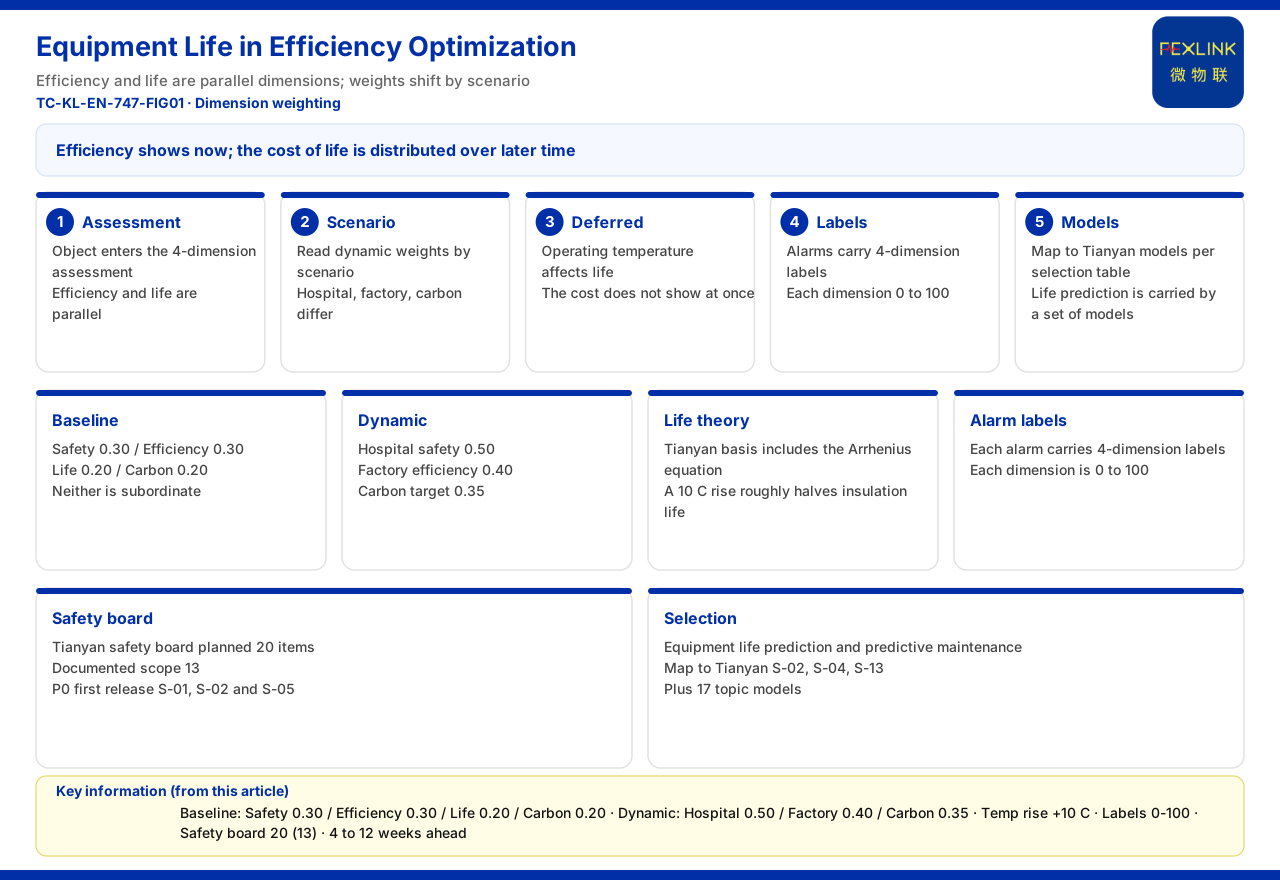
Considering equipment lifetime together with energy-efficiency optimisation is necessary because the four-dimensional impact assessment of the product knowledge base lists efficiency and lifetime as two parallel dimensions rather than keeping only one. The baseline weights of the four-dimensional impact assessment are safety 0.30, efficiency 0.30, lifetime 0.20 and carbon emission 0.20, so efficiency and lifetime stand side by side. This means that looking only at efficiency and ignoring lifetime is equivalent to leaving one whole dimension of the assessment model empty. It is all the more important to note that the weights can change dynamically with the scenario, for example strengthening safety in hospitals, efficiency in factories and carbon emission under carbon assessment, so the trade-off between lifetime and efficiency is not a fixed ratio but changes with the scenario. Within the text of the product knowledge base, no quantifiable conversion curve or coefficient between lifetime and energy efficiency is given, so this article states only why the two dimensions coexist, how the weights change with the scenario, and where lifetime sits in the analysis and alarm chain, without inferring a quantitative trade-off between them.
1. Efficiency and Lifetime Stand Side by Side in the Four-Dimensional Impact Assessment
In the product knowledge base, the four-dimensional impact assessment of the Wanxiang engine allocates weights in the baseline case as safety 0.30, efficiency 0.30, lifetime 0.20 and carbon emission 0.20. Efficiency and lifetime are two parallel dimensions, each holding a weight, and neither is subordinate to the other. Placed in the context of energy-efficiency optimisation, this yields a direct conclusion: energy efficiency is not the only objective function. If an operating-point adjustment raises efficiency but makes the equipment run in a harsher state, then the score of the lifetime dimension may fall, and the overall assessment may not improve. By using parallel weights, the product knowledge base reminds users not to treat other dimensions as constants when optimising a single indicator.
2. Dynamic Weights Show That the Trade-Off Changes with the Scenario
The product knowledge base also gives dynamic-weight cases: the hospital scenario raises the safety weight to 0.50, the factory scenario raises the efficiency weight to 0.40, and the carbon-assessment scenario raises the carbon-emission weight to 0.35. This shows that the same four-dimensional framework redistributes its focus under different scenarios. Hospitals prioritise safety, factories prioritise efficiency and carbon assessment prioritises carbon emission, while lifetime is always one of the four dimensions. The existence of dynamic weights further shows that there is no universal answer to the trade-off between efficiency and lifetime: the scenario must first be determined and the weight then read. Treating the weight of one scenario as a universal ratio for all scenarios is a misreading to avoid when using the four-dimensional impact assessment.
3. Why Lifetime Cannot Be Judged from the Present Moment Alone
The product knowledge base records that the theoretical basis of the Tianyan engine includes the Arrhenius equation, which gives that an insulation lifetime shortens by about half when the temperature rise increases by 10 degrees Celsius. This relation shows that the operating-point temperature directly affects equipment lifetime, and the effect is not linear. That is, pushing equipment to a higher load or a higher temperature rise now may not immediately appear as a fault but may instead manifest later as consumed lifetime. This is exactly why the lifetime dimension and the efficiency dimension must both be brought into the assessment: efficiency is often visible in the present, while the cost of lifetime is distributed over later time. Only by placing both in the same four-dimensional score sheet can a deferred cost be made visible in a decision.
4. How Alarms Carry Efficiency and Lifetime Impact
The alarm system of the Qianzhi engine in the product knowledge base specifies that each alarm carries a four-dimensional impact label, giving a score of 0 to 100 for safety, efficiency, lifetime and carbon emission respectively. This means that when an alarm appears, the impacts on efficiency and lifetime can be presented with the alarm instead of being left for separate analysis afterwards. The value to users is that an alarm is not only an anomaly prompt but also carries quantified labels of its impact, making it easier to judge what a given anomaly means for energy efficiency and lifetime respectively. The product knowledge base does not give the scoring algorithm or thresholds of the labels, so this article cites only the existence of the labels and their dimension composition and does not add a scoring method.
5. The Tianyan Safety-Analysis Section and Lifetime-Related Models
The Tianyan engine of the product knowledge base has a safety-analysis section planning 20 items, with a document convention of 13; among these, the P0 first release contains S-01 resistive leakage separation, S-02 residual-current trend drift and S-05 three-phase imbalance hazard. S-02 uses the CUSUM method and can detect trend drift 4 to 12 weeks in advance. Comparing this group of models with the lifetime topic shows that lifetime-related analysis does not rely only on temperature but also includes early trend identification of hazards such as residual current and three-phase imbalance, which, if present over the long term, consume equipment condition gradually. This article cites only the section's item count, the first-release models and their method conventions and adds no applicability condition or effect promise.
6. Predictive Maintenance in the Selection Comparison
In the product selection and capability comparison of the product knowledge base, equipment lifetime prediction and predictive maintenance correspond to the Tianyan models S-02, S-04 and S-13 plus 17 topic models. That is, lifetime prediction is not the function of a single model but is carried by a group of models. This entry turns "whether to consider lifetime" into "which models to use to consider it": S-02 handles trend drift and the other models share the remaining topics. The product knowledge base does not give the scheduling between the models or the output-merging rule, so this article cites only the correspondence in the selection comparison and does not expand it into a specific model-orchestration scheme.
7. Boundaries to Keep and the Reading Order
The above can be reduced to a reading order. First, confirm that the assessment object enters the four-dimensional impact assessment, with efficiency and lifetime parallel. Second, confirm the scenario and read the dynamic weights accordingly. Third, understand the deferral of the lifetime cost, referring to the relation between temperature rise and insulation lifetime. Fourth, read the four-dimensional impact labels in alarms. Fifth, if lifetime prediction is needed, correspond it to the relevant Tianyan models through the selection comparison. The boundary to keep is that the product knowledge base gives no quantifiable conversion curve or coefficient between lifetime and energy efficiency; the specific trade-off must be checked separately against equipment data, and no quantitative relation may be inferred from the product knowledge base, nor may the dynamic weight of one scenario be treated as a universal ratio.
Applicability and Limits
First, this article restates only what the product knowledge base lists, and its factual boundary is the record of the four-dimensional impact assessment of the Wanxiang engine, the alarm system of the Qianzhi engine, the theory of the Tianyan engine and the selection comparison.
Second, the baseline weights of the four-dimensional impact assessment — safety 0.30, efficiency 0.30, lifetime 0.20 and carbon emission 0.20 — are cited under the convention listed in the product knowledge base.
Third, the dynamic weights — hospital safety 0.50, factory efficiency 0.40 and carbon-assessment carbon emission 0.35 — are cited under the convention listed in the product knowledge base.
Fourth, the relation in the Arrhenius equation that insulation lifetime shortens by about half when the temperature rise increases by 10 degrees Celsius is cited under the convention listed in the product knowledge base; this article does not infer the lifetime value of a specific device from it.
Fifth, the fact that alarms carry four-dimensional impact labels with each dimension scored 0 to 100 is cited under the convention listed in the product knowledge base; no scoring algorithm is added.
Sixth, the Tianyan safety-analysis section planning 20 items with a document convention of 13, and the first release of S-01, S-02 and S-05 with the CUSUM advance of 4 to 12 weeks, are cited under the convention listed in the product knowledge base.
Seventh, the correspondence of equipment lifetime prediction and predictive maintenance to the Tianyan models S-02, S-04 and S-13 plus 17 topic models is cited as listed in the selection comparison of the product knowledge base, and this article does not expand the model orchestration.
Eighth, the product knowledge base gives no quantitative conversion between lifetime and energy efficiency; this article accordingly states no quantitative trade-off. It explains only the information and reading order within the product knowledge base and is not a commitment to energy-efficiency retrofit or maintenance decisions for a specific project; the latest product materials and formal documents prevail.