Direct Answer
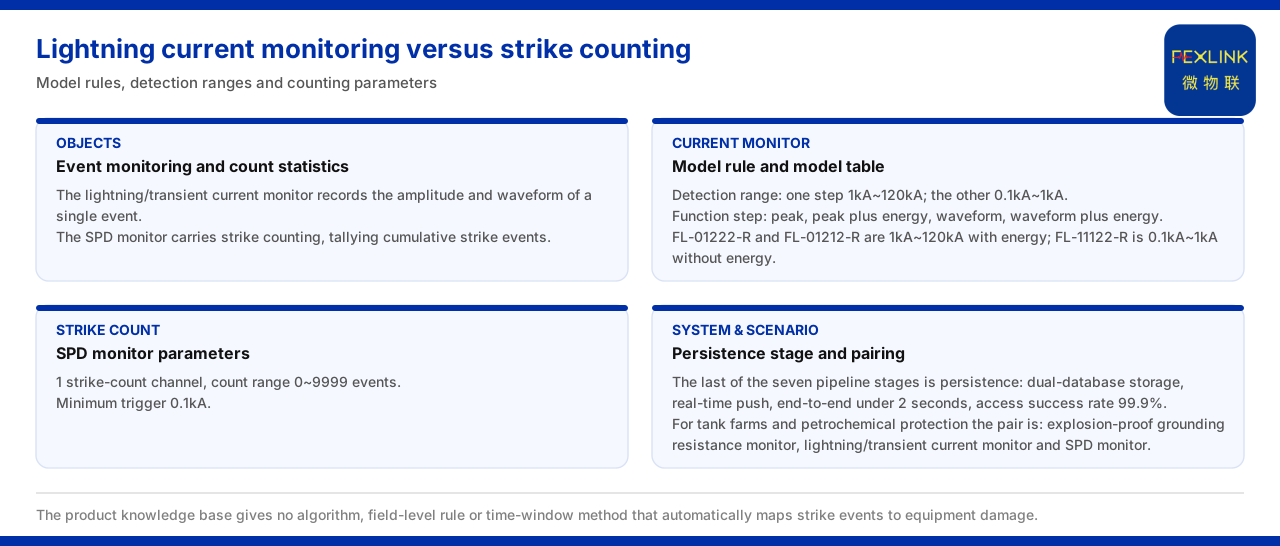
Lightning current monitoring is used to record lightning-strike or transient-current events and is one acquisition object in lightning-protection monitoring. In the product knowledge base, the entry for the lightning current / transient current monitor gives a model rule and a model table: by detection range it is divided into one thousand to one hundred twenty kiloamps and zero point one to one thousand kiloamps; by function it is divided into four tiers — peak value, peak value plus energy, waveform, and waveform plus energy. In the model table, the lightning current / transient current monitor (FL-01222-R) and the lightning current / transient current monitor (FL-01212-R) have a detection range of one thousand to one hundred twenty kiloamps and support energy, while the lightning current / transient current monitor (FL-11122-R) has a detection range of zero point one to one thousand kiloamps and does not support energy. Related to this, the surge protective device monitor carries one lightning-strike counting channel, with a counting range of zero to nine thousand nine hundred ninety-nine counts and a minimum trigger of zero point one kiloamp. The product knowledge base gives no algorithm, field-level rule or time-window method that automatically associates a lightning-strike event with equipment damage, so this article cites only the models, parameters and scenario conventions and does not infer that such a correspondence holds.
1. Distinguishing Lightning Current from Lightning-Strike Counting
Lightning current monitoring and lightning-strike counting sound similar but correspond to different products. The lightning current / transient current monitor records information such as the amplitude and waveform of a single current event; the surge protective device monitor carries lightning-strike counting, which counts the number of strikes passing through the lightning-protection device. The former focuses on the intensity of a single event, the latter on the cumulative number of occurrences. The product knowledge base places the two under different entries with separate model rules and key parameters. Once the objects are separated, each later parameter has a correct owner: on seeing a detection range and a function tier, one should know it points to the lightning current / transient current monitor; on seeing a counting range and a minimum trigger, one should know it points to the lightning-strike counting of the surge protective device monitor. Mixing the two makes it easy to apply a current-amplitude convention to counting.
2. Model Rule and Model Table of the Lightning Current Monitor
Consider the lightning current / transient current monitor first. The product knowledge base records that its model rule is assembled in order from segments for detection range, channel count, function, installation method and power supply, and ends with a communication suffix. In the detection-range tier, one option is recorded as one thousand to one hundred twenty kiloamps and another as zero point one to one thousand kiloamps; in the function tier, one option is peak value, one is peak value plus energy, one is waveform and another is waveform plus energy. The model table further gives specific entries: the lightning current / transient current monitor (FL-01222-R) is for indoor installation with a two hundred twenty volt AC supply, a range of one thousand to one hundred twenty kiloamps and energy support; the lightning current / transient current monitor (FL-01212-R) is for outdoor installation with a two hundred twenty volt AC supply, the same range and energy support; and the lightning current / transient current monitor (FL-11122-R) is for indoor installation with a two hundred twenty volt AC supply, a range of zero point one to one thousand kiloamps and no energy support. Here the detection range and function together determine the model value, while the installation method distinguishes indoor from outdoor. The waveform function tier has no mass-production selection table yet, so this article cites only its tier meaning and adds no specific model.
3. Lightning-Strike Counting of the Surge Protective Device Monitor
Next consider the lightning-strike counting of the surge protective device monitor. The product knowledge base records that it has one lightning-strike counting channel, with a counting range of zero to nine thousand nine hundred ninety-nine counts and a minimum trigger of zero point one kiloamp in the key parameters. That is, the counting function accumulates by number of occurrences and has a minimum trigger current below which a strike is not counted. The product knowledge base does not give the counting reset method, power-off retention or synchronisation rules with a host, so these are outside the scope of this article. The counting channels, counting range and minimum trigger are the boundary to keep when citing lightning-strike counting.
4. Position in the System and the Storage Step
In the general four-layer architecture of the monitoring system, the perception layer contains the surge protective device monitor, the grounding resistance monitor, the lightning current monitor and the electrical-safety series monitoring modules; the platform layer is the FEXCloud IoT cloud platform, which handles device access, the time-series database and the AI inference engine. Lightning current data is acquired at the perception layer and aggregated through the edge and the platform. In the seven-stage pipeline of the Taiyi intelligent control hub system, the last stage is persistence, recorded as using dual-database storage, real-time push and triggering the Tianyan prediction, with an end-to-end time of less than two seconds and a data-access success rate of ninety-nine point nine percent. This stage shows that time-series data such as lightning current is persisted at the end of the system and enters the prediction-trigger chain. No stage-by-stage mapping of each product is given, so only the persistence stage is cited.
5. Typical Application Combination
In the typical application scenarios and selection comparison of the product knowledge base, the row for oil-tank farms and petrochemical lightning and explosion protection recommends a product combination of the explosion-proof grounding resistance monitor, the lightning current / transient current monitor and the surge protective device monitor, where the explosion-proof grounding resistance monitor is marked with explosion-proof grade Ex d IIB. In this scenario grounding resistance monitoring, lightning current monitoring and lightning-protection device monitoring appear as parallel selection items. No wiring method, deployment quantity or linkage logic is given for this combination, so only the recommended combination and the explosion-proof grade marking are cited, without expanding them into a project scheme.
6. Reading Order and Boundaries
The above can be reduced to a reading order. First, confirm whether the object is lightning current monitoring or lightning-strike counting. Second, for lightning current monitoring, read the detection-range, function and installation-method tiers in the model rule, then check the model table; for counting, read the channels, range and minimum trigger. Third, if system integration is involved, cite the descriptions of the general four-layer architecture and the persistence stage of the seven-stage pipeline. Fourth, if a scenario is involved, return to the selection comparison and confirm the recommended combination for oil-tank farms and petrochemical lightning and explosion protection. The boundary to keep is that the product knowledge base gives no algorithm, field-level rule or time-window decision method that automatically maps or associates a lightning-strike event with equipment damage; the relevant conclusions must be checked separately and must not be inferred from the product knowledge base.
Applicability and Limits
First, this article restates only what the product knowledge base lists, and its factual boundary is the record of the model rule and model table of the lightning current / transient current monitor, the lightning-strike counting key parameters of the surge protective device monitor, the general four-layer architecture, the persistence stage of the seven-stage pipeline and the selection comparison.
Second, the indoor or outdoor installation, the two hundred twenty volt AC supply, the one thousand to one hundred twenty kiloamp range and energy support of the lightning current / transient current monitor (FL-01222-R) and (FL-01212-R), and the zero point one to one thousand kiloamp range without energy support of (FL-11122-R), are cited under the convention listed in the model table.
Third, the detection-range and function tier values are cited under the model rule; the waveform tier has no mass-production selection table, and no specific model is added.
Fourth, the one lightning-strike counting channel, the counting range of zero to nine thousand nine hundred ninety-nine counts and the minimum trigger of zero point one kiloamp of the surge protective device monitor follow the key-parameter convention; no reset or synchronisation rule is added.
Fifth, the perception-layer product scope and platform-layer functions follow the general four-layer architecture; the dual-database storage, real-time push, Tianyan prediction trigger, end-to-end time of less than two seconds and access success rate of ninety-nine point nine percent follow the seven-stage pipeline convention.
Sixth, the recommended combination for oil-tank farms and petrochemical lightning and explosion protection and the explosion-proof grade Ex d IIB are cited as listed in the selection comparison.
Seventh, the product knowledge base gives no algorithm, field-level rule or time-window method that automatically associates a lightning-strike event with equipment damage; this article accordingly states no such correspondence, and the latest product materials and formal documents prevail.