Direct Answer
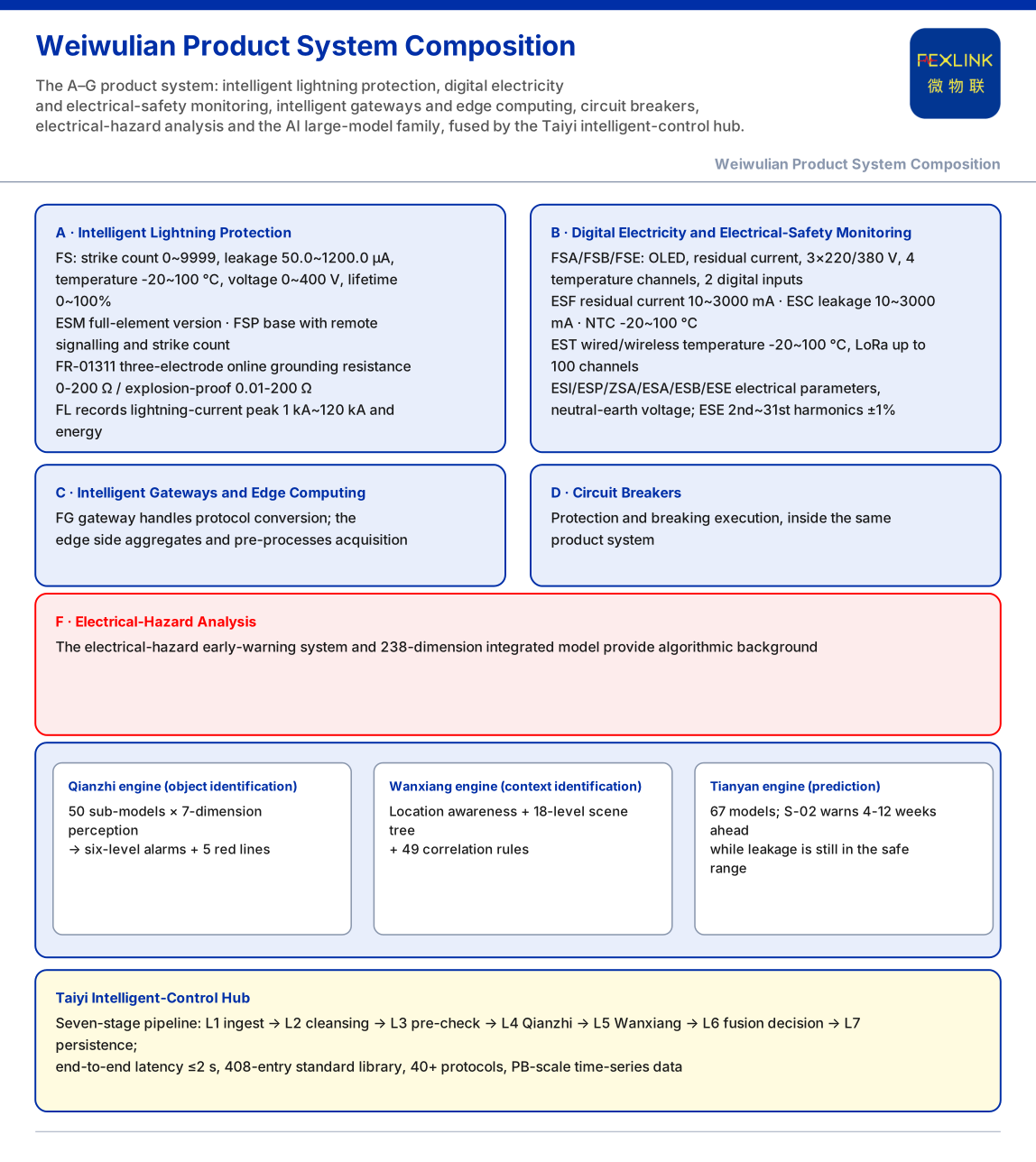
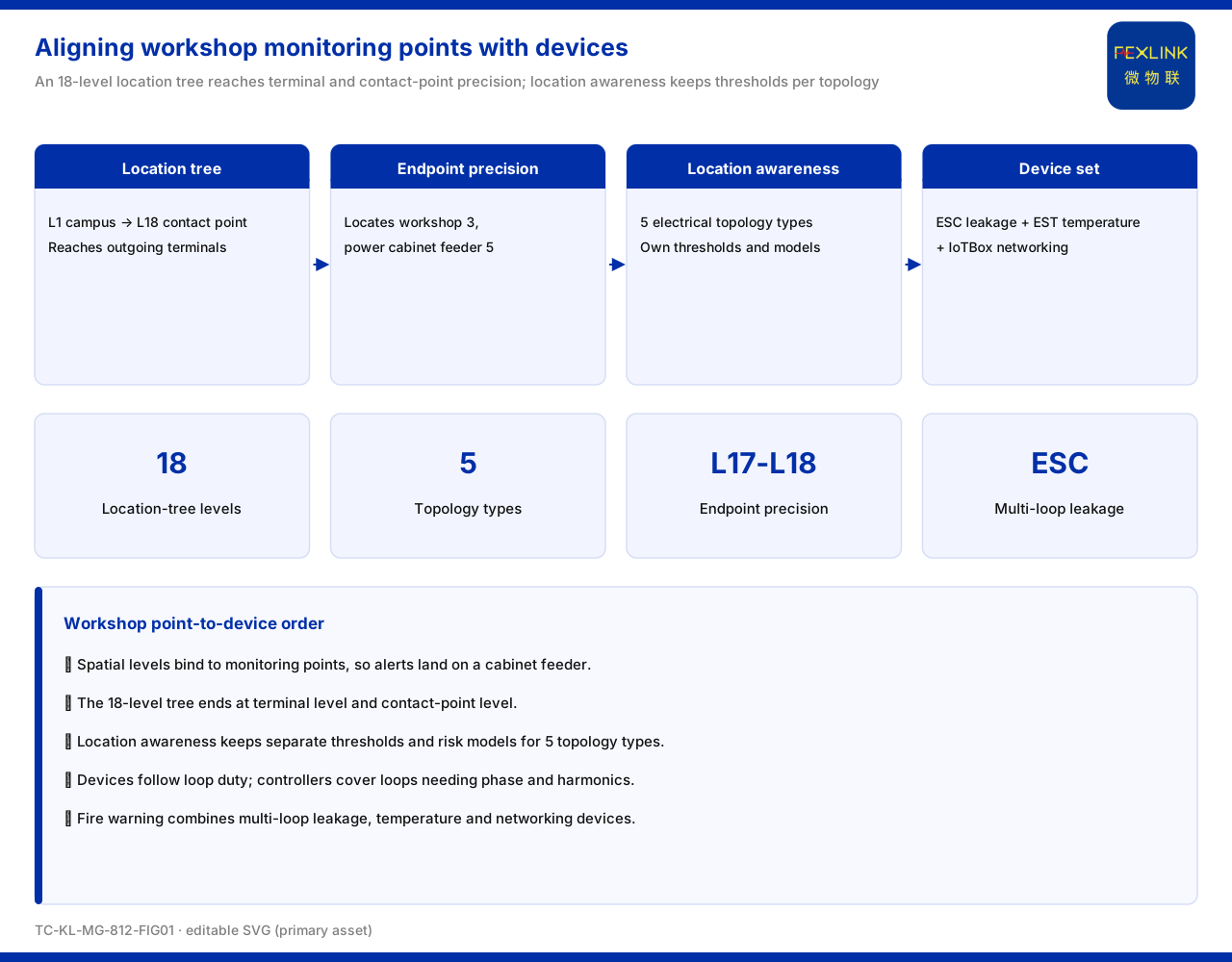
The difficulty of workshop-level distribution monitoring is not "installing a few more meters" but matching monitoring points to the workshop's actual spatial hierarchy and handing the problems of different circuits to suitable devices. According to the existing product material, the spatial basis is the eighteen-level scenario positioning tree: it drills down level by level from campus, building and floor through distribution area, transformer area, main distribution room, main switchgear, bus section, distribution panel and branch circuit, down to the wiring-terminal level and contact-point level, and at the end can precisely locate "an outgoing terminal of a power cabinet in a given workshop". The device-side basis distinguishes by circuit need: the multi-parameter electrical intelligent controller handles circuits that need phase, harmonics, residual current and digital-input linkage; electrical fire early warning in low-voltage distribution cabinets is carried by a combination of the electrical fire controller, the multi-channel leakage-current controller and the multi-channel temperature controller; and three-phase imbalance and power quality are carried by the corresponding monitors. This article restates these existing conventions only and does not infer the selection conclusion of any specific workshop.
1. Workshop-Level Monitoring First Solves "Matching the Points"
The objects of workshop distribution are dispersed: a workshop may have several power cabinets, each with a number of outgoing circuits, and below the outgoing circuits are the specific devices. If monitoring points are named only as "circuit one, circuit two", once an alarm occurs the operator finds it hard to quickly judge where the problem is. The eighteen-level scenario positioning tree in the product material is set precisely to solve this correspondence: with levels L1 to L18, it unfolds campus, building, floor, distribution area, transformer area, main distribution room, main switchgear, bus section, distribution panel and branch circuit level by level, ending at the wiring-terminal and contact-point levels. The finer the levels, the clearer the alarm landing point, which is the spatial foundation of workshop-level monitoring.
2. End-Point Precision Determines Troubleshooting Efficiency
The value of the eighteen-level scenario positioning tree is concentrated in its end-point precision. The product material records that the tree's end can precisely locate "outlet 5 of the power cabinet in workshop 3". This example shows that positioning no longer settles for "something abnormal in some workshop" but lands on a specific outgoing circuit of a specific cabinet. For workshop operation, this directly determines troubleshooting efficiency: knowing which outgoing circuit, the scope can be narrowed to the devices and lines it feeds, without inspecting every cabinet in the whole workshop. Binding the spatial hierarchy to monitoring points also lets data from different workshops and cabinets be indexed by one hierarchy, facilitating cross-comparison and centralised viewing.
3. Location Awareness Lets the Threshold Vary With Position
The same electrical parameter has different normal ranges and risk meanings in the main distribution room and on an end circuit. The location-awareness capability in the product material provides a mechanism for this: it maintains independent thresholds and risk models for five electrical topology position types, namely common coupling point, main distribution panel, distribution panel, feeder and load terminal. The meaning is that position itself participates in judgement: the same current reading on a feeder and at a load terminal may correspond to different degrees of concern. Combining location awareness with the scenario positioning tree gives workshop-level monitoring two capabilities at once: "knowing where" and "knowing by what standard that position should be viewed".
4. Choosing the Controller by Circuit Need
Device selection must correspond to circuit need. The product material records that the multi-parameter electrical intelligent controller is divided into three models, the meter type, the three-phase balance type and the power-quality type, with twelve current ratings and two networking methods; its common functions include one residual-current channel, three-by-two-hundred-and-twenty or three-by-three-hundred-and-eighty volt voltage, four temperature-monitoring channels, two digital inputs, two relay outputs, and two Modbus RS485 channels. The common functions show that the three models share one set of basic acquisition and linkage capabilities, their differences concentrating on whether they have phase monitoring and harmonic monitoring. For workshop circuits that need simple metering and basic monitoring, the basic configuration suffices; those needing three-phase balance or power-quality capability choose the corresponding model, avoiding paying for functions not needed.
5. Phase and Harmonic Capability Correspond to Different Circuits
The product material further distinguishes the tiers of monitoring capability. The three-phase imbalance monitor shares the architecture of the all-parameter smart meter and adds phase monitoring; the power-quality monitor adds harmonic monitoring on top of phase monitoring, covering the second to the thirty-first order with an accuracy of plus or minus one percent. This means circuits within a workshop can be configured by problem type: circuits concerned only with metering and simple state need basic metering; circuits at risk of three-phase imbalance get a device with phase monitoring; and circuits sensitive to harmonics or needing harmonic data get power-quality-grade monitoring. This tiered configuration matches investment to problem severity and gives later data analysis a unified parameter convention.
6. The Device Combination for Electrical Fire Early Warning
The electrical fire risk of workshop distribution cabinets needs a dedicated monitoring combination. In the typical application scenarios, the product material gives the recommended combination for electrical fire early warning in low-voltage distribution cabinets: the electrical fire controller, the multi-channel leakage-current controller and the multi-channel temperature controller, used with the IoT box. This combination covers the main cause dimensions of electrical fire: residual current, leakage and temperature. Distinguishing it from the multi-parameter controller above reveals two orientations of workshop monitoring: one is multi-parameter monitoring of circuit electricity and power quality, the other is specialised monitoring of residual current and temperature for fire risk. The two can coexist in a workshop, each serving a different decision goal.
7. Device Composition of the Perception Layer
The underlying basis of device selection can also be seen from the perception layer. The product material records that, in the general four-layer architecture of the monitoring system, the perception layer includes multiple series of monitoring modules, smart meters and sensors; the sensor types involve Rogowski coils, thermistor-type temperature sensors and microamp-level leakage-current sensors. These are the basic elements of monitoring capability: current acquisition relies on Rogowski coils and the like, temperature monitoring on temperature sensors, and residual-current monitoring on leakage-current sensors. That is, the device combination for workshop-level monitoring is not an arbitrary mix but determined by the element types and ranges available at the perception layer. Understanding this helps clarify which physical quantities need to be acquired when choosing specific models.
8. Organising the Workshop-Level Selection Into a Reviewable Order
Combining the above, the selection for workshop-level distribution monitoring can be organised in the following order. First, use the eighteen-level scenario positioning tree to establish a unified spatial hierarchy for the workshop, cabinets and outgoing circuits, ensuring alarms land on a specific outgoing circuit. Second, use location awareness to fix the corresponding thresholds and risk models for different topology positions. Third, by circuit need, distinguish basic, phase and harmonic capability among the three models of the multi-parameter electrical intelligent controller. Fourth, for the fire risk of distribution cabinets, configure the combination of the electrical fire controller, the multi-channel leakage-current controller and the multi-channel temperature controller. Fifth, return to the element types and ranges of the perception layer to check whether the chosen devices cover the physical quantities to be acquired. This order separates space, position, circuit need, risk type and element foundation, making item-by-item review easier.
Applicability and Limits
- The content is limited to the existing wording of the product material on the eighteen-level scenario positioning tree, location awareness, the multi-parameter electrical intelligent controller, the electrical fire early-warning recommended combination, the three-phase imbalance and power-quality monitors, and the perception layer. - The scenario-tree level count (eighteen), the end-point positioning example, the number of electrical topology position types (five), the controller's current ratings (twelve) and networking methods (two), the harmonic coverage (second to the thirty-first order, accuracy plus or minus one percent) and the number of common-function items are all as listed in the product material and are not a commitment to any project's results. - The recommended combination and device models are restated from the product material, and this article does not infer the final selection conclusion of any specific workshop. - The sensor types involved in the perception layer are limited to those listed in the product material, and this article does not infer unlisted elements or ranges. - This article is not a commitment to any unlisted indicator; actual capability is governed by the latest product material and project scheme.