Direct Answer
In the intelligent lightning-protection product line, leakage-current monitoring is carried mainly by three products: the surge protective device monitor (FS), the intelligent lightning-protection monitoring terminal (ESM) and the intelligent surge protective device (FSS). Their leakage-current conventions differ. The surge protective device monitor encodes voltage channels, leakage-current channels, temperature channels, digital input and grounding or lightning strike into the model, and in its model table the two groups FS-03211-R and FS-33211-R both have 3 leakage-current channels and 2 temperature channels. The intelligent lightning-protection monitoring terminal distinguishes supply, display, phase count, current parameter and version in its model rule, and its current-parameter tier has a acquisition range of 0.05 to 1.2 milliamps, with corresponding models for 1-channel and 3-channel leakage current in the model table. The intelligent surge protective device encodes leakage current as an optional configuration, and in the leakage-current version the 4P type has 3 leakage-current channels while the 2P type has 1. It should be noted that the knowledge base lists no leakage-current range selection rule, decision threshold or degradation criterion for different SPD types or circuits, so this article cites the three products' channel counts and ranges separately and does not infer a selection conclusion.
1. The Position of Leakage-Current Monitoring in the Product System
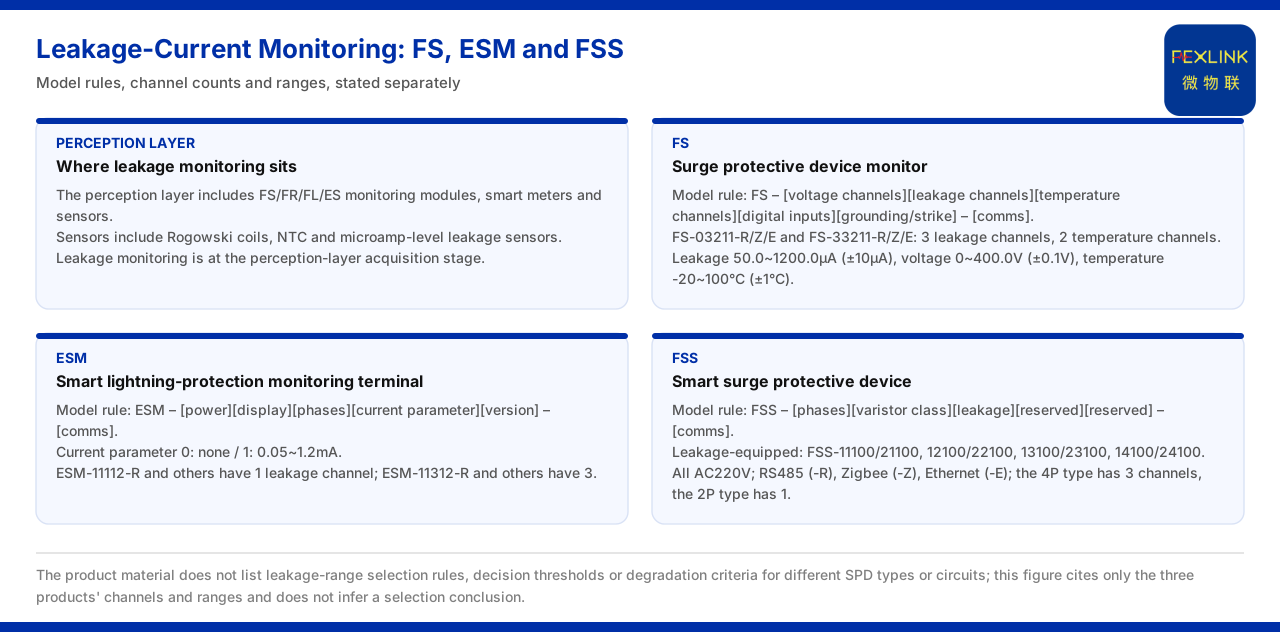
First see which layer of the system leakage-current monitoring occupies. In the general four-layer architecture of the knowledge base, the perception layer contains monitoring modules and sensors; the monitoring modules list the FS, FR, FL and ES series, and the sensors include Rogowski coils, NTC and microamp-level leakage-current sensors. The leakage-current element enters the system at the acquisition step of the perception layer. Once the layer is fixed, the three products' leakage-current capability has a unified landing point: all provide an acquisition convention at the perception layer rather than computing at the edge or application layer. Seeing this avoids conflating acquisition capability with later analysis and avoids taking one product's channel count as the leakage-current capacity of the whole system.
2. Model Rule and Leakage-Current Channels of the Surge Protective Device Monitor
The model rule given by the knowledge base for the surge protective device monitor consists of code segments for voltage channels, leakage-current channels, temperature channels, digital input and grounding or lightning strike, followed by a communication segment. In the model table, the groups FS-03211-R and FS-03211-Z and FS-03211-E, and FS-33211-R and FS-33211-Z and FS-33211-E, both have 3 leakage-current channels and 2 temperature channels. In this product, 3 leakage-current channels is one tier in the model table, expressed in combination with voltage, temperature and digital-input items. The knowledge base does not give the complete value table of each code position in this model rule, so this article cites only the combinations appearing in the model table, with their leakage-current and temperature channel counts, and does not supply the meaning of other code positions.
3. Key Parameters of the Surge Protective Device Monitor
The parameter section further gives the measurement convention of the surge protective device monitor. The leakage-current range is 50.0 to 1200.0 microamps with an accuracy of plus or minus 10 microamps; the voltage range is 0 to 400.0 volts with an accuracy of plus or minus 0.1 volts; the temperature range is -20 to 100 degrees Celsius with an accuracy of plus or minus 1 degree Celsius; the lightning-strike count range is 0 to 9999 with a minimum trigger of 0.1 kiloamps; and the life-estimation range is 0 to 100 percent. The monitor thus covers leakage current, voltage, temperature, lightning-strike counting and life estimation, with leakage current one independent item. The knowledge base does not state any correlation algorithm among the measurement items, so this article cites these ranges and accuracies in parallel and does not infer how they jointly participate in a judgement.
4. Model Rule and Leakage-Current Channels of the Intelligent Lightning-Protection Monitoring Terminal
Now consider the intelligent lightning-protection monitoring terminal. Its model rule, as given by the knowledge base, consists of code segments for supply, display, phase count, current parameter and version, followed by a communication segment, where the current-parameter tier takes 0 for none and 1 for 0.05 to 1.2 milliamps. In the model table of this intelligent SPD terminal, ESM-11112-R and ESM-21112-R are 1-channel leakage current, while ESM-11312-R and ESM-21312-R are 3-channel leakage current. One terminal can thus form two leakage-current configurations, 1-channel and 3-channel, expressed in concrete models. The knowledge base does not expand all values of the version and phase-count segments, so this article cites only the current-parameter range and the models for 1-channel and 3-channel leakage current.
5. Leakage-Current Configuration of the Intelligent Surge Protective Device
The third product is the intelligent surge protective device. Its model rule consists of code segments for phase count, varistor level, leakage current and two reserved segments, followed by a communication segment, where the leakage-current tier takes 0 for none and 1 for full current. The leakage-current version of this intelligent surge protective device includes FSS-11100 and FSS-21100 and FSS-12100 and FSS-22100 and FSS-13100 and FSS-23100 and FSS-14100 and FSS-24100, and these groups are marked with 1-channel or 3-channel leakage-current monitoring. The series description further states that in the leakage-current version the 4P type has 3 channels and the 2P type has 1. Leakage-current channels thus relate to pole count, 4P to 3 channels and 2P to 1. The knowledge base does not state the full-current tier's measurement range, so this article cites only the channel counts and optional configuration.
6. Communication Configuration and Supply Convention
The three products each have records on communication and supply. The whole intelligent surge protective device series has an AC220V supply and all support RS485, with the suffix R; Zigbee corresponds to the suffix Z and Ethernet to the suffix E, selected by suffix. The model of the surge protective device monitor likewise distinguishes RS485, Zigbee and Ethernet by suffix. The model of the intelligent lightning-protection monitoring terminal also expresses the communication choice by suffix. The suffix rules of the three products show that the communication method is an option determined at the model level rather than a software switch in one model. The knowledge base does not give the protocol details or networking scale under each communication method, so this article cites only the correspondence between suffix and communication type and does not infer a protocol implementation.
7. Boundaries to Hold and the Reading Order
The above can be reduced to a reading order. First, confirm which product the object belongs to: the surge protective device monitor, the intelligent lightning-protection monitoring terminal, or the intelligent surge protective device. Second, read its model rule and locate the code position of leakage current and its optional values. Third, find the corresponding leakage-current channel count in the model table, making clear whether it is 1 or 3. Fourth, cite the leakage-current measurement range and accuracy listed for that product, distinguishing the different range conventions of each product. The boundary to hold is that the knowledge base lists no leakage-current range selection rule, decision threshold or degradation criterion for different SPD types or circuits, so leakage-current element selection can cite only the channel counts and ranges in the model table, and no selection conclusion may be inferred from the knowledge base. This boundary is limited to the knowledge-base text and is the restriction readers most need to carry away.
Applicability and Limits
- This article restates only what the knowledge base lists; its factual boundary is the model rules, model tables and parameter sections recorded for the surge protective device monitor, the intelligent lightning-protection monitoring terminal and the intelligent surge protective device. - The 3 leakage-current channels and 2 temperature channels of the surge protective device monitor (FS-03211 and FS-33211 series), together with the leakage-current range 50.0 to 1200.0 microamps and accuracy plus or minus 10 microamps, are cited under the knowledge base's convention; no other code position of the model rule is added. - The 1-channel and 3-channel leakage current of the intelligent lightning-protection monitoring terminal (ESM-11112-R and ESM-21112-R and ESM-11312-R and ESM-21312-R), and the current parameter 0.05 to 1.2 milliamps, are cited under the knowledge base's convention. - The 1-channel and 3-channel leakage current of the intelligent surge protective device (FSS leakage-current version), with 4P corresponding to 3 channels and 2P to 1 channel, together with the AC220V supply and suffix communication, are cited under the knowledge base's convention; the full-current tier range is not added. - The placement of leakage-current monitoring at the perception-layer acquisition step, and the perception layer containing the FS, FR, FL and ES series and microamp-level leakage-current sensors, are cited under the four-layer architecture convention. - The knowledge base lists no leakage-current range selection rule, decision threshold or degradation criterion, and this article accordingly states no selection conclusion. - This article explains only the information and reading order within the knowledge base and is not a commitment to a project's selection or compliance conclusion; the latest product documents prevail in practice.