Direct answer
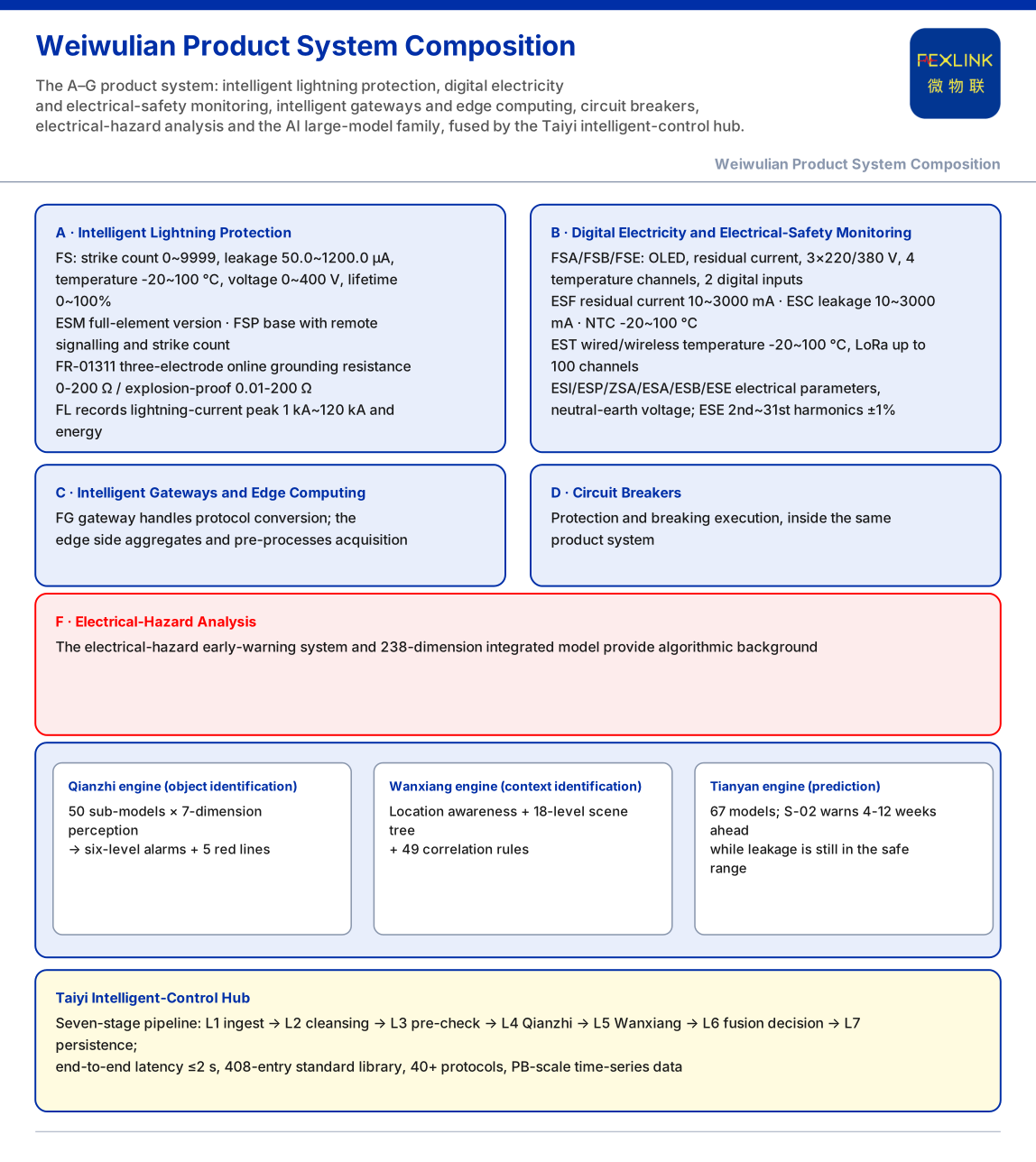
In a distribution system, an alarm is useful only if it can answer where. The same high temperature means entirely different things depending on whether it occurs on a main line, a distribution panel, or a load terminal. The Wanxiang engine (V4.0) is precisely the judgement layer built around where and why an anomaly occurs, and its foundation is an eighteen-level scenario locating tree together with a set of cross-dimension association rules. Based on the wording listed in the product documentation, this article explains the tree's grading, its end precision, the location-awareness types, the composition of the association rules, the dedicated analysis engines, and the quantified value; it infers no locating conclusion for any specific site.
1. Situation-awareness brain: Wanxiang's positioning
The family overview in the product documentation positions the Wanxiang engine (V4.0) as the situation-awareness brain, judgement layer, whose duty is to answer why and where an anomaly occurs, with an eighteen-level scenario tree plus forty-nine association rules at its core. This positioning shows that it does not compete with perception-type capabilities within the family but is dedicated to spatial and causal judgement.
Breaking the duty apart, why corresponds to causal analysis and where corresponds to spatial locating; only together do they make judgement. The eighteen-level scenario tree handles the spatial dimension, and the forty-nine association rules handle cross-dimension relations; superimposed, they form the basis of derivation from a point exceeding a limit to why and where an anomaly occurs. The product documentation gives the positioning and the core composition, and this article does not expand the engine's internal reasoning flow.
2. The eighteen-level scenario locating tree
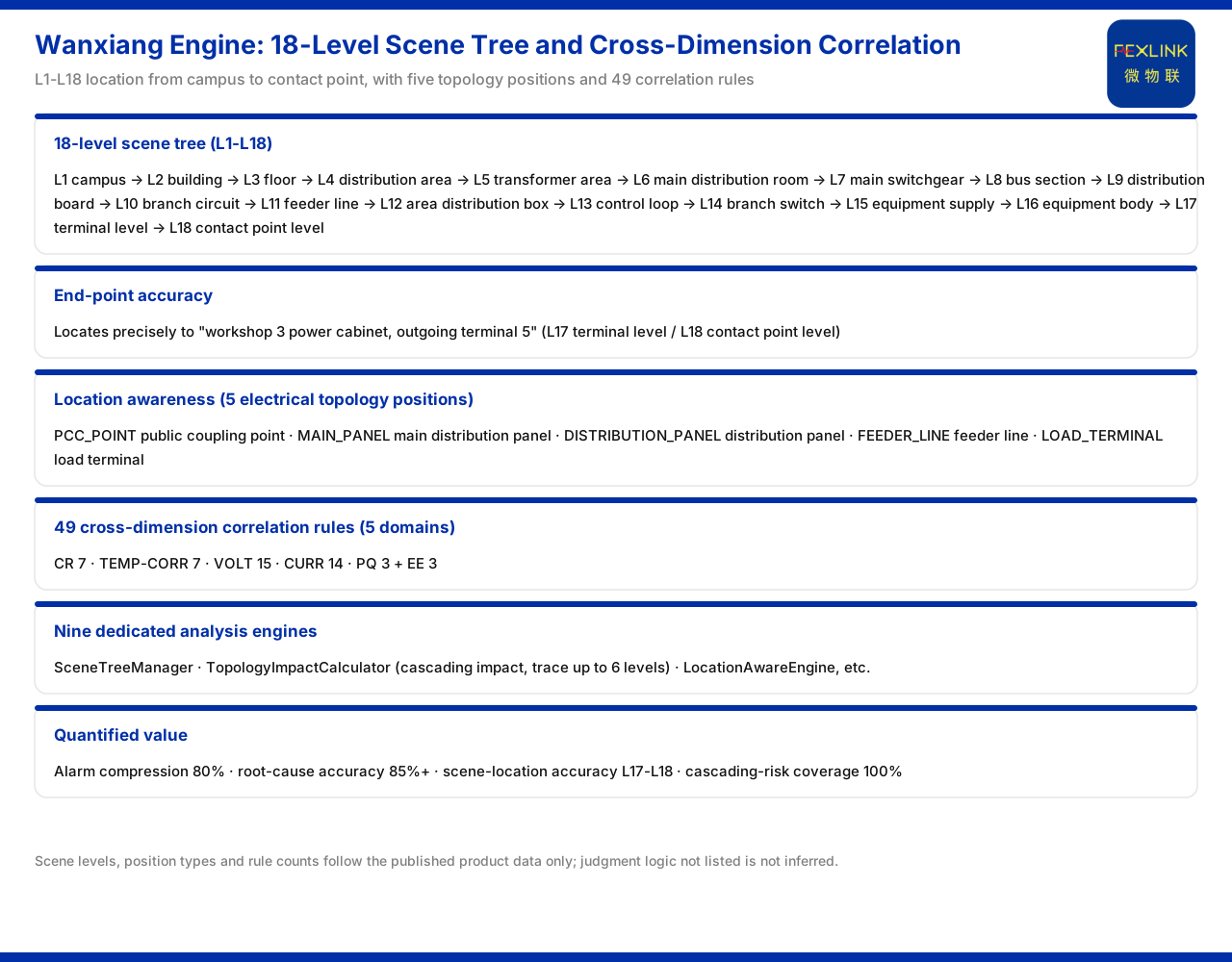
The product documentation states that the eighteen-level scenario locating tree of the Wanxiang engine runs from L1 to L18 in order: park, building, floor, distribution area, transformer area, main distribution room, main switchgear, bus section, distribution panel, branch circuit, trunk feeder, regional distribution box, control loop, branch switch, equipment supply, equipment body, L17 terminal level, and L18 contact-point level. The eighteen levels converge step by step from large to small.
The value of this tree is a unique path. From the park all the way down to the contact point, every point has one and only one path of belonging on the tree. When data becomes abnormal, the system can trace back up this path and judge at which level the anomaly falls. The later the level, the finer the locating. Viewing the tree levels against alarms explains why the same value carries different risk meanings at different levels. The product documentation gives the level names and order, and this article does not infer the decision threshold of each level.
3. End precision: L17 and L18
The product documentation states that the end precision of the scenario tree reaches the L17 terminal level and the L18 contact-point level. For example, an alarm can be located precisely to a granularity such as the fifth outgoing line terminal of the power cabinet in the third workshop.
From a distribution panel to a certain outgoing line terminal, the difference is not just textual detail but maintenance efficiency. Locating to the panel still requires manual checking circuit by circuit; locating to the terminal lets the maintenance worker reach the target point directly. End precision is therefore the most practical value outlet of the scenario tree. The specific position listed here is only an example given by the product documentation, and this article does not infer the actual point distribution or locating accuracy of any site from it.
4. Location awareness: five topology positions
The product documentation states that Wanxiang's location awareness maintains five types of electrical topology positions: point of common coupling, main distribution panel, distribution panel, feeder line, and load terminal, and maintains independent thresholds and risk models for each type of position.
The words independent thresholds are the key. The normal interval of the same current on a feeder line and on a load terminal is different to begin with, and sharing one set of thresholds would inevitably produce false or missed alarms. Building models separately for different position types makes judgement fit the electrical characteristics of that position. Location awareness and the scenario tree are two sides of one thing: the scenario tree gives spatial belonging, and location awareness gives the judgement rule corresponding to that belonging. The product documentation lists only the type names, and this article does not expand the specific values of the thresholds.
5. Forty-nine cross-dimension association rules
The product documentation states that the Wanxiang engine has forty-nine cross-dimension association rules, divided into five domains: seven in the CR series, seven in the TEMP-CORR series, fifteen in the VOLT series, fourteen in the CURR series, and three in the PQ series plus three in the EE series. The rules link data from different dimensions.
A single dimension can only show that one quantity exceeds a limit; cross-dimension association explains why. For example, the correlated change of temperature and current, and the mutual influence of voltage and power quality, both need rules to describe. A scale of forty-nine shows that the associations are not scattered settings but a system organised by domain. The point of the rules is to support the judgement layer in moving from discovery to explanation. The product documentation gives the rule domains and counts, and this article does not infer the conditions and conclusions of each rule.
6. Nine dedicated analysis engines and cascading tracing
The product documentation states that the Wanxiang engine has nine dedicated analysis engines, including the SceneTreeManager, the TopologyImpactCalculator, and the LocationAwareEngine. The topology impact calculator computes topology cascading effects and traces up to six levels.
Cascading tracing is the capability in the judgement layer closest to why. If an anomaly lies upstream in the supply chain, its effect spreads down the topology; being able to trace up to six levels means the system can judge the scope of impact rather than staring at an isolated point. The scenario tree manager maintains the spatial structure, and the location-awareness engine applies the location rules, with a clear division among the three. The product documentation gives the number of engines and some names, and this article does not infer the functional details of the remaining engines.
7. Quantified value
The product documentation states the quantified value of the Wanxiang engine: alarm compression 80%, root-cause accuracy above 85%, scenario locating precision reaching L17 to L18, and cascading-risk coverage 100%. The four indicators correspond to efficiency, accuracy, precision, and coverage.
Alarm compression of 80% shows that many repeated or low-value alarms are merged, reducing the handling burden; root-cause accuracy above 85% shows that judgement conclusions are broadly reliable; locating precision to L17 to L18 shows that spatial resolution reaches the terminal and contact-point level; and cascading-risk coverage of 100% shows that topology impact analysis leaves no blind spot. Together, the four outline the judgement layer's capability from accurate to complete. The product documentation gives the indicator values, and this article does not commit to the actual performance of any project on that basis.
Scope and limitations
First, this article restates only the wording listed in the product documentation, and its factual boundary is limited to: the positioning of the Wanxiang engine (V4.0) as the situation-awareness brain, judgement layer, its duty to answer why and where an anomaly occurs, and its core of an eighteen-level scenario tree plus forty-nine association rules; the scenario tree from L1 park to L18 contact-point level in eighteen levels, with the end reaching L17 terminal level and L18 contact-point level and an example located to the fifth outgoing line terminal of the power cabinet in the third workshop; location awareness containing the five types of point of common coupling, main distribution panel, distribution panel, feeder line, and load terminal, each maintaining independent thresholds and risk models; the forty-nine association rules divided into five domains (seven in CR, seven in TEMP-CORR, fifteen in VOLT, fourteen in CURR, and three in PQ plus three in EE); the nine dedicated analysis engines including SceneTreeManager, TopologyImpactCalculator (cascading tracing up to six levels), and LocationAwareEngine; and the quantified value of alarm compression 80%, root-cause accuracy above 85%, scenario locating precision L17 to L18, and cascading-risk coverage 100%.
Second, this article does not infer the threshold values of each level or position type, nor the actual locating result and root-cause judgement of any specific site.
Third, the scenario-tree levels, position types, and quantified indicators are product-documentation wording, and field placement and point division belong to engineering-design judgement.
Fourth, specific selection and configuration should follow the latest product documentation, the relevant standards, and the project scheme.