Direct answer
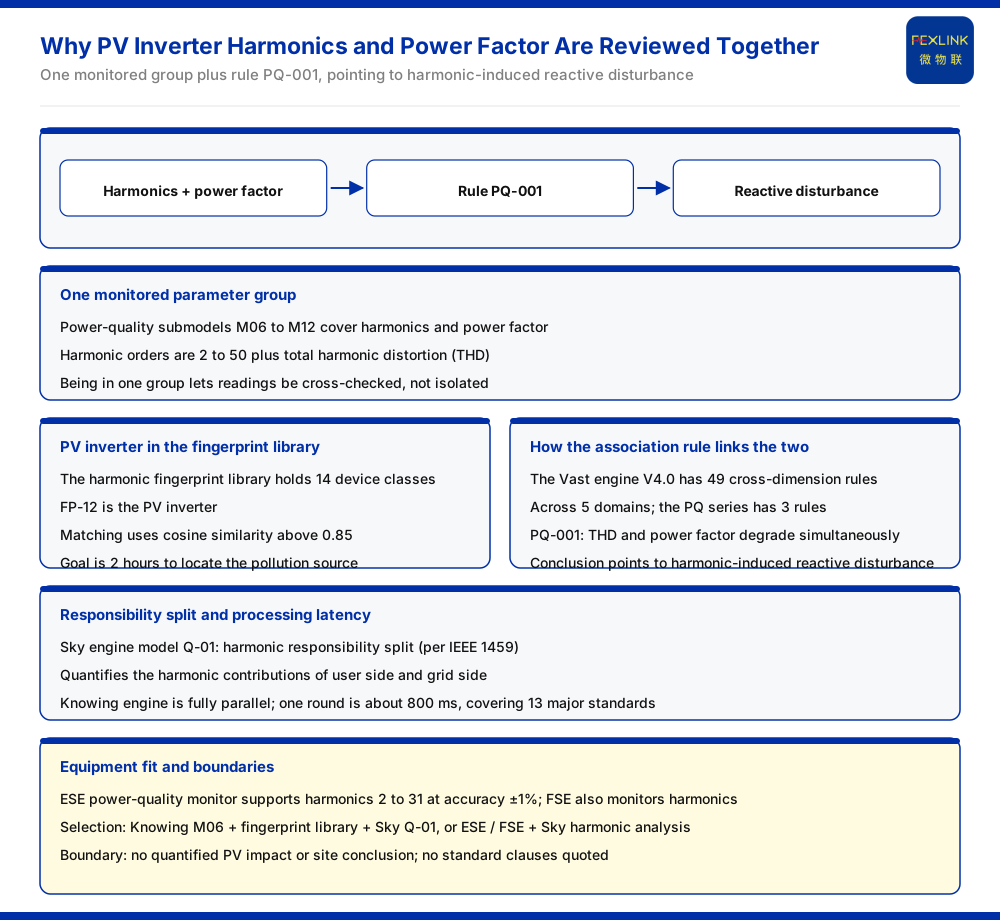
Harmonics and power factor in a PV inverter need to be observed jointly because, in the records of the product knowledge base, the two belong to the same group of monitored objects, and dedicated cross-dimensional association rules tie them together. The power-quality examination sub-models place harmonics (orders 2 through 50 plus total harmonic distortion) and power factor in the same sub-model group; association rule PQ-001 of the Wanxiang engine / large model (V4.0) reads directly as "total harmonic distortion and power factor deteriorate synchronously, pointing to harmonic interference with reactive power". The harmonic fingerprint library, for its part, lists the PV inverter separately as device fingerprint FP-12. Only when the two change together does the specific judgment "harmonic interference with reactive power" hold.
The objects of joint observation
The product knowledge base records that sub-models M06 to M12 of the power-quality examination block of the Qianzhi engine / large model (V4.1) cover harmonics and power factor — that is, at the level of monitored parameters, harmonics (orders 2 through 50 plus total harmonic distortion) and power factor are placed in the same group. Grouping them means their readings can be checked against one another rather than each being read in isolation. The point of joint observation is not to add a new measurement; it is to keep two quantities that share a physical mechanism inside one comparable frame. Harmonics and reactive-power behavior are not independent events at the inverter terminal, and placing them in one group is what later allows a rule to combine them.
The PV inverter's place in the fingerprint library
The harmonic fingerprint library contains 14 device fingerprint classes, of which FP-12 is the PV inverter. Fingerprint matching uses a criterion of cosine similarity greater than 0.85; the product knowledge base gives a target of locating the pollution source within 2 hours and notes that the conventional approach takes weeks. Listing the inverter as a fingerprint class of its own shows that its harmonic signature has an identifiable shape; the value is that when a harmonic anomaly appears on site, this entry can be used to judge whether the pollution source points to the inverter. Identification supplies a candidate class, which is a different question from quantification: it answers "which kind of device does this resemble", not "how much of the distortion is attributable here".
How the association rule links the two
The Wanxiang engine / large model (V4.0) has 49 cross-dimensional association rules, falling into 5 domains, of which the PQ series has 3. PQ-001 reads "total harmonic distortion and power factor deteriorate synchronously, pointing to harmonic interference with reactive power". What this rule supplies is not an out-of-limit judgment on a single parameter but a combined judgment on two parameters changing together: only when rising harmonic distortion and worsening power factor appear at the same time does it point to interference at the reactive-power level. Reading either of the two alone would not support that conclusion, which is why the two monitored objects must first sit in the same group. The rule is the mechanism that turns two parallel readings into one directional statement.
Division of harmonic responsibility
In the quantification of responsibility, the product knowledge base records that the signature model Q-01 of the Tianyan engine / large model is "harmonic responsibility division", on the basis of IEEE 1459. It is used to quantify the respective harmonic contributions of the user side and the grid side. The fingerprint library is responsible for locating the source, and responsibility division for apportioning contributions; the two answer different questions. Locating the source yields a device class, while apportioning contributions yields a split of responsibility on a standard basis. Keeping the two apart prevents a source-identification result from being read as an allocation of liability, and vice versa.
Processing latency and standard coverage
The Qianzhi engine / large model has a fully parallel structure, with a single-round analysis of about 800 milliseconds at the analysis level of the seven-level pipeline; it covers 13 major standards including GB/T 12325, GB/T 14549, and GB/T 15543. These are the figures listed by the product knowledge base, and this article does not infer the analytical performance of any given site from them. The standard list states the coverage of the engine; it does not by itself decide whether a particular reading passes or fails.
Monitoring devices and selection landing points
On the device side, the product knowledge base records that the power-quality monitor (ESE) adds harmonic monitoring on top of phase monitoring, supporting harmonics of orders 2 through 31 at an accuracy of ±1%; the multi-parameter electrical intelligent controller (power quality type, FSE) likewise carries harmonic monitoring. On selection comparison, the combination for "harmonic tracing and responsibility division" is Qianzhi M06 plus the fingerprint library plus Tianyan Q-01; the landing point for "power-quality and harmonic dedicated treatment" is the power-quality monitor ESE or the multi-parameter electrical intelligent controller (power quality type) FSE, together with Tianyan engine harmonic analysis. The two combinations serve different objects: the first assembles the analysis chain for tracing and apportioning responsibility, while the second lands on field monitoring devices plus harmonic analysis. Which applies depends on whether the task at hand is to attribute a harmonic problem or to monitor the power quality of a point continuously. In both cases the device side is responsible for measuring accurately and the engine side for assessing, so the two stages complement rather than replace one another.
Scope and limitations
First, this article restates only what the product knowledge base lists, and introduces no standard clause, parameter, certification or case that is not listed.
Second, the 49 association rules, the 3 in the PQ series, the 14 device fingerprint classes, the cosine similarity greater than 0.85, the 2 hours to locate the pollution source, the about 800 milliseconds, the 13 major standards, and the harmonics of orders 2 through 31 at an accuracy of ±1% are all figures listed by the product knowledge base, and this article does not extend them to other models or sites.
Third, this article's reference to IEEE 1459 and to the GB/T series standards is limited to the records of the relevant models and coverage in the product knowledge base; it does not set out specific clauses and makes no compliance determination.
Fourth, product versions and models are subject to the latest product documentation; actual configuration must be confirmed in conjunction with site conditions.