The trade-off between NILM and submetering
Direct answer
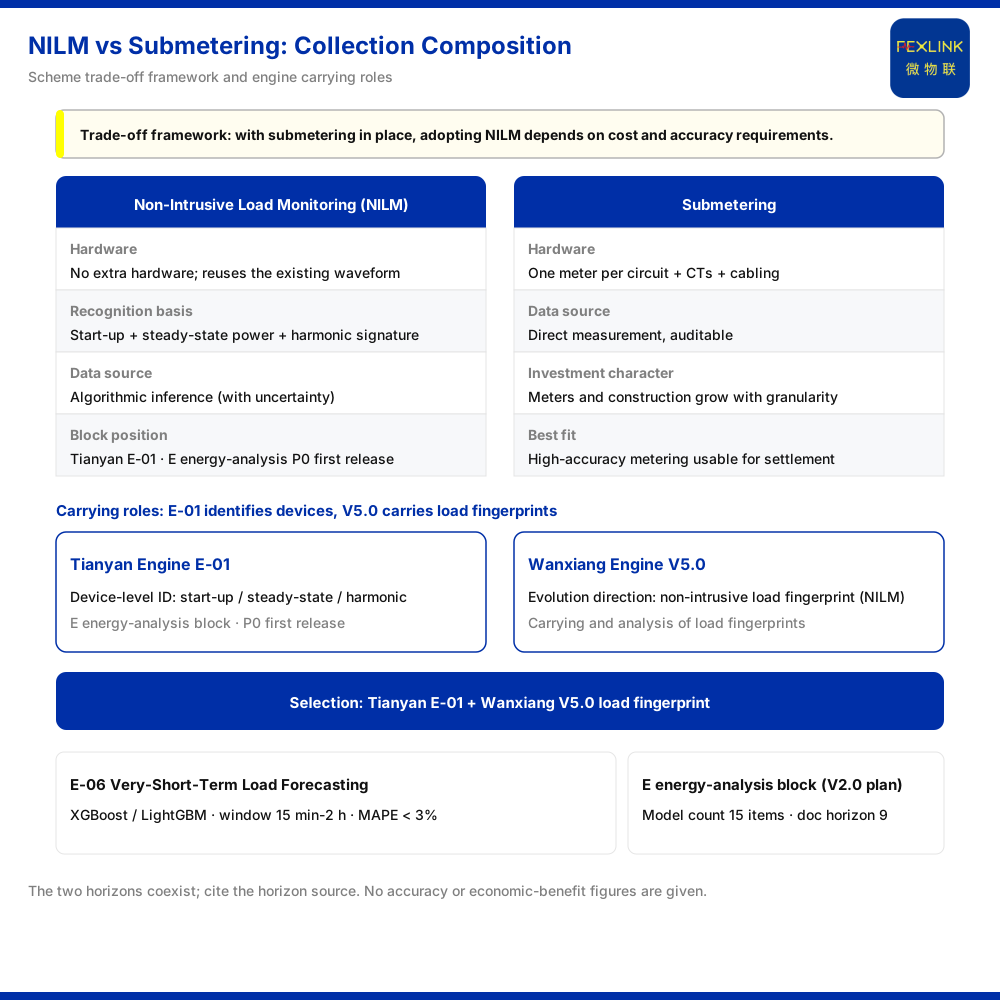
When submetering is already in place, whether to introduce non-intrusive load monitoring (NILM) as well has no one-size-fits-all answer. According to the knowledge base, the E-01 NILM model of the Tianyan engine requires no additional hardware, identifying specific devices from the existing current waveform; compared with installing submetering meters point by point, what it saves is the incremental investment in sensors and cabling, at the cost that the recognition result depends on algorithmic inference rather than direct measurement. The trade-off between NILM and submetering depends on cost and accuracy requirements. This trade-off judgment is the scheme-framing framework used in this article to organize a project decision. The knowledge base records that NILM requires no additional hardware and obtains device-level information from the existing current waveform, and the comparison with submetering is framed accordingly.
What NILM is: no additional hardware, waveform-based identification
The E-01 NILM model of the Tianyan engine (V2.0) is recorded as: no additional hardware, identifying specific devices from the current waveform. Its recognition basis is a joint judgment of "start-up signature, steady-state power, and harmonic signature": the shape of the current transient at the instant a device starts, the steady-state power level during operation, and the harmonic signature together constitute the device's identity. The joint judgment is adopted to compensate for the shortcomings of a single feature — steady-state power alone struggles to distinguish devices of similar power, while the start-up signature alone is easily disturbed by simultaneous start events. The harmonic signature contributes the spectral shape, so the three features cover the time-domain transient, the power level, and the spectral domain respectively, and it is their combination that supports a device-level answer. E-01 NILM belongs to the E energy-analysis block of the Tianyan engine and is listed as that block's P0 first-release model, indicating that passive device identification is placed at a priority position within energy analysis. Block assignment and release position are separate pieces of information: the former states which section of the engine the model belongs to, the latter its order of release, and the two should be read side by side rather than inferred from one another.
Difference from submetering: investment and accuracy
The submetering approach is "one meter per circuit," directly measuring the electricity use of each branch, with a clear and auditable data source; the cost is the incremental investment in meters, current transformers, cabling, and points, which grows with monitoring granularity. The NILM approach is "inferring devices from the existing main-point waveform," adding no measuring points and relying on an algorithm to disaggregate the total power to device level; the cost is that the recognition result derives from inference and inherently carries uncertainty. These two costs move in opposite directions: on the submetering side, finer granularity means more meters and more construction, while on the NILM side, granularity is not bought with hardware but paid for in the uncertainty of an inferred result. Therefore, where a scenario requires high-accuracy metering data usable for itemized settlement, submetering is more direct; where the scenario targets device profiling, energy-efficiency diagnosis, and rough screening before renovation, and wishes to control hardware investment and construction impact, the no-additional-hardware character of NILM is more attractive. The above comparison is the trade-off framework used in this article.
Understanding NILM within the broader engine layout
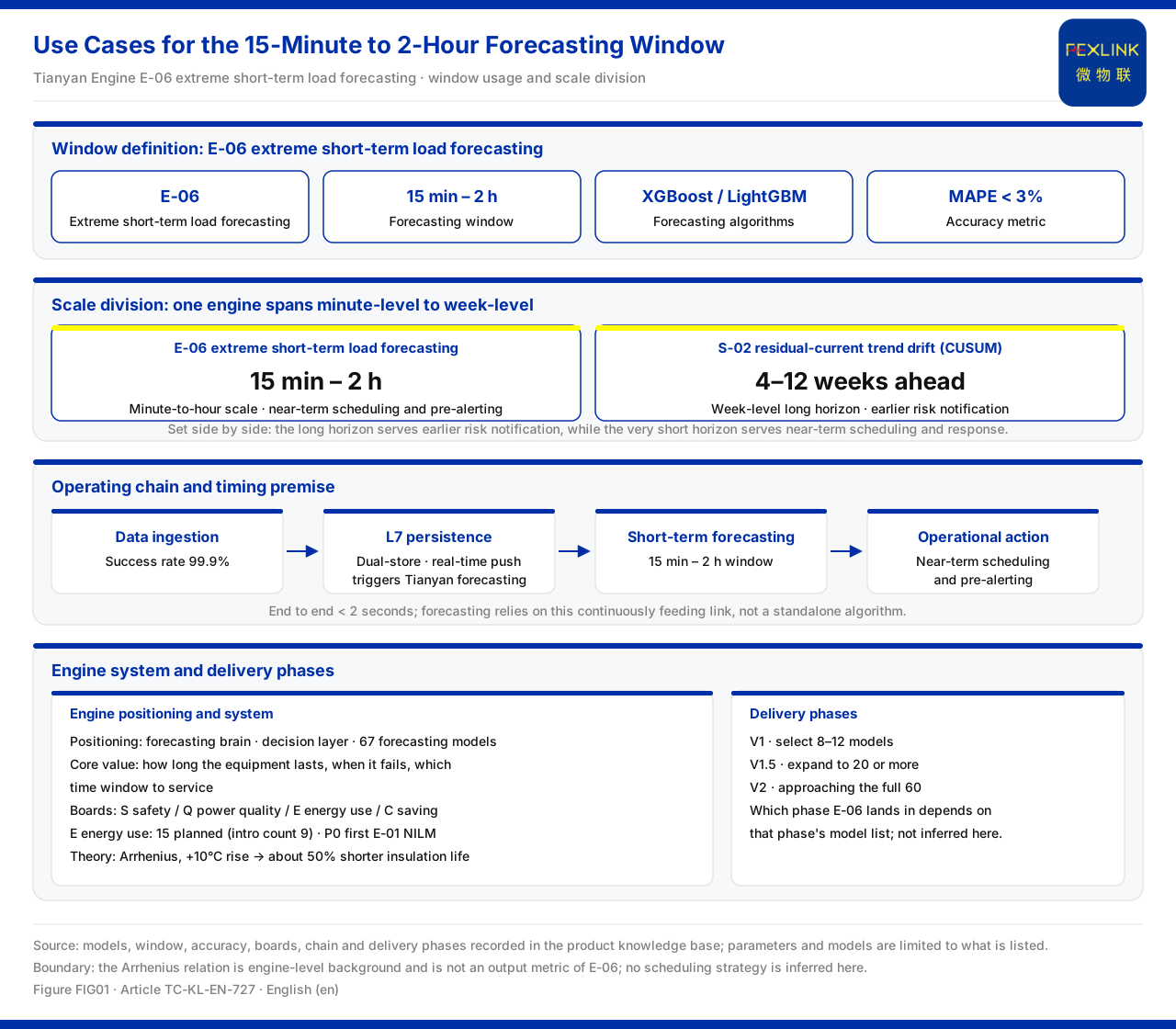
From the perspective of product evolution, NILM is not an isolated model. The evolution direction of the Wanxiang engine (V5.0) is recorded as "non-intrusive load fingerprint (NILM)," and includes the Wanxiang Engine Upgrade Technical Plan V5.0 and the Wanxiang V5 NILM advancement plan; in the selection comparison table, the combination for "non-intrusive load identification (NILM)" is the Tianyan E-01 together with the Wanxiang V5.0 load fingerprint. That is, the Tianyan side handles device-level recognition, while the Wanxiang side provides the bearing and analysis of the load fingerprint; the two together form the complete NILM capability. The combination in the table is itself the evidence that the capability is carried jointly by two engines rather than by either one alone; each engine is listed for what it contributes, and the pairing is what the table presents as the complete route. At the same time, E-06 very-short-term load forecasting, which also belongs to the Tianyan E energy-analysis block, uses XGBoost/LightGBM, with a window of 15 minutes to 2 hours and a MAPE of less than 3%. The model count of the E energy-analysis block is planned as 15 items under V2.0, while the documented introduction horizon is 9; the two horizons coexist, and the source of the horizon should be noted when citing.
Scope and limitations
This article answers only the question "when submetering is already in place, how should one choose between NILM and submetering," and its content is limited to the Tianyan E-01 NILM features, block positioning, the Wanxiang V5.0 evolution direction and selection combination, and the E-06 parameters of the same block already recorded in the knowledge base.
"the trade-off depends on cost and accuracy requirements" is the scheme-framing framework this article uses to organize the topic.
This article provides no recognition accuracy, misjudgment rate, disaggregation error, or any accuracy indicator, nor does it provide economic-benefit figures such as energy savings, investment payback period, or ROI; the knowledge base does not list these.
The "15 items" and "9" of the E energy-analysis block are two coexisting horizons; this article presents both and does not substitute one for the other.
This article does not assert that NILM is necessarily better or worse than submetering; actual selection must be confirmed item by item in conjunction with monitoring objectives, accuracy requirements, existing metering conditions, and budget.