Direct answer
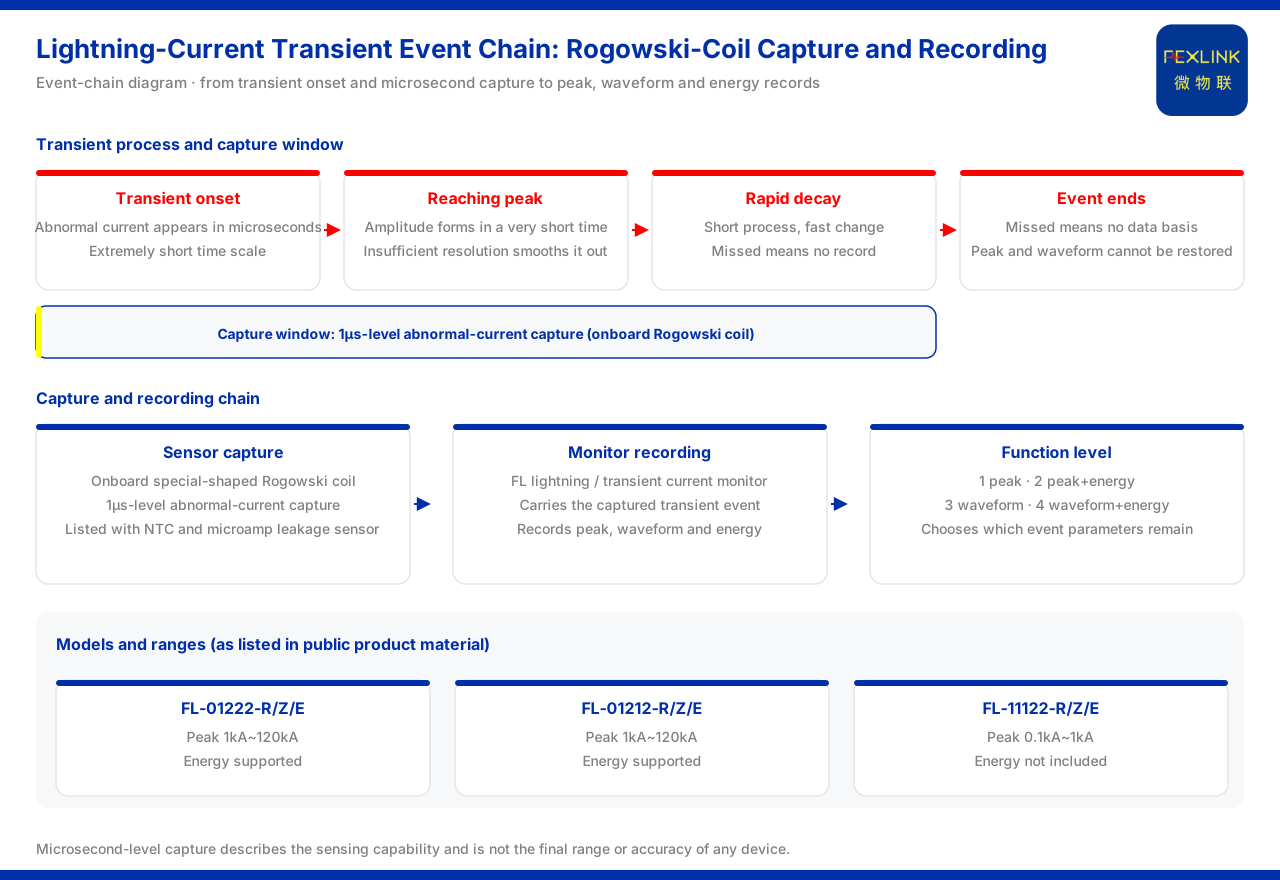
The positioning of the onboard special-shaped Rogowski coil in the product knowledge base is a core sensor technology, whose key capability is to capture abnormal current on a microsecond time scale. The knowledge base lists "onboard special-shaped Rogowski coil (1μs-level abnormal-current capture)" alongside "microamp-level leakage-current acquisition" as core sensor technologies, and records that its accuracy is 50~100 times better than comparable products. The significance of this technology is that lightning current and abnormal current are transient quantities: whether the front end can capture them on a microsecond scale determines whether the subsequent peak, energy and waveform recording has a usable raw signal. Therefore, adopting Rogowski-coil technology must answer not "can it measure current" but "can it sense this transient in time".
It is positioned as a core sensor technology
The knowledge base lists the onboard special-shaped Rogowski coil as one of the company's core sensor technologies, alongside "microamp-level leakage-current acquisition", and describes its time-resolution capability as "1μs-level abnormal-current capture". This positioning shows that the Rogowski coil sits at the sensing front end: it describes whether the acquisition end can sense abnormal current in time, rather than the range parameters finally presented by a finished device. In that position it is a component statement, not a device specification; what it fixes is the acquisition capability at the front end.
What microsecond-level capture corresponds to
Abnormal current is often a transient quantity. The point of capture is to press the acquisition time scale down to the microsecond level, so that such transient processes have a chance of being caught. If the time resolution is insufficient, the event is either missed or averaged and diluted in the record, and the subsequent peak, energy and waveform analysis loses its usable data basis. The 1μs level defines the capture capability of the Rogowski coil at exactly this scale.
Its position at the perception layer of the four-layer architecture
In the general four-layer architecture of the monitoring system in the knowledge base, the perception layer explicitly contains sensors, among which the Rogowski coil, the NTC and the microamp-level leakage-current sensor are listed. The Rogowski coil therefore occupies the perception-layer position of lightning-current / transient-current acquisition: it sits at the very front of the data chain, responsible for turning the transient at the site into a signal, after which the edge layer and platform layer aggregate and analyse the signal. Information not captured at the front end cannot be recovered by later links.
Recording is carried by the lightning current / transient current monitor
The captured signal is recorded by the FL lightning current / transient current monitor (for example FL-01222-R). Its model rule is FL–[detection range][channels][function][installation][supply]–[communication], with function codes divided into 1: peak, 2: peak + energy, 3: waveform, 4: waveform + energy, and detection-range tiers of 0: 1kA~120kA and 1: 0.1kA~1kA. The model table in the knowledge base gives three configurations under this name:
| Model | Peak range | Energy support | | --- | --- | --- | | FL-01222-R/Z/E | 1kA~120kA | Supported | | FL-01212-R/Z/E | 1kA~120kA | Supported | | FL-11122-R/Z/E | 0.1kA~1kA | Not included |
Capture solves "was a signal obtained at all"; the model fields determine "which parameters of this event are kept".
An extension of the same time-scale capability
This microsecond-level capability does not appear only in the sensor entry. In the electrical-hazard early-warning system, the knowledge base lists "low-frequency wavelet / high-frequency surge capture (microsecond-level capture of abnormal current)" as one of the core technologies, on the same time scale as the microsecond-level abnormal-current capture of the onboard special-shaped Rogowski coil, and used for hazard monitoring in charging scenarios. In addition, the knowledge base lists "oil-tank farm / petrochemical lightning and explosion protection" as a recommended scenario, whose recommended combination includes the FL lightning current monitor and the FS surge protective device monitor, showing that monitoring based on transient-current acquisition and surge-protector status monitoring are configured in coordination in explosion-proof scenarios. The recurrence of the same microsecond scale in more than one entry indicates that this time-scale capability is treated as a shared technical foundation rather than the property of a single product.
How to decide whether to adopt Rogowski-coil technology
Condensing the foregoing into a decision path: first confirm whether the object to be acquired includes transient quantities such as lightning current or abnormal current—if only steady-state electricity or residual current is of interest, that belongs to another class of sensing element; if a transient event must be caught, the front end needs microsecond-level capture capability, and the Rogowski coil enters the selection scope. Then, according to the question to be answered, choose the function level and detection range on the FL lightning current / transient current monitor: intensity falls on the peak line, process falls on the waveform line, and energy is superimposed on the corresponding line when needed; choose between the two tiers of 1kA~120kA and 0.1kA~1kA according to the amplitude magnitude of the expected event. The essence of the technology choice remains: first make clear "what quantity is to be caught, and on how fast a time scale".
Applicability and limits
First, this article explains only the positioning of the onboard special-shaped Rogowski coil in the knowledge base, the description of its time scale and its landing point in lightning-current monitoring; its factual boundary is limited to the product knowledge base, and it introduces no standard clause, parameter, certification or case that is not listed.
Second, the 1μs and 50~100 times cited here are core-technology statements listed in the knowledge base; this article does not infer the sampling rate, accuracy or other unlisted indicators of a specific model on that basis, nor does it equate them with the range parameters of any controller.
Third, the function levels and detection-range tiers of the FL lightning current / transient current monitor, the peak range and energy support of each model, and the recommended combination for "oil-tank farm / petrochemical lightning and explosion prevention" are all existing records of the knowledge base; this article does not extend them to unlisted models and makes no performance or result inference.
Fourth, this article provides no field-deployment calculation method or recommendation result; actual selection should be determined in combination with the transient characteristics of the monitored object and engineering design.