Direct answer
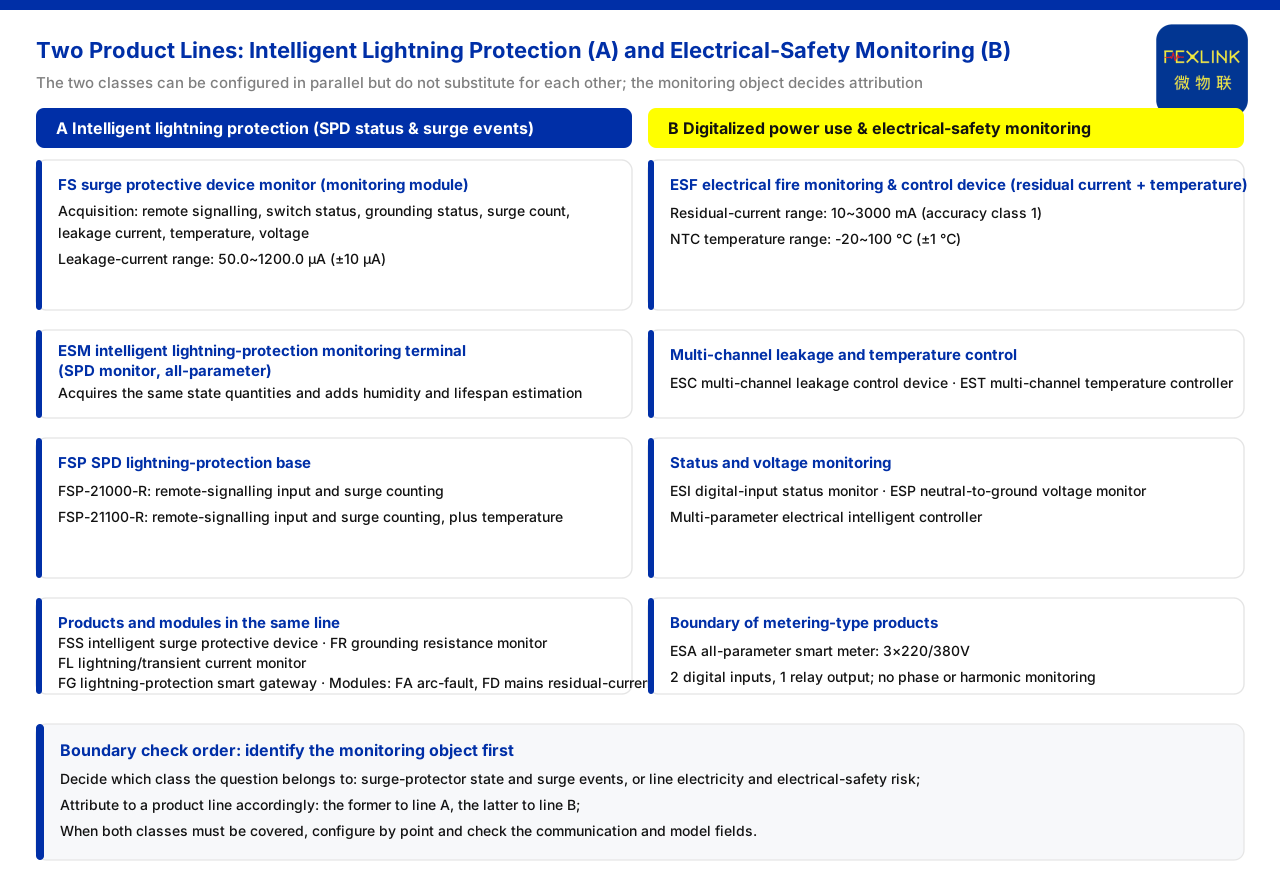
The selection boundary between lightning-protection monitoring products and electrical-safety monitoring products rests on one point: the monitoring object is different. The product knowledge base places intelligent lightning protection as product line A, covering the surge protective device monitor, the intelligent lightning-protection monitoring terminal, the SPD lightning-protection base, the grounding resistance monitor, the lightning current / transient current monitor and the lightning-protection smart gateway; and places digitalized power-consumption and electrical-safety monitoring as product line B, covering the multi-parameter electrical intelligent controller, the electrical fire monitoring & control device, the multi-channel leakage-current monitoring & control device, the digital-input status monitor, the neutral-to-ground voltage monitor, the smart meter, the three-phase imbalance monitor and the power-quality monitor. The two classes can work together but cannot substitute for each other: line A covers lightning-specific elements such as SPD status and surge counts, while line B covers electrical-safety elements such as residual current, temperature and electricity quantity.
Two product lines, each covering one segment
The knowledge base makes intelligent lightning protection an independent product line A, which includes the FS surge protective device monitor, the ESM intelligent lightning-protection monitoring terminal, the FSS intelligent surge protective device, the FSP SPD lightning-protection base, the FR grounding resistance monitor, the FL lightning current / transient current monitor and the FG lightning-protection smart gateway, and at module level lists the FA arc-fault monitoring module and the FD mains residual-current monitoring module. Product line B is digitalized power-consumption and electrical-safety monitoring, including the multi-parameter electrical intelligent controller, the ESF electrical fire monitoring & control device, the ESC multi-channel leakage-current monitoring & control device, the EST multi-channel temperature intelligent controller, the ESI digital-input status monitor, the ESP neutral-to-ground voltage monitor, the smart meter, and the three-phase imbalance monitor and the power-quality monitor. Product attribution is decided first by the product-line division.
The lightning-protection side: SPD status and surge counts
The exclusivity of line A appears in the monitoring object. The FS surge protective device monitor (lightning-protection monitoring module) takes the state elements of the surge protective device as its exclusive acquisition object, including remote signalling, switch status, grounding status, surge count, leakage current, temperature and voltage, with the model rule FS–[voltage channels][leakage channels][temperature channels][digital inputs][grounding/surge]–[communication], and its leakage-current monitoring range is 50.0~1200.0μA (±10μA). The ESM intelligent lightning-protection monitoring terminal (SPD monitor, all-parameter), beyond switch status, grounding status, surge count, leakage current, temperature and voltage, also contains SPD-exclusive elements not covered by electrical-safety products, such as humidity and lifespan estimation. These elements point to the operating state of the surge protective device itself, not to the electricity on the line.
The electrical-safety side: residual current and temperature
The monitoring object of line B is another set of elements. Taking the ESF electrical fire monitoring & control device as an example, it takes residual current and temperature as the monitoring elements of electrical-fire risk, with the model rule ESF–[power][display][output][current parameter][reserved]–[communication]; the residual-current range is 10~3000mA (accuracy class 1), and the NTC temperature range is -20~100℃ (±1℃). This set of elements does not overlap with the SPD status and surge-count elements of the lightning-protection product line; the two answer different questions.
Meter-type products likewise do not carry SPD-state monitoring
The metering products in line B have their own boundary. The ESA all-parameter smart meter is a metering product with the specification 3×220/380V, 2 digital inputs and 1 relay output, and it does not include phase or harmonic monitoring; when phase and harmonics are needed, the knowledge base points to the ESB three-phase imbalance monitor and the ESE power-quality monitor. It can be seen that meter-type electrical-safety products likewise do not carry the SPD-state monitoring function, and metering capability cannot substitute for lightning-protection state acquisition during selection.
The scenario comparison lands the boundary on combinations
The typical application scenario and selection comparison in the knowledge base lists the two classes as different recommended combinations: low-voltage distribution cabinet electrical-fire early warning uses the ESF electrical fire monitoring & control device (for example ESF-22110) and the ESC multi-channel leakage-current monitoring & control device, together with temperature monitoring and a gateway; surge-protector status monitoring (retrofit of existing SPDs) uses the FS surge protective device monitor, the ESM all-parameter SPD monitor and the FSP SPD lightning-protection base. In the same comparison table, the two classes each stay in their own place, which exactly shows that they can be configured in parallel but the combinations will not replace each other.
A boundary-check sequence
Condensing the boundary into a checking sequence: the first step is to judge which class the question belongs to—"surge-protector state and lightning events", or "line electricity and electrical-safety risk"; the second step is to attribute it to a product line accordingly, choosing from line A in the first case and line B in the second; the third step, when both classes of question must be covered at the same time, is to configure separately by point rather than covering one product line with the other; the fourth step is to check whether the communication and model fields agree with the field conditions. In this order, the question of the selection boundary reduces to "who is the monitoring object". The sequence is not a ranking of products; it is a way to keep the monitoring object in view before the model is chosen.
Applicability and limits
First, this article explains only the selection boundary and the cooperative relationship between the two classes of products; its factual boundary is limited to the product knowledge base, and it introduces no standard clause, parameter, certification or case that is not listed.
Second, the 50.0~1200.0μA (±10μA), 10~3000mA (accuracy class 1), -20~100℃ (±1℃) and 3×220/380V cited here are parameters listed in the knowledge base; this article only explains element attribution and does not judge whether a site is acceptable on that basis.
Third, the attribution of the two product lines, specific models such as ESF-22110, and the two recommended combinations are all existing records of the knowledge base; this article infers no unlisted model or certification.
Fourth, the boundary conclusion of this article does not constitute a conclusion about product selection, configuration or quotation for a specific project.