Direct answer
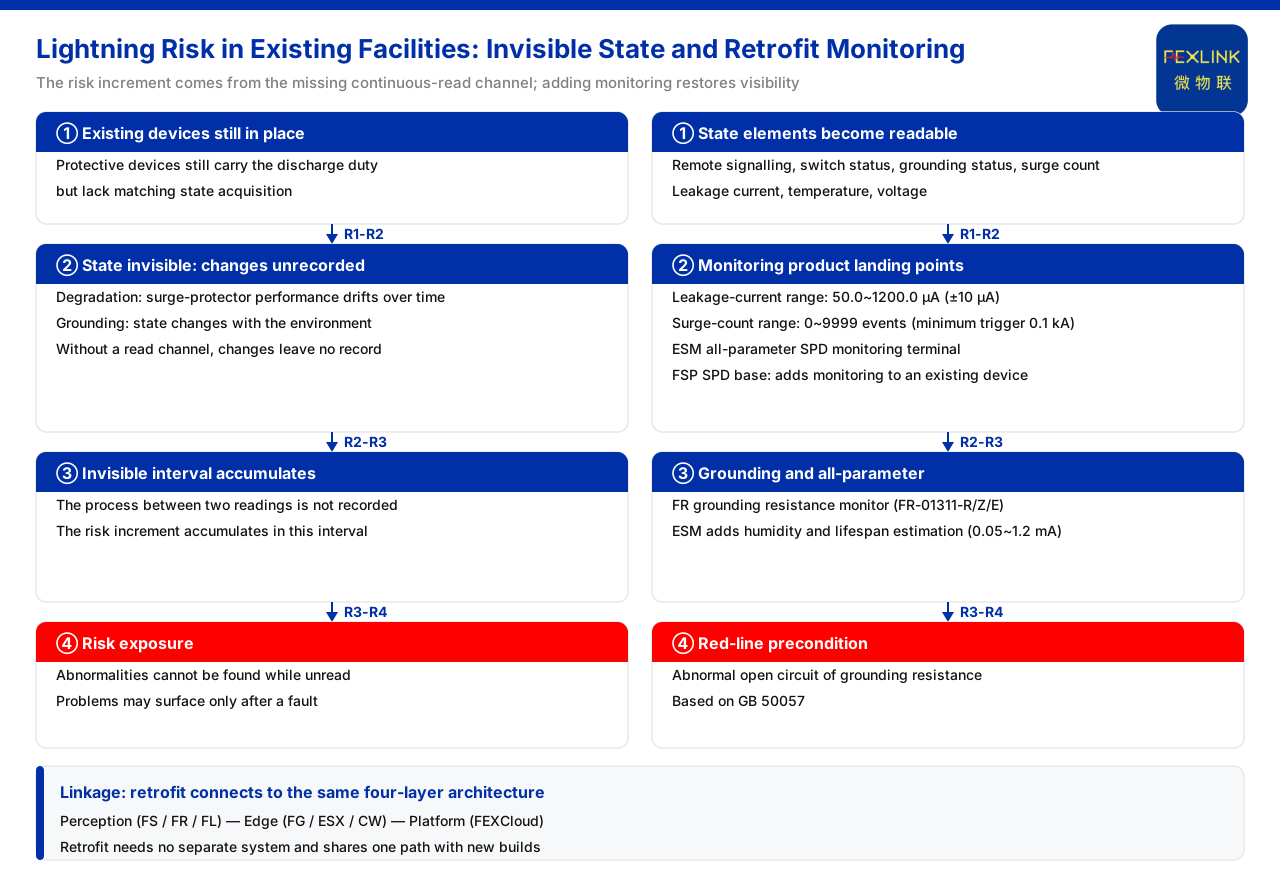
Lightning risk is higher for old buildings and existing facilities not because their original lightning-protection devices must have failed, but because the state of those devices is "invisible" for long periods: surge protective devices degrade and grounding states change, yet without a state-acquisition capability those changes leave no continuously readable record. The product knowledge base lists "surge-protector status monitoring (retrofit of existing SPDs)" as an independent recommended scenario, with a recommended combination of the FS surge protective device monitor (lightning-protection monitoring module), the ESM intelligent lightning-protection monitoring terminal (SPD monitor, all-parameter) and the FSP SPD lightning-protection base, showing that the existing-asset scenario lands on adding status monitoring. The lightning risk of existing facilities can therefore be understood as a "risk increment": the protective devices are still in place, but there is no channel to read their state continuously.
The source of existing-asset risk: invisible state
New-build projects normally design the lightning-protection devices together with their state acquisition; existing facilities often have only the devices themselves, without matching state acquisition. The product knowledge base lists "surge-protector status monitoring (retrofit of existing SPDs)" as a separate recommended scenario, reflecting the general situation of existing SPDs: the device carries the discharge duty, but its operating state is not read continuously. The risk increment comes precisely from this "unseen" period—component degradation and grounding changes cannot be discovered while nobody is reading them.
What state elements become visible once monitoring is added
Taking the FS surge protective device monitor (lightning-protection monitoring module) as an example, the acquisition objects given in the knowledge base include surge-protector state elements such as remote signalling, switch status, grounding status, surge count, leakage current, temperature and voltage, and its model rule is FS–[voltage channels][leakage channels][temperature channels][digital inputs][grounding/surge]–[communication]. Among these, the leakage-current monitoring range is 50.0~1200.0μA (±10μA), and the surge-count range is 0~9999 events (minimum trigger 0.1kA). These elements turn "what state the surge protective device is in now" from invisible into readable. The set is not a fixed list for every site; it defines which state quantities can be read from the surge protective device, so that the landing point can be chosen according to the element that matters most.
All-parameter monitoring and the base form
When more complete state coverage is required, the ESM intelligent lightning-protection monitoring terminal (SPD monitor, all-parameter), beyond switch status, grounding status, surge count, leakage current, temperature and voltage, also includes humidity and lifespan estimation, with the model rule ESM–[power][display][phase][current parameter][version]–[communication] and a current-parameter tier of 0.05~1.2mA. If only a monitoring base is to be added to an existing surge protective device, the FSP SPD lightning-protection base provides a remote-signalling input and surge counting: FSP-21000-R contains 1 remote-signalling input and 1 surge count with 0 temperature channels, while FSP-21100-R adds 1 temperature-monitoring channel on that basis.
Grounding state is likewise a readable element
Another class of state in existing facilities is grounding. The model rule given in the knowledge base for the FR grounding resistance monitor (for example FR-01311-R) is FR–[signal acquisition][detection principle][installation][supply]–[communication]; the example models FR-01311-R/Z/E are DC12V, outdoor and three-point, and the entry also notes that the FR/FRP series has been applied to grounding-grid online monitoring, showing that grounding state is a state element of existing facilities that can be continuously acquired. The knowledge base also lists "abnormal open circuit of grounding resistance" as a non-bypassable red line, on the basis of GB 50057, which means confirmation of grounding state is a national-standard floor that must be completed in advance, not an option.
Retrofit connects to the same architecture
Retrofit does not require building a separate system. In the general four-layer architecture of the monitoring system given in the knowledge base, the perception layer contains lightning-protection monitoring modules such as the surge protective device monitor, the grounding resistance monitor and the lightning current monitor, together with the ES series of modules; the edge layer is carried by gateways such as the lightning-protection smart gateway, the intelligent edge-computing gateway and the industrial gateway; and the platform layer is the FEXCloud IoT cloud platform. Status monitoring added to existing facilities can connect to the same four-layer architecture, sharing one "perception—edge—platform" path with new-build scenarios. Sharing the architecture means the retrofit does not need a separate platform or a separate data path; it joins the existing one at the perception layer.
A decision path
To judge whether an existing facility needs monitoring added, two steps suffice: first confirm whether a state-reading means currently exists—if neither the surge protective device nor the grounding has acquisition, the facility is in the state-invisible interval; then choose the landing point according to the element to be read—to judge the state of the surge protective device itself, choose the FS surge protective device monitor or the ESM intelligent lightning-protection monitoring terminal; to add monitoring to an existing surge protective device, choose the FSP SPD lightning-protection base; to keep continuous awareness of grounding state, choose the FR grounding resistance monitor. In this order, the retrofit answers "which segment of visibility is currently missing", not "whether to replace everything". The order matters because the two steps answer different questions: whether visibility exists at all, and which element is most worth reading first.
Applicability and limits
First, this article explains only the source of the lightning-risk increment for existing and old facilities and the monitoring landing points that can be added; its factual boundary is limited to the product knowledge base, and it introduces no standard clause, parameter, certification or case that is not listed.
Second, the 50.0~1200.0μA (±10μA), 0~9999 events (minimum trigger 0.1kA) and 0.05~1.2mA cited here are parameters listed in the knowledge base; this article only explains their selectable ranges and does not represent any field configuration or performance conclusion.
Third, the element differences between FSP-21000-R and FSP-21100-R of the FSP SPD lightning-protection base, the supply, installation method and detection principle of the FR grounding resistance monitor (FR-01311-R/Z/E), and the recommended combination for "surge-protector status monitoring (retrofit of existing SPDs)" are all existing records of the knowledge base and are not applied across models.
Fourth, this article's reference to GB 50057 is limited to the grounding red-line criterion in the knowledge base; it does not set out specific clauses and makes no compliance determination.