Direct answer
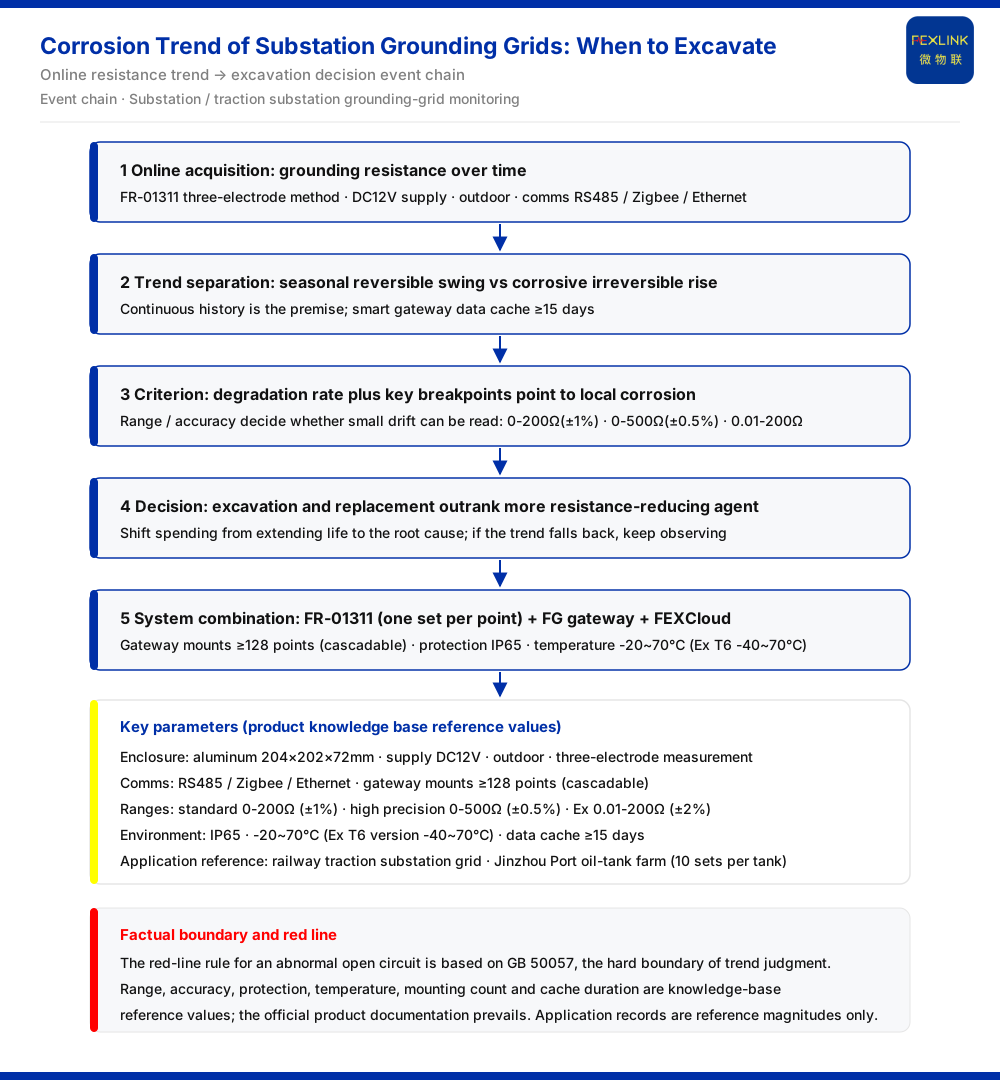
When grounding resistance rises slowly, should maintenance money keep going into resistance-reducing agents, or should it shift to excavation and replacement? The conclusion is: first use the online trend to separate "seasonal reversible fluctuation" from "corrosive irreversible rise", and then decide the direction of spending. Concretely, the change of grounding resistance over time is acquired online by the FR grounding resistance monitor (FR-01311-R), separating the part that falls back with the seasons from the part that keeps climbing without falling back; if the degradation rate and the trend of the key breakpoints point to local corrosion, then excavation and replacement take priority over continuing to add resistance-reducing agent, shifting maintenance spending from "extending life" to "addressing the root cause". It should be noted that the object of this judgment is the direction of the maintenance budget, not whether to adopt monitoring; the monitoring solution answers "can it be measured, and measured for long", whereas this article answers "once a trend is measured, where should the money go".
The model rule of the FR grounding resistance monitor
The model rule given in the product knowledge base for the FR grounding resistance monitor is: FR–[signal acquisition][detection principle][installation][supply]–[communication]. Each position means the following: signal-acquisition code 01 denotes grounding-grid resistance; in the detection-principle position, 2 denotes the loop method and 3 denotes the three-point method; in the installation position, 1 denotes outdoor and 2 denotes indoor. By this rule, FR-01311 corresponds to signal acquisition 01, detection principle 3 (the three-point method / three-electrode method) and installation 1 (outdoor). The model suffix distinguishes the communication method: FR-01311-R is RS485, FR-01311-Z is Zigbee, and FR-01311-E is Ethernet. What the three models share is that all are DC12V supplied, installed outdoors and use the three-point method; they differ only in communication. The value of understanding this rule is that operations and procurement can read the installation environment, measurement principle and communication capability from the model itself, reducing ambiguity in selection communication.
Ranges, accuracy and data retention
According to the reference range tiers of the grounding resistance monitoring unit given in the product knowledge base, the standard type is 0-200Ω (±1%), the high-precision type is 0-500Ω (±0.5%), and the explosion-proof type is 0.01-200Ω, with explosion-proof marking Ex d IIB T4/T6 Gb and accuracy ±2%. The point of the tiers is to cover different field requirements: range and accuracy determine whether the trend curve can read out small drift; the low-resistance segment requires the explosion-proof type to measure from 0.01Ω, while ordinary scenarios choose between the standard type and the high-precision type according to budget.
Trend judgment depends on continuous historical data. The system-level reference parameters given in the product knowledge base are: protection rating IP65, operating temperature -20~70℃ (the explosion-proof T6 version is -40~70℃); the smart gateway mounts ≥128 points and supports cascading, with data cache ≥15 days. Among these, the data cache duration directly determines how continuous the trend curve is when the link drops or transmission is interrupted, and it is the material precondition for "being able to judge by trend rather than by a single reading".
Application combination and engineering reference
The typical application scenario and selection comparison table in the product knowledge base lists the recommended product combination for "online monitoring of substation / traction substation grounding grids" as: FR-01311 (one set per point) + FG lightning-protection smart gateway + FEXCloud. That is, the field-side points are carried by the FR grounding resistance monitor, aggregated upstream through the gateway to the cloud platform, and the trend curve and the maintenance decision are completed on the platform.
In form, the FR grounding resistance monitor is an aluminum enclosure of 204×202×72mm. The product knowledge base further notes that the FR/FRP series grounding resistance monitors have been applied to projects including online monitoring of railway traction substation grounding grids and the Jinzhou Port oil-tank farm (10 sets per tank). These records only indicate the application scenarios and magnitudes listed in the knowledge base and do not constitute a point-count commitment for any specific project.
Standard and red line
In the red-line guard table of the Qianzhi engine, "abnormal open circuit of grounding resistance" is a non-bypassable red-line rule, and its governing standard is GB 50057. This means that once grounding resistance shows an abnormal open circuit, it is no longer handled by the ordinary weighting logic but triggers the red line. For the maintenance decision, this red line is the hard boundary of trend judgment: trend analysis is used to identify degradation early in the slowly changing stage, while an abrupt event such as an open circuit is directly backstopped by the red line.
Applicability and limits
This article applies to the discussion, in scenarios such as substations and traction substations, of a maintenance strategy that decides "continue adding resistance-reducing agent or carry out local excavation and replacement" on the basis of the online trend of grounding resistance.
The limits and boundaries are as follows. First, the conclusion of this article concerns the direction of the maintenance budget; it does not constitute an estimate of excavation quantities, schedule or cost, nor does it infer the resistance-reducing effect of a resistance-reducing agent. Second, the ranges, accuracy, protection rating, operating temperature, gateway mounting point count and data cache duration in this article are all reference values listed in the product knowledge base; the specification of a specific model is subject to the official product documentation and order confirmation. Third, the online monitoring of railway traction substation grounding grids and the Jinzhou Port oil-tank farm at 10 sets per tank are application information recorded in the knowledge base, serving only as reference magnitudes and not as performance evidence or project commitments. Fourth, the applicability of GB 50057 is subject to the clause matched in the standards library; other standards related to resistance-reducing agents and grounding-electrode materials must be matched in the standards library before they can be cited, and this article makes no prior assertion. Fifth, this article infers no product certification, compliance conclusion or quantified performance indicator. Any parameters, cases or certifications beyond the boundaries above are outside the scope of this article.