Direct answer
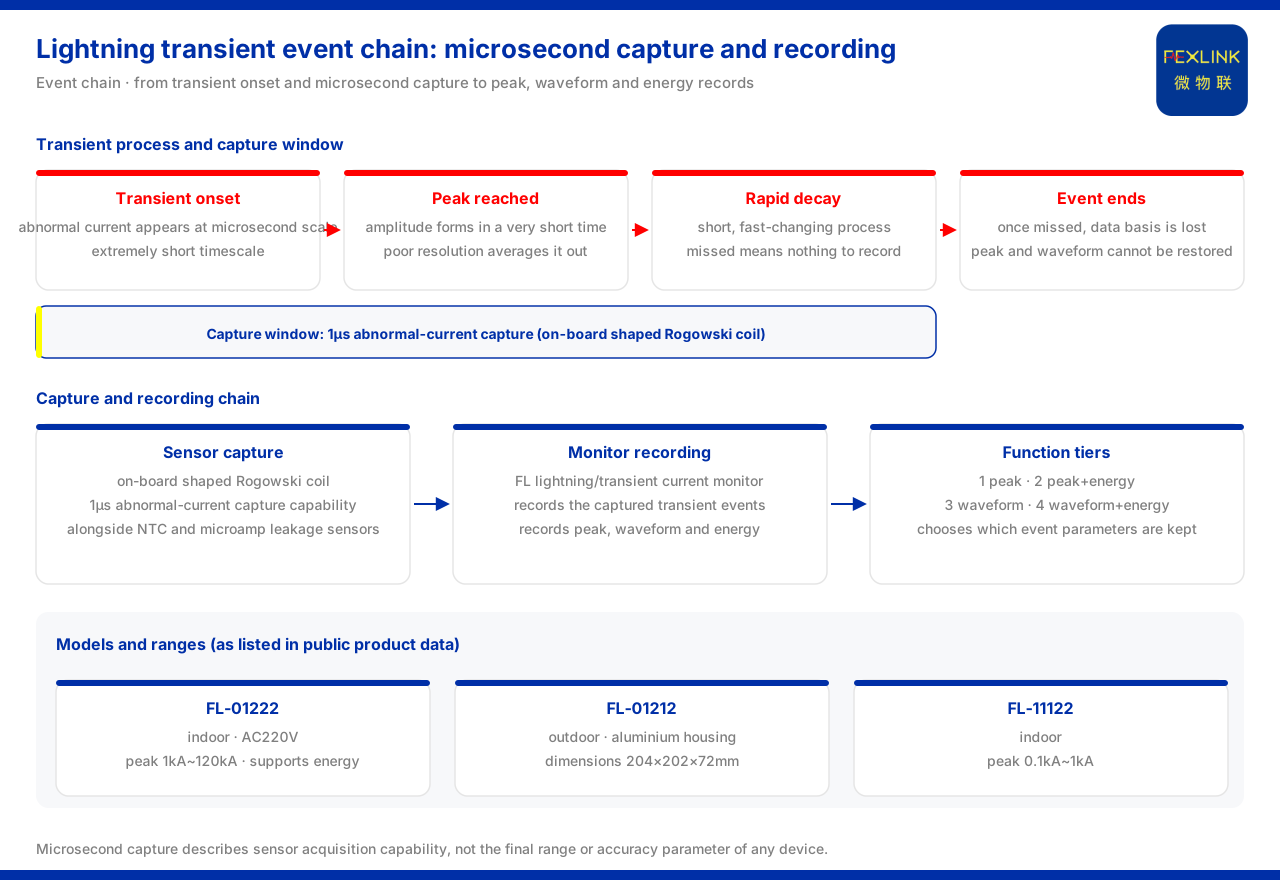
Microsecond-class capture matters because abnormal currents are usually transient events: they occur within an extremely short interval, reach a peak, and then decay rapidly. If the acquisition time resolution is insufficient, the event is either missed altogether or "flattened" in the recording, and the subsequent analysis of peak, energy and waveform loses any usable data basis. The knowledge base lists a "board-mounted shaped Rogowski coil (1 μs-class abnormal current capture)" as one of the company's core sensor technologies, and in the electrical hazard early-warning system it lists "low-frequency wavelet / high-frequency surge capture (microsecond-class capture of abnormal current)" as one of the core technologies. Both point to the same thing: only after the microsecond transient has been captured is there anything to record and analyse.
Abnormal current is transient, and the time scale decides whether it is seen at all
The defining characteristic of a transient event is that it is short. If the resolution of detection and recording stays at a coarser time scale, what is seen is an averaged, diluted result, and the true amplitude and shape of the event cannot be reconstructed. The meaning of 1 μs-class capture lies exactly here: it compresses the acquisition time tick to the microsecond order, so that such short processes have a chance of being captured completely. Capture is the precondition of recording; what cannot be caught cannot be recorded, and still less judged. This is why the time scale is not a secondary specification but the gate that decides whether the event enters the data chain at all.
The capture capability sits on the sensor side
The knowledge base files this capability under sensor technology: one of the core technologies is the board-mounted shaped Rogowski coil, which has 1 μs-class abnormal current capture capability and is listed alongside the NTC and the microampere-level leakage-current sensor. The placement is itself informative. Because the capability is recorded as a sensor technology rather than as a parameter of a finished instrument, it describes the front end of the acquisition chain. One reading caution is needed here: microsecond-class capture describes the acquisition capability of the front-end sensor, not the range or accuracy parameter eventually presented by a device. It answers "can this transient be sensed in time", not "how strong and how accurate a value can ultimately be recorded". Keeping the two apart prevents a sensor-side acquisition claim from being quoted as a device-level measurement specification.
After capture, the lightning current monitor carries the recording
The captured transient is taken up and recorded by the FL lightning current / transient current monitor (FL-01222). For this class of product, the knowledge base defines the function settings by "what is recorded": function 1 records peak, function 2 records peak plus energy, function 3 records waveform, and function 4 records waveform plus energy. Peak corresponds to the intensity of the event, waveform corresponds to its process, and energy is superimposed on either of the two. In other words, capture solves "whether a signal has been acquired", while the function setting solves "which parameters of this event are retained". The two are different decisions made at different points in the chain, and a completed capture does not by itself determine which of the four settings is present.
Model rule and detection range
For the FL lightning current / transient current monitor, the knowledge base gives the model rule FL–[detection range][channel count][function][installation][supply]–[communication]. Detection range 0 covers 1 kA~120 kA, and detection range 1 covers 0.1 kA~1 kA. The model table lists the indoor model (FL-01222, AC220V, peak 1 kA~120 kA, energy supported), the outdoor model (FL-01212) and the indoor low-range model (FL-11122, peak 0.1 kA~1 kA). The fact that the detection range is written into the model rule shows that "what magnitude of transient is to be captured" is settled at the selection stage, alongside the function setting, and not adjusted afterwards on site.
Where it sits in the monitoring system
The knowledge base's generic four-layer architecture for monitoring systems places the FL series monitoring modules, the Rogowski coil and other sensors in the perception layer. This means microsecond-class capture happens at the very front of the whole data chain: the perception layer turns the on-site transient into a signal, the edge layer handles aggregation and conversion, and the platform layer handles admission and analysis. The capture time scale determines what the input end of this chain can obtain, and later stages cannot restore information that was never captured at the front end. Location in the perception layer therefore matters for what may be expected of the system: downstream aggregation and analysis can reorganise and interpret the acquired signal, but they cannot recover resolution that was absent at acquisition.
A note on the installation environment
The knowledge base records the exterior of the outdoor variant: FL-01212 uses an aluminium housing with dimensions of 204×202×72 mm. This is installation-related information recorded in the product entry; this article does not use it to infer protection rating, environmental adaptability or other unlisted parameters. The dimension belongs to the housing record alone and is not transferred to any other model.
Applicability and limits
First, this article explains only what microsecond-class abnormal current capture means and where it lands in the knowledge base; its factual boundary is limited to the product knowledge base, and it introduces no standard clauses, parameters, certifications or cases the knowledge base does not list.
Second, the 1 μs-class capture and the microampere-level leakage-current acquisition cited here are core-technology statements listed in the knowledge base; this article does not use them to infer the sampling rate, accuracy or other unlisted indicators of any particular model.
Third, the FL function settings (1 peak / 2 peak plus energy / 3 waveform / 4 waveform plus energy), the detection ranges (1 kA~120 kA and 0.1 kA~1 kA), and the indoor/outdoor correspondence of the indoor model (FL-01222), the outdoor model (FL-01212) and the indoor low-range model (FL-11122) are existing records in the knowledge base; 204×202×72 mm is only the exterior record of FL-01212 and this article does not apply it across models.
Fourth, this article does not equate the microsecond-class capture capability on the sensor side with the range parameter of any controller, nor does it extend it into unrecorded quantitative effects.