Direct answer
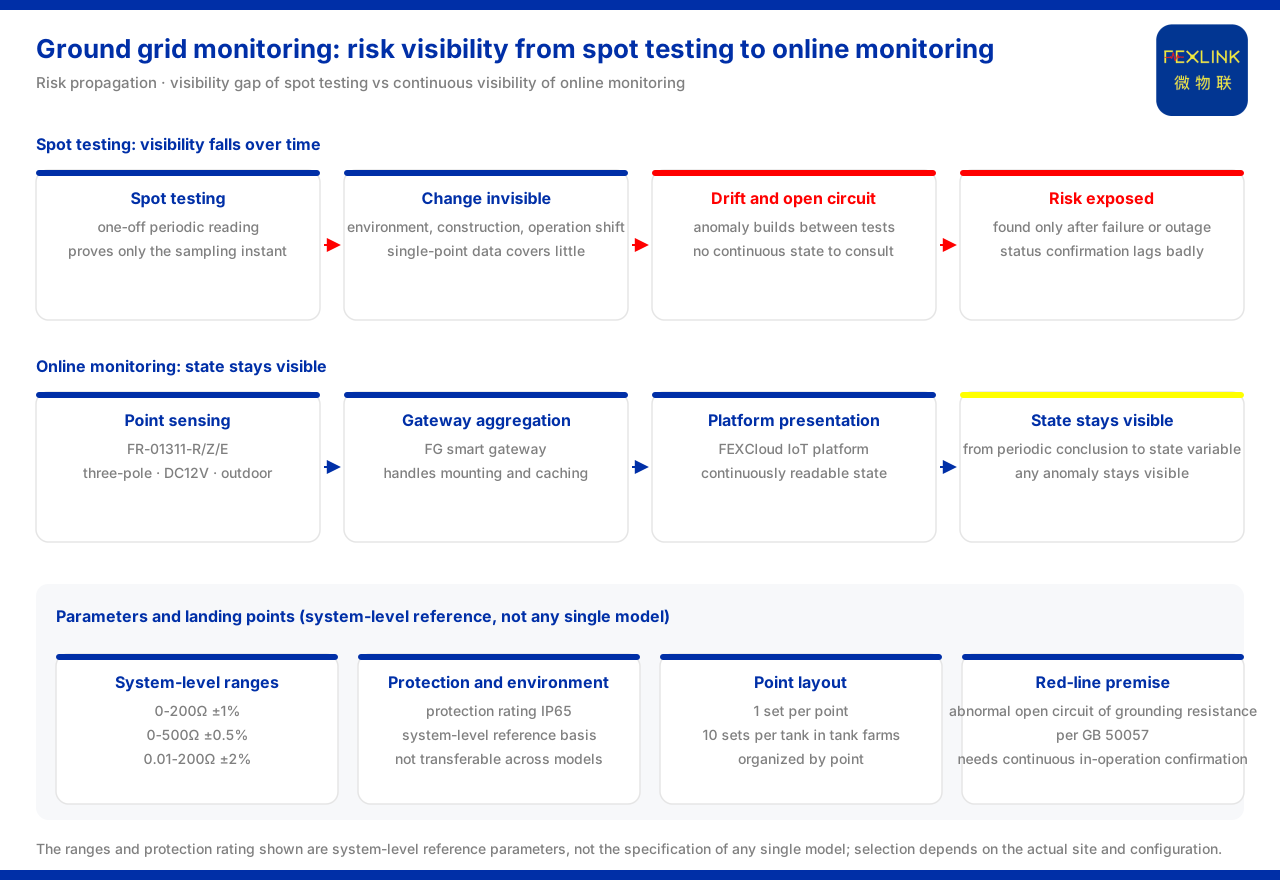
"Grounding-grid online monitoring" means measuring the grounding resistance of a grounding grid (earthing grid) continuously, online and in a readable form, rather than taking a one-off measurement at commissioning acceptance or during periodic inspection. The essential change it makes is to turn the question "is the grounding still effective" from a periodic conclusion into a continuously visible state variable. In the knowledge base, the landing point for this is the FR grounding resistance monitor (FR-01311): DC12V supply, outdoor installation and the three-electrode method, with communication in three variants—RS485, Zigbee and Ethernet. The data is aggregated through an FG lightning-protection smart gateway (for example FG-0221-ER) and uplinked to the FEXCloud IoT cloud platform. The knowledge base also lists "abnormal open circuit of grounding resistance" as one of the non-bypassable red lines, on the basis of GB 50057, and this criterion points precisely at continuous confirmation of the grounding state.
What is monitored is the grid; what is observed is grounding resistance
A grounding grid is the set of paths along which lightning current and fault current are discharged into the earth, and grounding resistance is the quantitative reading of whether that path conducts and how well it conducts. Online monitoring watches this reading: whether it stays within the normal interval, whether it drifts over time, whether an open circuit appears.
For the grounding resistance monitoring system, the knowledge base gives system-level reference ranges in three tiers: standard type 0–200 Ω (±1%), high-precision type 0–500 Ω (±0.5%), and explosion-proof type 0.01–200 Ω (±2%), with a protection rating of IP65. These are system-level reference parameters. They are stated to describe the resistance intervals that can be covered, and they are not acceptance limits. Reading them as pass/fail thresholds would cross the boundary of what the knowledge base records.
The weight of the word "online"
Online means the time dimension of measurement changes from "a moment" to "a continuous state". The significance of this shift comes from two directions.
First, the state of a grounding grid changes with environment, construction and operating conditions, and a single measurement can only demonstrate the condition at the sampling instant. Second, the knowledge base ties the grounding state to a non-bypassable red line: "abnormal open circuit of grounding resistance", on the basis of GB 50057, is listed as a red-line criterion. A red-line designation requires continuous confirmation during operation, not an after-the-fact look back through a trend. That is why the monitoring has to be online: the criterion is a state that must hold, not a value that can be reconstructed later.
How the model rule describes this monitor
For the FR grounding resistance monitor (FR-01311), the knowledge base gives the model rule FR–[signal acquisition][detection principle][installation][supply]–[communication]. It defines signal-acquisition code 01 as grounding-grid resistance, detection principle 2 as the loop method and detection principle 3 as the three-point method.
This rule shows that reading one monitor requires confirming at least four classes of information at once: what it acquires, by what principle it measures, whether it is installed indoors or outdoors, and how it is powered, with the communication suffix added on top. Selection for grounding-grid monitoring is therefore not a matter of checking only "can it measure resistance", but of confirming these items together, because each of them constrains whether the device fits a given site.
Communication differences across the specific models
Under the FR grounding resistance monitor (FR-01311), the model table lists three communication variants: the RS485 variant (FR-01311-R), the Zigbee variant (FR-01311-Z) and the Ethernet variant (FR-01311-E). All three are DC12V, outdoor and three-electrode, and differ only in communication, being RS485, Zigbee and Ethernet respectively. Three products sharing one body and differing only by suffix show that communication is an independent option; the upstream method actually available on site determines which of the three is selected.
The data path from point to platform
A grounding grid is distributed as points, and online monitoring is organised accordingly into a chain: each point takes one grounding resistance monitor, the data is aggregated and uplinked through an FG lightning-protection smart gateway, and it is then admitted to the FEXCloud IoT cloud platform. The knowledge base lists "substation / traction substation grounding-grid online monitoring" as a typical application scenario, with the recommended combination being FR-01311 (one set per point) together with the gateway and the platform.
The meaning of this chain is that online monitoring is not merely one meter in the field, but a complete path of "point acquisition — gateway aggregation — platform presentation". If one link is missing, the state cannot be seen continuously, however capable the sensing point may be on its own.
Where it lands in application
Under the entry for the FR grounding resistance monitor, the knowledge base notes that the FR/FRP series has been applied to projects including railway traction substation grounding-grid online monitoring and the Jinzhou Port oil-tank farm (10 sets per tank). These records show that online monitoring has entered situations that require long-term awareness of grounding-grid state. The "10 sets per tank" also indicates that point density is related to the structure of the monitored object and must be organised by point, rather than by installing a single unit.
Applicability and limits
First, this article explains only what "grounding-grid online monitoring" means and where it lands in the knowledge base; its factual boundary is limited to the product knowledge base, and it introduces no standard clauses, parameters, certifications or cases the knowledge base does not list.
Second, the 0–200 Ω (±1%), 0–500 Ω (±0.5%), 0.01–200 Ω (±2%) and IP65 cited here are system-level reference parameters listed in the knowledge base; this article does not equate them with the specification of any particular model, nor does it use them to judge whether an on-site grounding resistance is acceptable.
Third, the supply, installation method and communication methods of the three communication variants of the FR grounding resistance monitor (FR-01311), and the recommended combination for "substation / traction substation grounding-grid online monitoring", are existing knowledge-base records; the railway traction substation and Jinzhou Port oil-tank farm references are internal application records of the knowledge base, and this article makes no inference about performance or results.
Fourth, the reference to GB 50057 in this article is limited to the grounding red-line criterion recorded in the knowledge base; it does not set out specific clauses and makes no compliance determination.