Direct answer
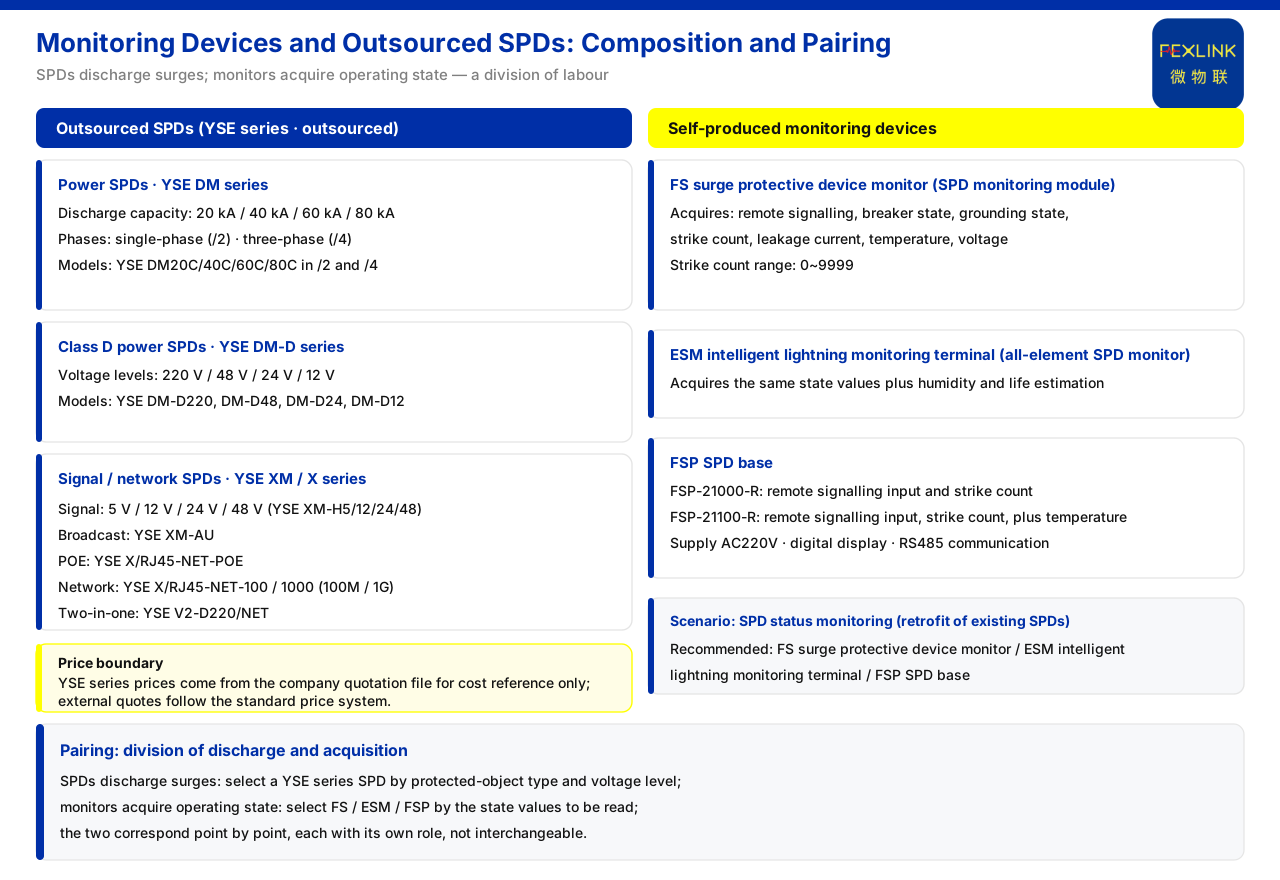
Self-produced monitoring products and outsourced bundled surge protective devices are in a relationship of division of labor, not substitution: the surge protective device handles surge discharge, and the monitoring product handles operating-state acquisition. The product knowledge base lists the YSE series surge protective devices (YSE SPDs) as outsourced bundled surge protective devices (outsourced production), and lists the FS surge protective device monitor, the ESM intelligent lightning-protection monitoring terminal, and the FSP SPD lightning-protection base as self-produced monitoring products. Selection is therefore not a question of "which one to pick" but of "which points need discharge and which points need monitoring."
Outsourced bundled surge protective devices: source and price boundary
In the knowledge base, the YSE series surge protective devices are explicitly identified as outsourced bundled surge protective devices, that is, outsourced production, and belong to a different source from the application-side self-produced monitoring products. Their prices come from the company's product quotation file and serve only as a cost reference; external quotations must follow the company's standard price system and must not treat the quotation file directly as an external figure. This boundary shows that, in procurement and quotation, the outsourced bundled surge protective devices and the self-produced monitoring products are two independent management lines.
The three form classes of outsourced bundled surge protective devices
By application, the YSE series can be divided into three classes: power, class D power, and signal/network. Their models and capabilities are as follows:
| Category | Example models | Capability grades | |:--|:--|:--| | Power SPD | YSE DM20C/40C/60C/80C in /2 and /4 | Discharge capability 20 kA / 40 kA / 60 kA / 80 kA, single-phase /2, three-phase /4 | | Class D power SPD | YSE DM-D220/D48/D24/D12 | Voltage levels 220 V / 48 V / 24 V / 12 V, for device-side power protection | | Signal/network SPD | YSE XM-H5/12/24/48, XM-AU, X/RJ45-NET-POE, X/RJ45-NET-100/1000, V2-D220/NET, etc. | Covers 5 V / 12 V / 24 V / 48 V signals, broadcast, POE, 100 Mbit/s and 1000 Mbit/s networks, and network two-in-one |
These grades are the model correspondences listed in the knowledge base, used to describe the selectable protection range; they do not mean that a site must be configured at any particular grade.
Reading the three classes together shows how the outsourced range is organized: the power class sets the discharge capability and phase count, the class D power class sets the device-side voltage level, and the signal/network class sets the interface and signal type. Each class answers a different protection question, and the classes are selected by the type of object being protected rather than mixed by model number. The model codes in the table are listed in the knowledge base and are used here only to identify the classes and their capabilities.
Self-produced monitoring products: carrying status acquisition
The monitoring side is carried by self-produced products. The FS surge protective device monitor (lightning-protection monitoring module) and the ESM intelligent lightning-protection monitoring terminal (all-parameter SPD monitor) acquire surge-protector state quantities such as remote signalling, switch status, grounding status, surge count, leakage current, temperature, and voltage; the surge-count range of the surge protective device monitor is listed as 0 to 9999 events. The FSP SPD lightning-protection base is a self-produced matching base, and the parameters of its two models are as follows:
| Product | Model | Key description | |:--|:--|:--| | SPD base | FSP-21000-R | Remote signalling input and surge count; AC220V supply, digital display, RS485 communication | | SPD base | FSP-21100-R | Remote signalling input and surge count, plus temperature; AC220V supply, digital display, RS485 communication |
Pairing: division of labor between discharge and acquisition
The knowledge base lists "surge protective device status monitoring (retrofit of existing SPDs)" as an independent scenario, with the recommended combination of the FS surge protective device monitor, the ESM all-parameter SPD monitor, and the FSP SPD base. On that basis, the pairing can be summarized as: the surge protective device handles surge discharge, and the monitoring product handles operating-state acquisition. Arranging a separate monitoring means for an existing SPD is premised on the original surge protective device still carrying the discharge duty while its operating state needs to be read. The two functions therefore run in parallel: one set solves "discharging the surge," the other solves "reading out its current state." When pairing, first select the surge protective device according to the type and voltage level of the object being protected, then select the monitoring product according to the state quantities that need to be read; the two correspond point by point. There is no need to fold monitoring capability into the surge protective device, and no need for the monitoring product to carry the discharge duty.
This division also clarifies a common question during retrofit: whether adding monitoring changes the protection design. Under the knowledge base's scenario, the existing SPD continues to perform discharge, and the monitoring product adds a status-acquisition path alongside it, so the retrofit is an addition of supervision rather than a replacement of protection. Keeping the two duties separate is what makes the point-by-point correspondence straightforward.
Scope and limitations
First, this article's description of product sources and pairing is limited to the product knowledge base: the YSE series surge protective devices are outsourced bundled products, while the FS, ESM, and FSP products are self-produced monitoring products. It does not infer models, certifications, accuracies, or engineering cases not listed in the knowledge base.
Second, the figures in this article, such as the 20 kA / 40 kA / 60 kA / 80 kA discharge-capability grades, the 220 V / 48 V / 24 V / 12 V voltage levels, and the 0 to 9999 event surge count, are all existing parameters listed in the knowledge base. They only describe the selectable range and do not represent any site configuration or effect conclusion.
Third, the prices of the outsourced bundled surge protective devices come from the company quotation file and serve only as a cost reference; external quotations must follow the company's standard price system. This article neither cites nor infers any specific price.
Fourth, the pairing conclusion in this article is premised on the scenario combinations listed in the knowledge base and does not constitute a conclusion about selection, deployment, or quotation for a specific project.