Direct answer
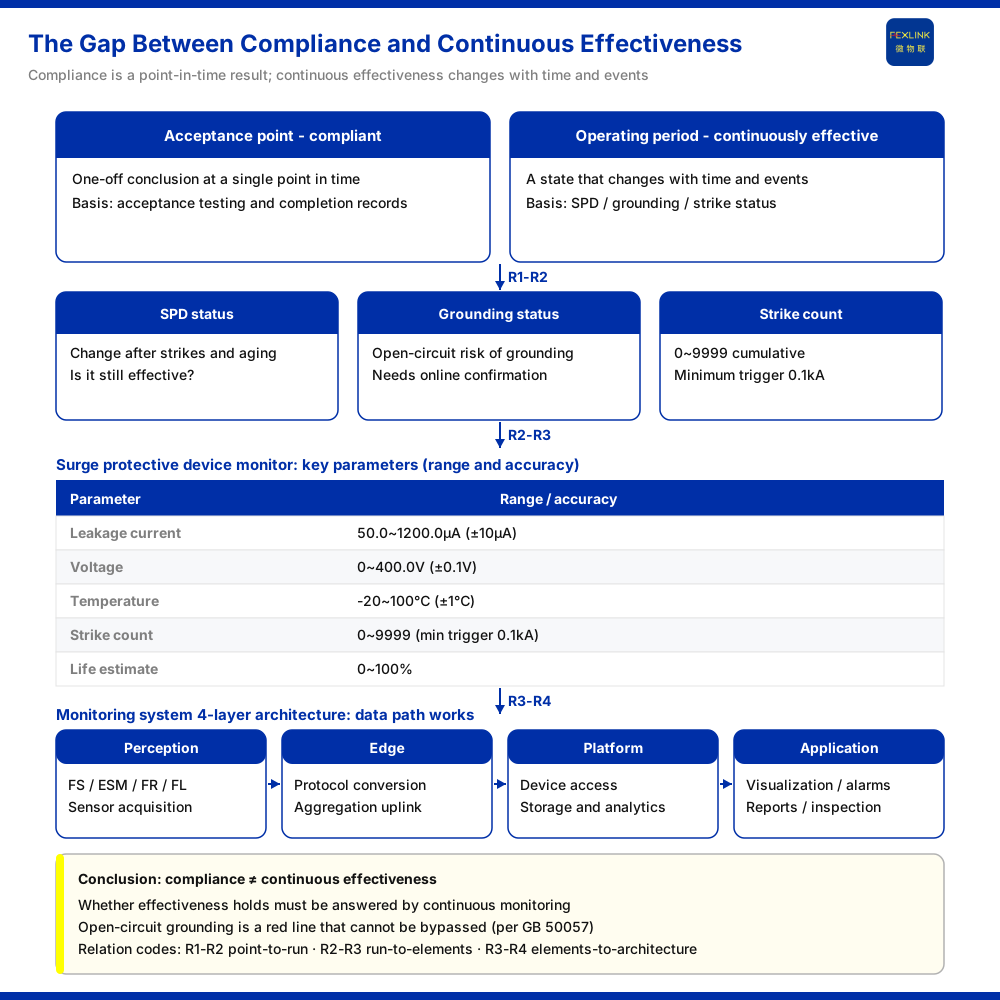
A lightning protection system that passes acceptance is not thereby guaranteed to remain effective in service. A pass certifies the system's condition at one instant: at the moment of testing, its measured quantities lie within the specified ranges. Effectiveness is a different kind of statement. It is a state variable that shifts as strike events occur, as components age and as grounding conditions change. The knowledge base treats leakage current, voltage, temperature, strike count and lifetime estimation as monitorable parameters of the surge protective device monitor, and it folds SPD status, grounding status and strike count into the set of monitored elements. That arrangement is itself an admission that effectiveness must be read continuously and cannot be settled by a single acceptance. Whether post-acceptance monitoring is needed therefore does not turn on pass or fail; it turns on whether the state can change during operation — which is the ordinary condition of a lightning protection system.
Compliance is a point-in-time verdict; effectiveness is a state variable
Acceptance happens at one point in delivery and answers only "does the system meet requirements right now"; it carries no information about what follows. In operation a lightning protection system faces two classes of variable. The first is external events, such as the impulse delivered by a strike. The second is internal evolution, such as the slow change in component performance under accumulated stress. Neither stops acting because a test was passed once.
An acceptance report is best understood as a dated snapshot. It states which quantities were checked, what values they held and against which thresholds they were judged, and it does so for the moment of testing only. Nothing in the report describes the rate at which those quantities may drift, the events that may perturb them, or the interval over which the judgement is expected to hold. Reading a pass as a promise about the future asks the document to carry information it was never designed to carry.
Confusing "compliant" with "effective" usually collapses a continuous problem into a one-off verdict: once acceptance clears, no further state capture is scheduled. By the next test or the next failure, there is no on-site record of what happened in between to look back on.
The monitorable parameters explain why effectiveness changes
The knowledge base lists a set of key parameters for the surge protective device monitor: leakage current 50.0~1200.0 μA (±10 μA), voltage 0~400.0 V (±0.1 V), temperature -20~100 °C (±1 °C), strike count 0~9999 (minimum trigger 0.1 kA) and lifetime estimation 0~100%. These cover five aspects: current, voltage, temperature, events and lifetime.
The choice of parameters is informative in itself. If an SPD's condition were constant, there would be no reason to define leakage current, temperature and lifetime estimation as separate observables; they are collected separately precisely because they change with operation and events. The existence of a strike count and a minimum trigger condition likewise shows that "whether an event occurred" and "how far accumulation has gone" are matters worth recording. The full-element SPD monitoring terminal reflects the same logic: its model distinguishes a basic four-element version from a flagship multi-element version, with element coverage configured on demand — evidence that the monitoring scope is itself a selectable quantity.
Continuous effectiveness needs a continuously read path
For "has it stayed effective" to be answerable, the state has to be acquired continuously and delivered into a system. The knowledge base divides the monitoring system into four layers: perception, edge, platform and application. The perception layer acquires the monitoring modules and sensors of each series, where the Rogowski coil, the NTC and the microampere-level leakage sensor address current, temperature and small leakage current respectively. A state can be aggregated, stored, assessed and turned into an alarm layer by layer only after it has entered the perception layer first.
In its typical application scenarios the knowledge base gives "surge protective device status monitoring (retrofit of existing SPDs)" a row of its own, with a recommended combination of the surge protective device monitor, the full-element SPD monitoring terminal and the SPD lightning protection base. Mounting a dedicated monitoring means for existing SPDs presupposes exactly that the original SPD changes with time and events. In other words, the monitoring system is built around the judgement that effectiveness changes.
One class of state cannot be watched only over the long term
Not every state suits slow observation. The knowledge base lists "abnormal open circuit of grounding resistance" as a red line that cannot be bypassed, on the basis of GB 50057. A red-line designation means it must not be allowed to become nominal between two observations, and its judgement criteria must not be relaxed on site. For that premise to hold, the triggering condition must be continuously readable, so that interception covers the whole operating period.
A latent premise is what makes this class different. A grounding path that has opened is not a small deviation to be confirmed at leisure; it removes the discharge route on which the rest of the protection depends. Treating such a state as something to be observed "when convenient" is precisely the failure mode a red line is meant to prevent.
Applicability and limits
First, this article only explains the conceptual difference that a passed acceptance does not equal continuous effectiveness; the facts it draws on are limited to the product knowledge base, and it introduces no standard clauses, parameters, certifications or cases that the knowledge base does not list.
Second, the leakage current 50.0~1200.0 μA (±10 μA), voltage 0~400.0 V (±0.1 V), temperature -20~100 °C (±1 °C), strike count 0~9999 (minimum trigger 0.1 kA) and lifetime estimation 0~100% cited here are existing parameters of the surge protective device monitor as listed in the knowledge base; they do not represent other models or actual engineering configurations, and they are not a conclusion about lifetime, failure probability or replacement interval.
Third, the reference to GB 50057 is limited to the grounding red-line criteria recorded in the knowledge base; the article does not set out the standard's specific clauses, nor does it make a determination about grounding resistance limits.
Fourth, this article does not infer accuracies, certifications, project cases or effect data that the knowledge base does not list; the application scenarios and product combinations mentioned are existing knowledge-base records only and do not constitute a conclusion about a specific project deployment.