Direct answer
In a lightning protection system that already has surge protective devices (SPDs) and grounding, lightning current monitoring is still needed, because these two parts do not carry the same task. SPDs and grounding answer "how to protect"; lightning current monitoring answers "how to obtain event-level evidence." The FL lightning current / transient current monitor (e.g., FL-01222) is a distinct branch of the intelligent lightning-protection product line, supporting peak and energy recording. It supplies event-level evidence and is the direct means of judging whether a lightning strike occurred and how strong it was. The action of a protective device and the event record are parallel capability lines; the former cannot substitute for the latter. Even when protective measures are complete, the question of whether a strike occurred and how large it was remains open.
1. Protection and evidence: two tasks inside a protection system
Surge protective devices and grounding belong to the protection side. Their duty is to withstand, divert, or limit an overvoltage or large current so that the protected object takes less of the impact. Their value shows up in the action of "taking the hit for the system," and that action does not necessarily leave a searchable event record.
Lightning current monitoring belongs to the evidence side. It does not change how a protective device acts; instead it records the lightning current—a transient process quantity—forming a queryable, comparable, archivable event datum. The protection side answers "is the system protected," while the evidence side answers "what exactly happened." Complete protection is therefore not complete evidence. A protective device can act with no one knowing its magnitude, and when it later becomes necessary to decide whether an anomaly came from a strike and at what order of magnitude, only an event record provides the basis. ## 2. Event-level evidence: the direct means of judging occurrence and intensity
Lightning current monitoring provides event-level evidence and is the direct means of judging whether a lightning strike occurred and how strong it was. "Event-level" is the key: what it records is one concrete event, not an accumulated period result or a device status bit.
Because the record hangs on a single event, it can support a judgment about "this one." Judging occurrence requires that an event be recorded; judging intensity requires that the event carry an amplitude-order parameter. Records such as peak and energy place "it happened" and "how strong it was" onto the same event datum. The configuration and status of a protective device alone cannot establish whether a given strike occurred or at what order of magnitude. Lightning current monitoring therefore fills an evidence chain from "protective action" to "event fact," letting the system not only protect but also state what it protected against.
3. Function tier: event records split into a peak line and a waveform line
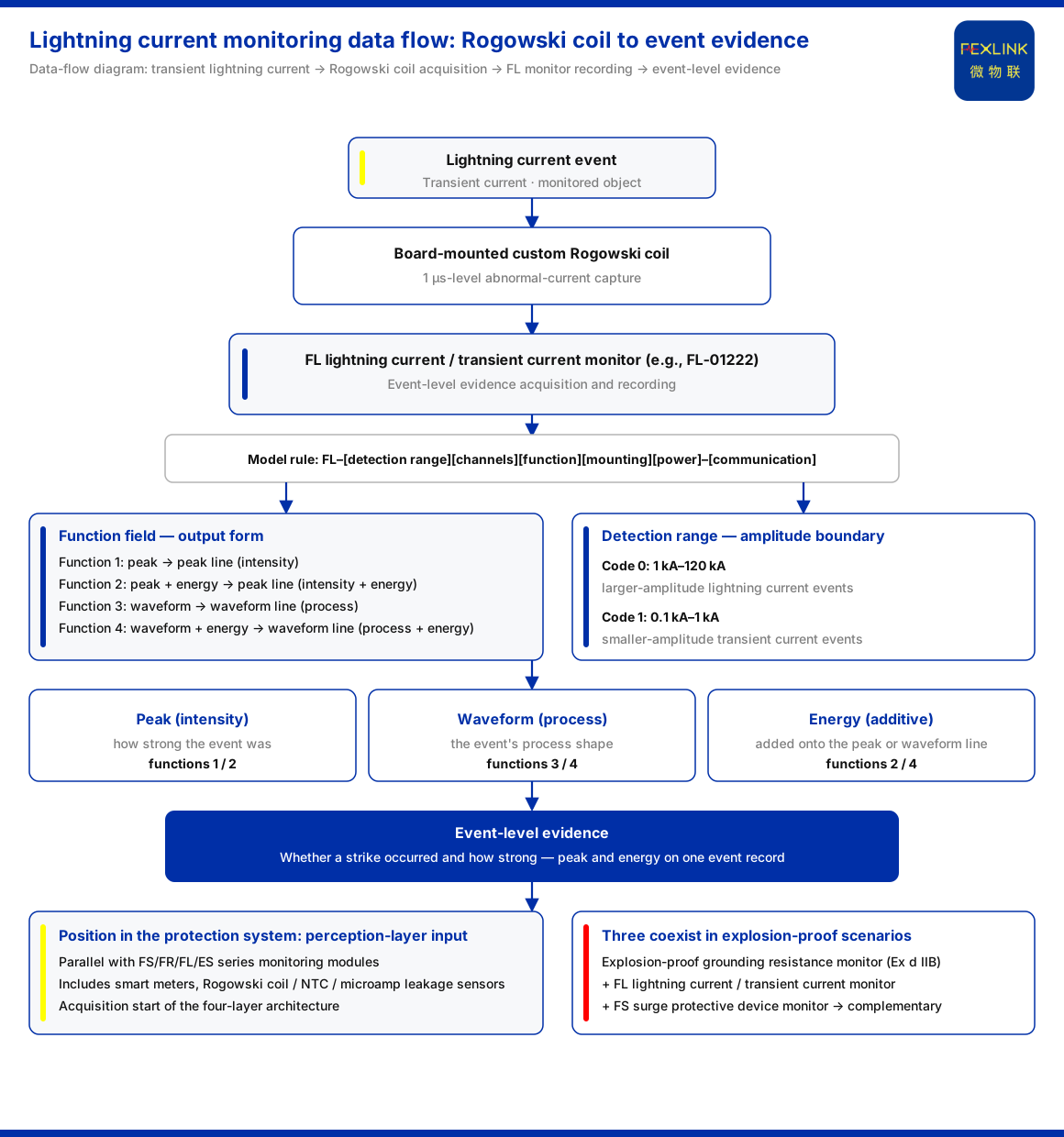
The model rule for the FL lightning current / transient current monitor is FL – [detection range][channels][function][mounting][power supply] – [communication], in which the function field organizes event records into four tiers:
| Function code | Recorded content | Main line | |:--|:--|:--| | 1 | Peak | Intensity | | 2 | Peak + energy | Intensity + energy | | 3 | Waveform | Process | | 4 | Waveform + energy | Process + energy |
Two relationships follow. The first is the two main lines, peak and waveform: functions 1 and 2 answer how strong the event was, while functions 3 and 4 answer its process shape. The second is energy as a superposable parameter: it does not form a tier of its own but is added onto the peak line or the waveform line respectively. Because the function field is independent in the model, "how far event evidence must be recorded" is fixed at the selection stage.
4. Detection range: the amplitude boundary of event evidence
To record event evidence, the covered order of magnitude must first be determined. Under the model rule, detection range has two tiers: detection range 0 covers 1 kA to 120 kA, suited to lightning current events of larger amplitude; detection range 1 covers 0.1 kA to 1 kA, aimed at transient current events of smaller amplitude. The range code likewise sits at the start of the model, alongside the function field, and together they determine what this monitor can record and up to how large. Event forms beyond the selected tier fall outside that model's recording scope, so when deploying lightning current monitoring, detection range and function tier must be fixed together—not function alone while the order of magnitude is ignored.
5. Acquisition foundation: 1 μs-level capture is the front end of event evidence
The quality of event evidence depends on whether the front end can catch the transient process of lightning current. The core sensor technology is a board-mounted custom Rogowski coil, with 1 μs-level abnormal-current capture capability. Lightning current is a short-duration transient quantity, and capture capability determines how far the raw signal can be preserved; peak, energy, and waveform are output forms taken after this front-end channel. The sensor's time-response capability is thus the shared physical basis of both the peak and waveform lines.
6. Within the general four-layer architecture, it is a perception-layer input
In the general four-layer monitoring architecture, the perception layer's collectable quantities include FS/FR/FL/ES series monitoring modules, smart meters, and sensors such as the Rogowski coil, NTC, and microamp-level leakage-current sensor. Lightning current monitoring is one class of perception-layer input, in parallel with grounding resistance monitoring and SPD monitoring—not an accessory module on top of protective devices, but a data source on par with other monitored quantities, organized with them through the edge, platform, and application layers. Deployment adds one event-level input at the perception layer; it is not a substitute for the existing protection system.
7. In explosion-proof scenarios the three coexist: division of labor, not replacement
In the typical application scenarios and selection comparison, the recommended combination for oil tank farm / petrochemical lightning protection and explosion prevention is: explosion-proof grounding resistance monitor (Ex d IIB) + FL lightning current monitor + FS surge protective device monitor. The three appear side by side in the same combination—in the more demanding explosion-proof scenario, lightning current monitoring is not replaced by grounding monitoring or SPD monitoring. Each answers a different question: the explosion-proof grounding resistance monitor faces the state of the grounding loop; the FS surge protective device monitor faces the SPD side; lightning current monitoring faces the lightning current event on the line itself. Because the objects differ, they are complementary rather than redundant.
8. How to decide whether lightning current monitoring is needed
The preceding material condenses into a decision path:
- If the need is only whether protective devices and the grounding loop are normal, protection-side monitoring covers it. - If the need is to judge whether lightning strikes occurred within a period and how many strong events took place, event-level records are required, and lightning current monitoring should be deployed.- Once deployment is decided, choose the function tier by the question to be answered: intensity calls for the peak line (functions 1 and 2), process for the waveform line (functions 3 and 4), and energy is added to the corresponding line. - Then choose the detection range by the expected event's amplitude order: larger amplitudes fall in the 1 kA to 120 kA tier, smaller amplitudes in the 0.1 kA to 1 kA tier.
The essence is to clarify first "whether the protection system lacks protection or evidence," then return to the two model fields, function tier and detection range. Lightning current monitoring matters precisely because it fills in what protective devices cannot supply on their own: the event itself.
Scope and limitations
This article explains only why lightning current monitoring still needs independent deployment in a protection system that already has surge protective devices and grounding. Its factual basis is limited to the model rule, function tiers, and detection ranges of the FL lightning current / transient current monitor; the core sensor technology; the perception layer of the general four-layer monitoring architecture; and the relevant combinations in typical application scenarios and selection comparison. The function tiers, detection ranges, and combinations listed here are model- and architecture-level definitions; they constitute no measurement conclusion about any specific on-site event and no standard-conformity determination. This article contains no sampling rate, accuracy, or storage depth beyond what is documented, and makes no cross-inference between model variants; indoor and outdoor versions, different detection-range tiers, and different function tiers must not have parameters applied across one another. For on-site configuration, the mounting environment, function tier, detection range, and communication field should be checked item by item.