1. Direct Answer
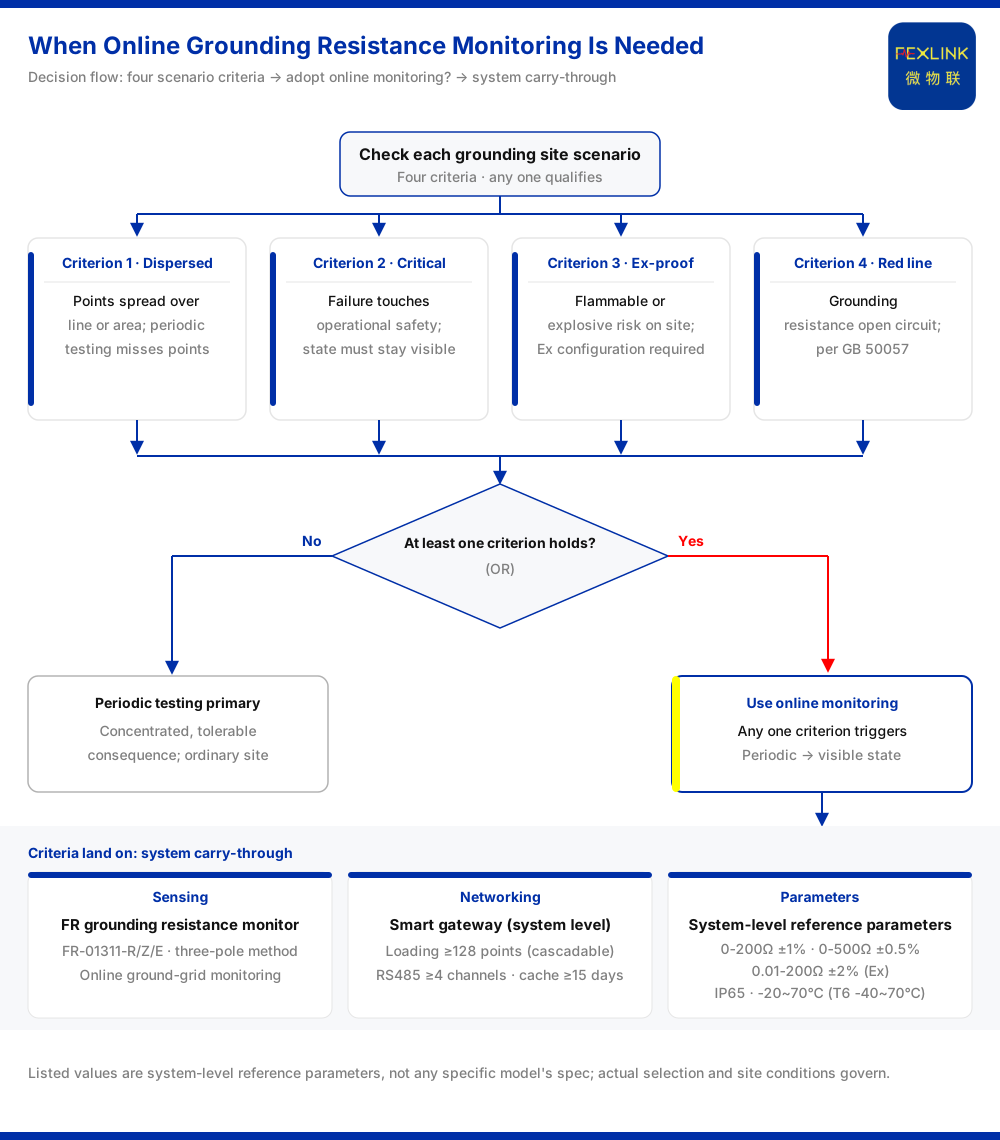
The scenarios calling for online grounding resistance monitoring reduce to four criteria: dispersed grounding points that periodic testing cannot practically cover one by one; a failure consequence that directly touches operational safety, making the location critical; a site requiring an explosion-proof configuration; or grounding status positioned as a non-bypassable red-line prerequisite. If any one holds, "is grounding continuously effective" should move from a periodic conclusion to a continuously visible state variable.
Two documented applications support this. The FR grounding resistance monitor (FR-01311-R/Z/E) series has been applied to online monitoring of railway traction substation ground grids and the Jinzhou Port oil tank farm (10 sets per tank), showing online monitoring has entered sites that need long-term awareness of ground-grid state. The safety red line lists "grounding resistance abnormal open circuit" as one of five non-bypassable criteria, based on GB 50057, pointing precisely to continuous online monitoring.
Conversely, when points stay concentrated, the failure consequence is tolerable, and the item is not a red line, periodic testing is usually sufficient. This is not an argument that everyone should deploy online monitoring, but a checklist of scenario criteria.
2. Premise: Periodic Testing Answers "How It Was Then," Online Monitoring Answers "Whether It Holds"
Periodic testing is a measurement at one time under one condition, answering "what the grounding resistance was then." It is valid for compliance confirmation but carries no information between tests. Grounding state can drift from the previous reading through soil conditions, loosened connections, conductor corrosion, or construction disturbance; unrecorded drift can only be found at the next test.
Online monitoring changes the continuity of information: it makes grounding resistance a continuously read state variable, answering "whether it remains effective." The two differ in coverage, not rank—periodic testing documents the test instant, online monitoring keeps any instant visible. Only when "does the state hold throughout" is itself the question does online monitoring become necessary.
3. Criterion One: Dispersed Points Push Organizational Cost onto Inspection
The first criterion is spatial dispersion. When points spread across a long linear or planar area, periodic testing pours labor into "reaching each point," and measurement becomes the smaller part of the cost. Organizational cost then squeezes frequency: more and remoter points stretch the cycle and widen the blind window between confirmations.
Online monitoring changes the cost structure. Devices read continuously on site, so no visit is needed per point, and coverage density and update frequency can rise together. For dispersed points, the scarce resource is often not measurement capability but the organizational capacity to spread measurement across every point—which online monitoring supplies.
The grounding resistance monitor series has been used for online monitoring of railway traction substation ground grids. Traction substations sit along the line with point-like ground grids, matching the "dispersed points" criterion.
4. Criterion Two: Failure Consequence Directly Touches Operational Safety
The second criterion is consequence severity. Grounding carries the discharge path for lightning and fault current; its failure is not a modest performance drop but a possible breach of the safety floor. If no other design measure fully absorbs the consequence, the location is critical and needs online monitoring to keep its state visible.
A concrete question decides criticality: if grounding broke open between two tests, could the site detect it before operations are affected? If not, the location is critical. A critical location's feature is not that grounding matters more but that failure is less visible—only continuous readings catch it in time.
5. Criterion Three: The Site Requires Explosion-Proof Configuration
The third criterion comes from the environment. Where a grounding point carries flammable or explosive risk, the monitoring device itself must meet explosion-proof requirements; a standard configuration cannot simply be carried over. In the grounding resistance monitoring system reference parameters, the explosion-proof monitoring unit forms its own tier: 0.01–200 Ω, ±2%. That separate tier shows explosion-proof grounding monitoring has its own configuration basis rather than ordinary equipment moved in unchanged.
The application note records the series applied to the Jinzhou Port oil tank farm (10 sets per tank). An oil tank farm typically requires explosion-proof configuration; grounding points sit by tank and in groups, while long-term awareness of ground-grid state is also needed. When "explosion-proof" and "grouped layout" coincide, the burden of point-by-point testing and the safety requirement rise together, raising the necessity of online monitoring.
6. Criterion Four: Grounding Positioned as a Non-Bypassable Red-Line Prerequisite
The fourth criterion is institutional positioning. The safety red line lists "grounding resistance abnormal open circuit" as one of five non-bypassable criteria, based on GB 50057. Red-line designation means the judgment basis cannot be adjusted on site, nor replaced by post-hoc trend observation.
For a red line to be genuinely non-bypassable, its trigger must be continuously readable; otherwise it exists only at test instants and is effectively absent between tests. Any point under such prerequisite positioning should by default acquire its state online, so interception covers the whole operating cycle.
7. How the Four Criteria Land on One System
Criteria answer "should it be done"; the system answers "can it carry it." The grounding resistance monitor uses the three-pole method for online ground-grid monitoring, giving the dispersed and critical points named by criteria one and two a concrete sensing means.
At system level, the grounding resistance monitoring system reference parameters are: monitoring units in three tiers—0–200 Ω (standard, ±1%), 0–500 Ω (high-precision, ±0.5%), 0.01–200 Ω (explosion-proof, ±2%); protection rating IP65; operating temperature −20 to 70 °C (explosion-proof T6 version −40 to 70 °C). The tiers match different measurement spans and accuracy needs; the explosion-proof tier matches criterion three; IP65 and the temperature span show equipment built for long-term online operation.
For networking, the lightning-protection smart gateway reference parameters are: at least 128 points (cascadable), at least 4 RS485 channels, at least 15 days of data cache—covering single-system scale, fieldbus access, and data retention during a communication interruption. For scaled coverage of dispersed points and no data loss at critical points, networking and caching matter as much as measurement.
8. Combining the Criteria into a Deployment Decision
The four criteria work better in combination. A point satisfying both dispersion and criticality outranks one satisfying only one; an explosion-proof environment layers on a matching configuration; a red-line prerequisite means online state acquisition regardless of the other criteria. Conversely, concentrated points, tolerable consequence, ordinary environment, and no red-line leave periodic testing as the primary means.
This order is checkable: each criterion maps to a concrete fact—dispersed points, controllable consequence, explosion-proof demand, red-line listing. Role division follows: the sensing side acquires through the grounding resistance monitor, the system side ensures networking and caching through the lightning-protection smart gateway, and the upper layer stores, assesses, and alarms.
9. Scope and Limitations
First, the four criteria rest on the documented model-and-system data and add no standard clause, parameter, certification, or case beyond it.
Second, the GB 50057 reference is limited to the single citation for grounding resistance abnormal open circuit; it does not expand specific clauses or judge grounding resistance limits.
Third, 0–200 Ω (±1%), 0–500 Ω (±0.5%), 0.01–200 Ω (±2%), protection rating IP65, operating temperature −20 to 70 °C (explosion-proof T6 version −40 to 70 °C), at least 128 points, at least 4 RS485 channels, and at least 15 days of data cache are all system-level reference parameters, not the specification of any specific model.
Fourth, the railway traction substation ground-grid and Jinzhou Port oil tank farm (10 sets per tank) records are internal application references; this article restates them without inferring other industries' adaptability or unrecorded quantitative effects.
Fifth, this article explains online grounding resistance monitoring through scenario criteria and does not replace a specific project's grounding design, testing plan, or compliance judgment; deployment and configuration depend on site conditions and product access capability.