Direct answer
When many quantities must be monitored and they are concentrated at the same power-distribution node, give priority to a multi-element unit. When only a few quantities are needed, or when the points are scattered, give priority to a combination of separate devices.
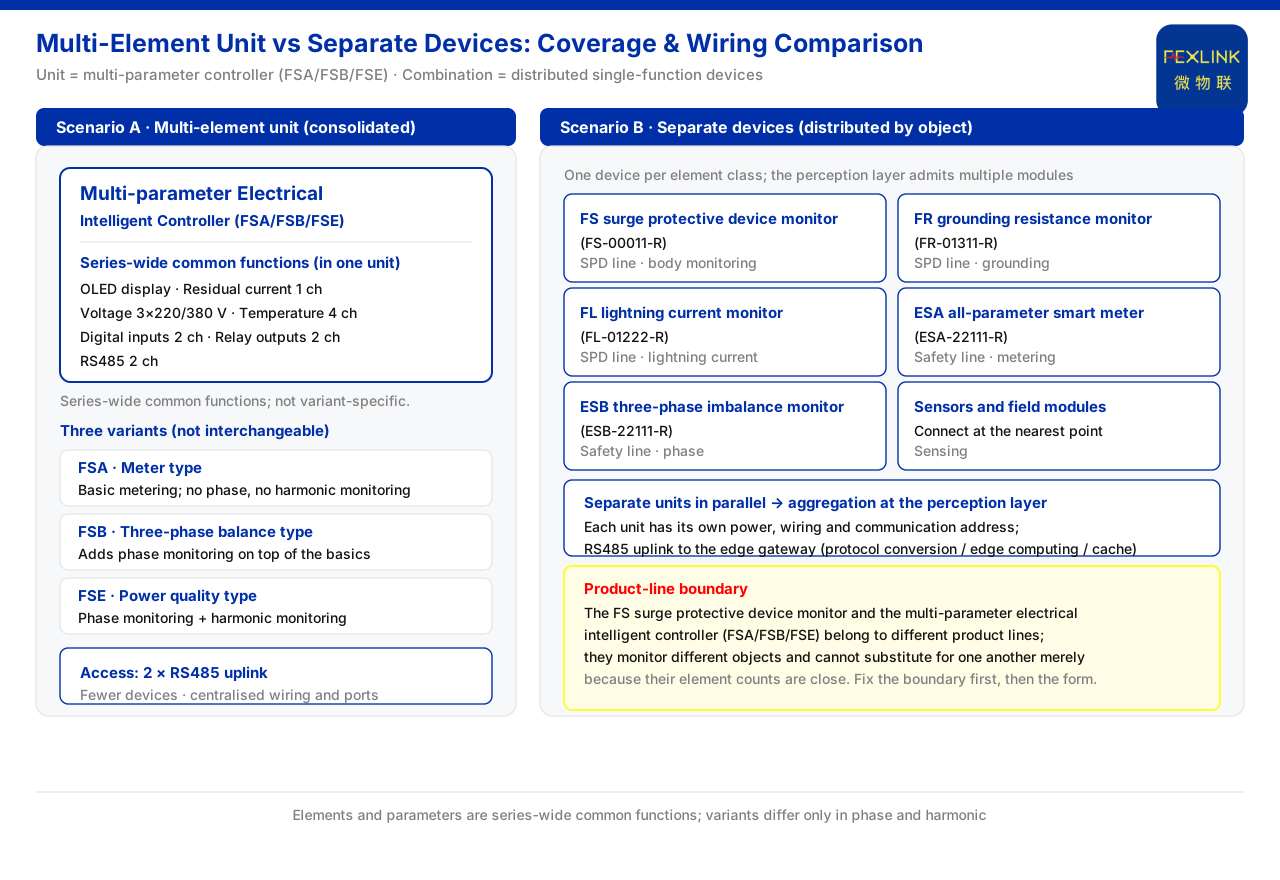
Here the multi-element unit means the multi-parameter electrical intelligent controller, divided into the meter type (FSA), the three-phase balance type (FSB) and the power quality type (FSE). Its series-wide common features are OLED display, residual current 1 channel, voltage 3×220/380 V, temperature monitoring 4 channels, digital inputs 2 channels, relay outputs 2 channels and two RS485 channels — one unit carrying metering and several safety parameters.
A separate-device combination is the opposite: several single-function monitoring devices each perform their own task and then feed into the system through the perception layer. The FS surge protective device monitor (FS-00011), for example, belongs to the intelligent lightning-protection product line and organises its monitoring around the body of the surge protective device.
"More elements means choose the multi-element unit" is not the only criterion: the monitor and the controller have different product lines and monitoring objects and do not replace each other merely because their element counts are close. Fix the object first, then the elements and points, then the form.
The essential difference between the two forms
The multi-element unit concentrates several elements inside one device: one unit covers metering and several safety parameters, reserves digital inputs and relay outputs for interlocking, and sends data upstream through two RS485 channels.
A separate-device combination solves one class of element per device. The surge protective device monitor faces status monitoring of the surge protective device body, and its variables and channel counts are set by the corresponding model. When several devices are connected in parallel, the perception layer can take in several classes of module at once — intelligent lightning-protection monitoring modules (such as the surge protective device monitor, the grounding resistance monitor and the lightning current monitor), digital electrical-use and electrical-safety monitoring modules, smart meters and sensors — after which the edge-layer gateway performs protocol conversion, edge computing and local caching.
Judgement dimension one: number and type of monitored elements
The element list is the first filter. Write down, item by item, the elements that must be monitored, then judge whether they fall within the coverage of one device.
If the elements are concentrated in the category of "electrical parameters plus safety parameters" and their number reaches a level the controller can cover, the unit is clearer: one selection yields metering, residual current, voltage, temperature, digital input and relay output capability, with wiring and communication ports comparatively centralised.
If only one or two classes of element are required, or the object is a dedicated one such as the surge protective device body, a single device fits better.
The type matters more than the count: the controller covers only its series-wide common features; objects outside them are the responsibility of the intelligent lightning-protection product line.
Judgement dimension two: concentration of points
Concentrated points mean that several elements or circuits converge at the same power-distribution node. The multi-element unit then completes acquisition with fewer devices and communication ports, reducing devices and wiring and keeping the maintainable objects more concentrated.
Scattered points are distributed across cabinets or areas that are far apart. A separate-device combination is more flexible here — each point is fitted with one device or a few as needed, installed and connected nearby, without bringing a highly integrated device to every scattered point.
The essence of concentration is the device-to-point correspondence: the multi-element unit tends towards one-to-many, the separate-device combination towards one-to-one. When points outnumber element varieties the combination is usually more economical; when element varieties outnumber points the unit is usually more compact.
Judgement dimension three: monitoring object and product-line boundary
The monitoring object is the most easily overlooked yet most critical dimension.
The surge protective device monitor is positioned as a lightning-protection monitoring module, in a different product line from the multi-parameter electrical intelligent controller: the former monitors the surge protective device body, the latter electrical-use and electrical-safety parameters. This boundary cannot be crossed by "adding up elements": the controller is not a substitute for the monitor merely because it has more elements, and the monitor is not inferior merely because its configuration is simpler. A requirement concerning the surge protective device state therefore goes to intelligent lightning-protection product-line selection; only metering, residual current, voltage, temperature and I/O interlocking are evaluated within the controller. Draw the boundary first, then discuss the form.
How to distinguish the three variants inside the multi-element unit
Once the multi-element unit is chosen, the three variants must still be distinguished and never conflated:
- multi-parameter electrical intelligent controller (meter type, FSA): basic meter monitoring, without phase or harmonic monitoring; - multi-parameter electrical intelligent controller (three-phase balance type, FSB): adds phase monitoring on top of the basic capability; - multi-parameter electrical intelligent controller (power quality type, FSE): has both phase monitoring and harmonic monitoring.
All three share the same series-wide common features; their differences concentrate on the two extended capabilities of phase monitoring and harmonic monitoring. Judge step by step according to whether the site needs phase and whether it needs harmonics, rather than "the higher the better": choose the meter type when neither is needed, the three-phase balance type when only phase is needed, and the power quality type only when both are needed. One variant's capability description must never be applied to another.
How a separate-device combination completes system access
When a separate-device combination is chosen, check whether the access link holds. Under the four-layer architecture: the perception layer takes in the monitoring modules, smart meters and sensors; the edge layer, via a gateway, undertakes protocol conversion, edge computing and local caching; the platform layer handles device access and data storage; the application layer presents visualisation, alarms and analysis.
More separate devices increase pressure on the perception and edge layers: each needs its own power supply, wiring and address planning, and the gateway's access count and protocol matching must still be checked. The multi-element unit uses the same architecture with fewer perception-layer devices; both lead to the upstream link, differing in the layer where elements are aggregated.
Selection decision path
1. Draw the product-line boundary: judge whether the monitoring object is the surge protective device body or electrical-use and electrical-safety parameters, and lock the product line accordingly. 2. List the elements: write out the elements to be monitored, item by item, and count the channels each requires. 3. Assess point concentration: judge whether the elements are concentrated at a few nodes or scattered across many points. 4. Fix the form and variant: when the elements are many and concentrated, choose the multi-element unit and distinguish the three variants by phase and harmonic needs; when the elements are few or scattered, choose the separate-device combination and determine each model in turn.
The order cannot be reversed. Choosing the form first and then filling in the monitoring object makes it easy to compare devices from different product lines side by side and reach a wrong conclusion.
Common misconceptions
- Equating "more elements" with "more suitable": devices with different product lines and monitoring objects cannot be ranked by element count alone. - Using the multi-element unit to replace a separate device: the two belong to different product lines and are not interchangeable. - Conflating the three variants: their differences lie in phase and harmonic monitoring, and the capability of one must not be transferred to the other two. - Ignoring point concentration: looking only at element count and not at point distribution tends to force integration at scattered points, wasting devices and wiring. - Treating the common features as exclusive to one variant: the series-wide common features cannot be used to distinguish variants.
Applicability and limits
First, the trade-offs here follow the documented product data, and the elements and parameters are limited to the series-wide common features of the multi-parameter electrical intelligent controller: OLED display, residual current 1 channel, voltage 3×220/380 V, temperature monitoring 4 channels, digital inputs 2 channels, relay outputs 2 channels and two RS485 channels; the three variants differ only by the presence or absence of phase and harmonic monitoring.
Second, this article distinguishes only forms and product-line boundaries and does not infer models, channel capabilities, certifications, accuracy, protection ratings or engineering cases beyond those documented. Actual configuration follows the corresponding model table.
Third, the conclusion depends on three premises: the on-site monitoring object, the element list and the point distribution. A change in any premise may change the conclusion, so reassess rather than applying one form directly. This article does not extend one scenario's combination method into a general conclusion, nor make a suitability commitment for objects outside the product lines. For a specific project, confirm the decision against the site survey and the complete technical documentation.