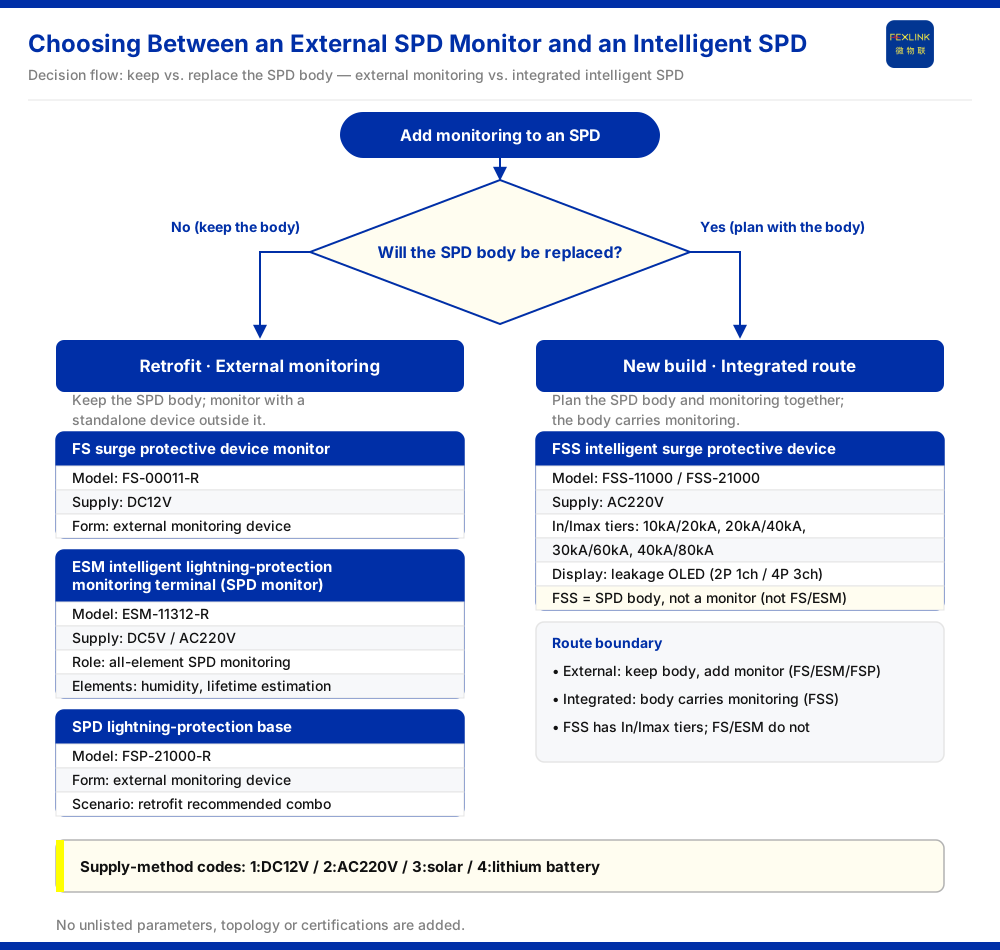
When a project needs to add monitoring to a surge protective device (SPD), two routes usually appear in the solution: fit a monitor alongside the existing SPD, or specify an intelligent SPD with built-in monitoring. The first route maps to the FS surge protective device monitor (e.g. FS-00011-R) and the ESM intelligent lightning-protection monitoring terminal (SPD monitor, e.g. ESM-11312-R); the second maps to the FSS intelligent surge protective device (e.g. FSS-11000/21000). Answering "which one" is not about comparing two isolated models. The prior question is whether the project is an existing-SPD retrofit or a new-build package. The documented "surge protector status monitoring (existing SPD retrofit)" scenario recommends external monitoring products (the FS surge protective device monitor, the ESM intelligent lightning-protection monitoring terminal, and the SPD lightning-protection base), so retrofits are better served by external monitoring; that "for new-build packages, an integrated intelligent SPD can be considered" is this article's editorial judgment, not a direct conclusion of the knowledge base.
1. Separate the two routes first
"Adding monitoring" happens at a different level in each route.
On the external-monitoring route, the SPD body is left untouched and monitoring is performed by a standalone device outside the body, so the existing SPD can be retained. On the integrated route, monitoring is carried by the SPD body itself, and no additional monitoring device is needed outside it.
This difference determines the project stage each route suits: external monitoring assumes the body is kept; integration assumes the body and monitoring are planned together. It is placed first because every later trade-off is derived from it, not from the parameter size of any one model.
2. Where the external-monitoring route lands in the product line
Three product classes carry the external-monitoring role.
First, the FS surge protective device monitor (a lightning-protection monitoring module, e.g. FS-00011-R). Its supply is DC12V, making it a typical external monitoring device.
Second, the ESM intelligent lightning-protection monitoring terminal (SPD monitor, e.g. ESM-11312-R). It is positioned as all-element SPD monitoring, with supply supporting DC5V / AC220V, and monitoring elements including humidity and lifetime estimation. So although both are external, ESM and FS differ in supply method and element coverage.
Third, the SPD lightning-protection base (e.g. FSP-21000-R). The "surge protector status monitoring (existing SPD retrofit)" row of the typical application scenarios and selection comparison lists it together with the FS monitor and ESM all-element SPD monitoring as a recommended combination.
What the three have in common: all are monitoring devices outside the SPD body—the body comes first, then the monitoring.
3. Where the integrated route lands
The integrated route corresponds to the FSS intelligent surge protective device (e.g. FSS-11000/21000). Its defining feature is that monitoring is carried by the body rather than attached by an external device.
The FSS In/Imax tiers cover four groups: 10kA/20kA, 20kA/40kA, 30kA/60kA, and 40kA/80kA; the leakage version uses an OLED display, with one leakage channel for the 2P type and three for the 4P type; and the whole series is supplied at AC220V. The display and leakage monitoring are exactly how "intelligent" manifests on the body.
Note especially that the FSS is an SPD body, not a monitor. It carries protection-capability tiers such as In/Imax—a parameter category that monitoring devices such as the FS and ESM units do not have. Treating the FSS as "an FS with monitoring" misreads both product classes at once.
4. The dividing line: retrofit or new build
The route choice converges on one concrete question: will the SPD body be replaced?
In a retrofit, an SPD already exists on site, and adding monitoring makes replacing the body inconvenient or unnecessary, so monitoring can only happen outside the body. The "surge protector status monitoring (existing SPD retrofit)" scenario is listed as its own row, and all recommended combinations fall on external-monitoring products—the FS monitor, ESM all-element SPD monitoring, and the SPD base—none of which requires replacing the protection body.
In a new-build package, the SPD body and monitoring can be planned together. An integrated intelligent SPD can then be considered, with the body directly carrying display and leakage monitoring and reducing the standalone monitoring link outside the body. This is this article's editorial judgment based on product form, not a direct conclusion of the knowledge base.
So "monitor or intelligent SPD" should first become "replace the body or not." Once that is settled, the route is largely settled.
5. The supply-method difference
The supply-method codes for lightning-protection products are: 1 is DC12V, 2 is AC220V, 3 is solar, and 4 is lithium battery.
Compare this code set with the two routes: the FS monitor uses DC12V (code 1); the ESM terminal supports DC5V / AC220V; the FSS intelligent SPD series uses AC220V (code 2). Supply method is part of the model designation, not a detail to ignore afterwards. In selection, confirm the power form the site can provide, then map back to the model rule—rather than choosing the route first and working backward to supply.
6. Do not compare the monitoring elements across the two routes directly
Both routes involve "monitoring," but its ownership differs, so item-by-item counting is inappropriate.
On the external route, monitoring elements belong to the monitoring device: the FS monitor's and the ESM terminal's element coverage vary by model, with the ESM unit being all-element SPD monitoring that includes humidity and lifetime estimation. On the integrated route, display and leakage monitoring are part of the protection body, and the FSS model table presents body tiers plus display and leakage-channel counts.
One side is "the element list of a monitoring device"; the other is "the built-in capability of a protection body." They do not share one classification scheme. Adding or offsetting the two directly, or judging route superiority by element count, easily mistakes a model difference for a route difference.
7. Common pitfalls
- Treating the FSS as an "integrated FS." The FSS is an intelligent SPD body; the FS is an external monitor; they are not two configurations of the same product. - Conflating the FS and ESM units. Both are external monitoring, but their supply methods and element coverage differ, and they cannot be described interchangeably. - Treating the "existing SPD retrofit" combination as a general recommendation. That scenario targets retrofit applications, and its product combination is entirely external monitoring. - Substituting element count for scenario judgment. Retrofit and new-build constraints differ; look at the scenario first, then the elements. - Recalling supply from impression alone. Supply has a corresponding position segment in the model rule—for example, the ESM power position distinguishes DC5V from AC220V—so it should be checked against the model position, not loosely called "all 220V."
8. A route-decision checklist
1. Does the on-site SPD body need replacing: if not, go external; if it can be planned with the body, consider integration. 2. For external monitoring, choose among the FS monitor, the ESM terminal, and the SPD base by element coverage and site power. 3. For integration, specify the FSS model by In/Imax tier, pole count (2P/4P), and whether leakage and display are included. 4. Both routes require confirming the available supply and checking the model position against the supply codes. 5. Return the chosen model to its model table and verify position by position; do not configure directly from this article's summary.
The checklist produces no new parameter conclusions; it only fixes the order of judgment so that a team can align on the same basis.
Scope and limitations
First, this article's product and parameter descriptions are bounded by the documented model and parameter data, and add no model, parameter, certification, or cost conclusion beyond it.
Second, the FS monitor, the ESM terminal, the FSS intelligent SPD, and the SPD base are different product forms. This article does not extend any one model's parameters or capabilities to another; version differences such as display type are subject to the actual order version.
Third, "retrofit chooses external" rests on the recommended combination of the documented "surge protector status monitoring (existing SPD retrofit)" scenario, while "new build may consider integration" is this article's editorial judgment, not a direct conclusion of the knowledge base; the specific configuration should still follow site conditions, the corresponding model table, and the relevant knowledge-base sections.
Fourth, this article does not cover cost-performance judgments that are not documented, nor does it use its route summary as the selection basis for any specific project. If site conditions differ from the assumptions here, return to the specific model entries and their documentation.