Direct answer: lightning is a transient event, while a once-a-year periodic inspection is a cyclic action, and the two do not match on the time scale. A periodic inspection records a state snapshot for the day and the location inspected. It cannot prove that no lightning occurred across the three-hundred-plus days between two inspections, nor can it show whether a device degraded after a strike. From an industry-evolution perspective, lightning-protection inspection is heading from "one inspection per year" toward "continuous risk service"; the safety red line lists "abnormal open circuit of grounding resistance" as one of the criteria that cannot be bypassed, based on GB 50057. A criterion that must be held continuously is itself evidence that the risk does not appear only on inspection day.
1. Two Time Scales: Event-Type Risk and Cyclic Action
To answer the question, first separate the two objects: lightning risk is an event-type object, while periodic inspection is a cyclic action.
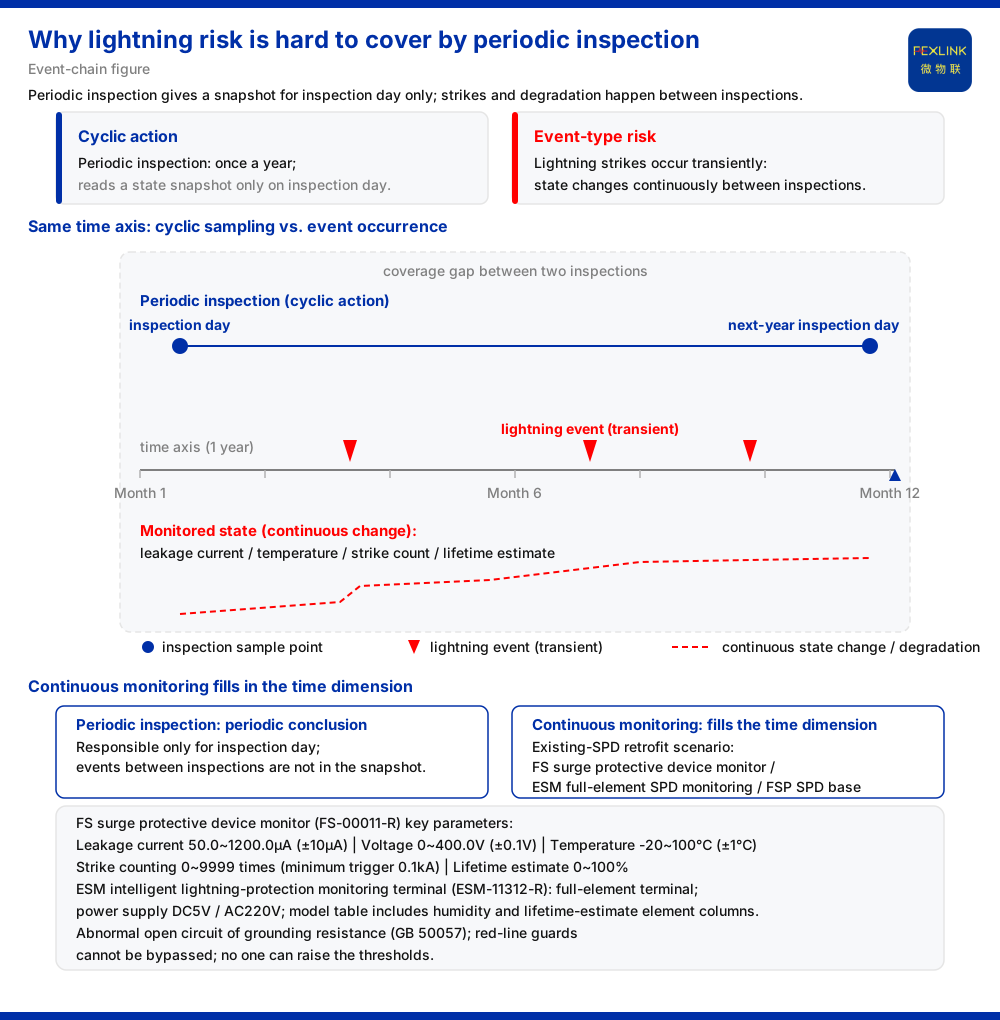
A lightning strike is transient. On the time axis it is a point, not a continuous line. Whether a strike lands within the protected zone, how the current is discharged, and what the devices along the discharge path endure — all of this happens within a very short time window. A one-year period, by contrast, is a time line spread out evenly, and inspection only drives a few discrete sampling points into that line. Using a single instant to cover an entire time line is inherently limited.
This is not a matter of whether an inspection method is good or bad; it is a matter of time scale. No matter how rigorous an inspection is, if it occurs on only one day of the year, its conclusion is responsible only for that day.
2. What Periodic Inspection Can and Cannot Answer
Periodic inspection is not without value. On inspection day it can confirm whether the resistance of the grounding installation is within existing requirements, whether the appearance and indicators of the surge protective device are normal, and whether connections are reliable. These are all state snapshots; they answer the question "was it acceptable at the time of inspection?"
What it cannot answer falls into two categories.
The first is "what happened in between." Whether lightning events occurred between two inspections, and how many, is not recorded in the snapshot. The second is "what it became after the event." After a device has endured a strike or long-term operation, its state may drift from the reading taken on inspection day, and that drift likewise will not be seen by anyone before the next inspection.
In one sentence: periodic inspection yields a periodic conclusion, while risk occurs continuously.
3. After a Strike, Degradation Happens Between Inspections
Treating lightning as a one-off event that ends once it has occurred is a common misunderstanding. After a strike, the relevant circuits and devices must continue to operate carrying the effects of that event.
For a surge protective device, leakage current, temperature, strike counting, and lifetime estimation are all monitorable elements. Leakage current and temperature describe the device's current working state, strike counting records the number of events it has experienced, and lifetime estimation converts state and events into a progress value. The problem is precisely this: these quantities change continuously between inspections, while inspection reads them only once on a single day. If a change occurs after inspection day, it may have to wait until the following year to be discovered.
This is where the coverage blind spot comes from — not the absence of inspection, but an inspection frequency lower than the frequency of events and degradation.
4. Why an Abnormal Open Circuit of Grounding Resistance Must Be Guarded Continuously
Among the safety red lines is one directly related to lightning protection: "abnormal open circuit of grounding resistance," based on GB 50057. There are 5 such red lines in total, they cannot be bypassed, and no one is able to raise their thresholds.
The grounding installation is the discharge path for lightning current. For the vast majority of the year it sits silent, neither touched by daily operations nor read continuously during general patrols. Precisely because it appears normal in ordinary times, an abnormal open circuit is very hard to encounter in time through annual inspection. Listing it as a red-line criterion that cannot be bypassed means this risk path needs to be watched continuously, not spot-checked once on a periodic basis.
5. Which States Can Be Continuously Monitored
Continuous monitoring presupposes that the state itself can be measured. At the device layer, the following set of elements applies: the key parameters of the FS surge protective device monitor (e.g., FS-00011-R) cover leakage current 50.0~1200.0μA (±10μA), voltage 0~400.0V (±0.1V), temperature -20~100℃ (±1℃), strike counting 0~9999 times (minimum trigger 0.1kA), and lifetime estimation 0~100%.
If the site requires fuller element coverage, the ESM intelligent lightning-protection monitoring terminal (SPD monitor, e.g., ESM-11312-R) is a full-element terminal, with power supply supporting DC5V / AC220V, and its model table includes element columns such as humidity and lifetime estimation. Environmental elements such as humidity can likewise be brought in, to support continuous observation of the conditions in which the device operates.
It must be emphasized that these parameters only state the fact that state can be characterized; they do not establish which values represent failure. This article does not restate criteria beyond the parameters.
6. Continuous Monitoring Does Not Negate Inspection; It Fills In the Time Dimension
Setting the two against each other is not accurate. Periodic inspection addresses whether something is acceptable at a given point in time; continuous monitoring addresses whether a change occurred between two inspections. They answer different questions.
"Surge protective device status monitoring (retrofit of existing SPDs)" is listed as an independent scenario, whose recommended product combination is the FS surge protective device monitor, the ESM full-element SPD monitoring terminal, and the SPD lightning-protection base. The reason this scenario is singled out is precisely that a large number of existing lightning-protection installations have been in place for many years and cannot gain visibility by replacing the entire equipment set; the feasible path is to add the monitoring role onto the existing structure, turning a state that was previously read only on inspection day into continuously observable data.
Within the architecture, these collected states are perception-layer objects and must connect to a monitoring system to be continuously observed; after collection, they must pass through edge-side aggregation, platform-side storage and analysis, and application-side alarming and display before they can truly be seen. The conclusion of a periodic inspection stays on a report, whereas continuous monitoring must advance it into a data chain that can answer at any time.
7. Common Misconceptions
The first misconception is to treat a passing inspection as valid for the whole year: a pass is only the conclusion for the day of inspection. The second is to treat strike counting as a lifetime conclusion: the count is only a record of events, and does not mean the device has failed or is still healthy. The third is to fixate only on the inspection period itself while ignoring the gaps between inspections — shortening the period increases sampling density, but as long as it remains a cyclic action, gaps between samples remain. What truly needs to change is the time dimension itself, that is, moving from periodic reading to continuous observation.
Scope and Limitations
This article discusses the temporal characteristics of lightning risk as an explanation of the two time scales of periodic inspection and continuous monitoring, and does not constitute a conclusion about any specific project's inspection period, point count, or deployment plan. The parameters cited — the leakage current 50.0~1200.0μA, voltage 0~400.0V, temperature -20~100℃, strike counting 0~9999 times (minimum trigger 0.1kA), and lifetime estimation 0~100% of the FS surge protective device monitor, together with the DC5V / AC220V power supply and the humidity and lifetime estimation element columns of the ESM intelligent lightning-protection monitoring terminal — describe the corresponding product models and do not represent other models or actual engineering configurations, nor do they serve as conclusions about lifetime, failure probability, or replacement intervals. The reference to GB 50057 is limited to the red-line row for grounding resistance abnormal open circuit and does not cite other clauses; the statement that the 5 red lines cannot be bypassed merely restates the applicable rule. No certification, accuracy rate, case, or performance data is asserted within the scope of this topic, and this article does not extend beyond that.